
Your Only Competition Is You
“You do not have any other competition in the world than yourself.”
That’s how my friend Mudita Nigam closed our conversation on our podcast.
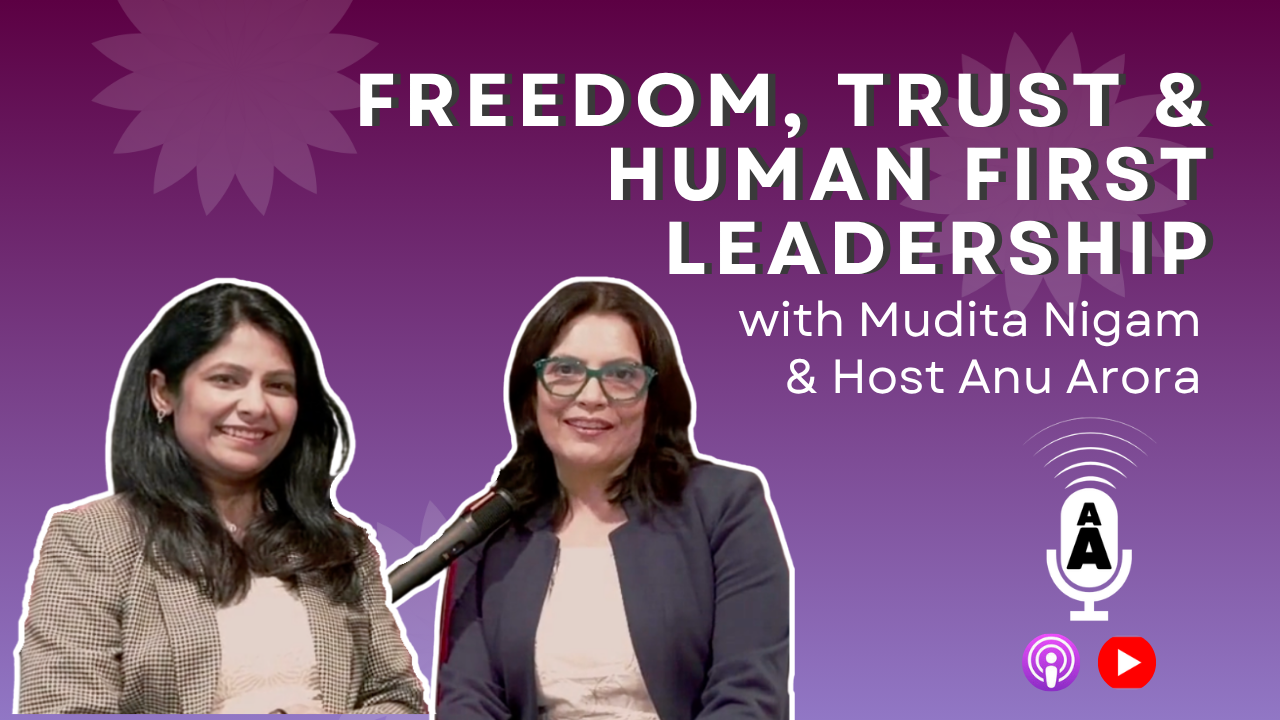
I want you to sit with it for a moment before I say anything else about it, because I think it’s easy to hear a sentence like that and stash it away as just another pithy motivational quote.
But coming from Mudita, it didn’t feel like just another hanging kitty poster. It felt impactful. Mudita is an engineer leading teams of teams at Amazon while moving — in her own words — at supersonic speed. In an industry that runs almost entirely on comparison with performance cycles, promotion committees, and stacked rankings – the next rung on the ladder is being climbed by the person next to you and there’s only one ladder. If anyone had reason to believe she was in a race against others, it was Mudita. But here she was telling us explicitly that she isn’t.
The Silent Comparison
Almost none of us think of ourselves as being particularly competitive in a basic sense. We don’t picture ourselves elbowing a rival or hurting someone’s shins before competition. But, comparison inevitably sneaks in anyway.
It shows up as the internal scorecard you keep against the peer who got promoted faster. It’s the team that seems to ship more, complain less, and burn out slower. Lately, it even shows up as comparison against machines and technology like AI.
In our discussion, we consider whether this comparison is even fair.
Crystal vs Rubber Balls
The only comparison that might serve us is knowing which things to prioritize and what can wait for later. Together, Mudita and I discussed a helpful framework for prioritization. That is, understanding the difference between the types of balls you are juggling is key.
Ask yourself – are they crystal balls or rubber balls? Some of what you’re juggling — like your physical and mental health, your closest relationships, and your own sense of who you are — is crystal. Drop that ball and it shatters. You’ll spend a long time picking up the pieces and it may never be recovered.
Other things like soft deadlines and deprioritized projects are rubber balls. They bounce. You can drop them and pick them back up when you have more time.
Human First Leadership
Mudita talked about how she learned, as a young girl in a small town in India, that the “sub-caste” other kids kept asking her about didn’t apply to her. When she came home confused with questions, her father answered simply: you are human first.
And that was everything. This perspective formed the foundation of Mudita’s growth and development. Long before she ever walked into a workplace ripe with internal and external comparison, she’d already been taught that her worth was intrinsic.
That grounding belief shows up later in a skill often overlooked by today’s developing leaders, and that’s self-advocacy. Mudita talked about learning, sometimes the hard way, that your work doesn’t always speak for itself. Sometimes you have to speak for it.
Helping your management team understand the impact of your performance is key. Not necessarily because you are competing with the person next to you but because if you aren’t your own best advocate, no one else will be.
Consider the Crystal
So, is there a race you are running against a competitor who never actually was one? Is it a peer? A co-worker? Maybe even an earlier version of yourself that no longer is…
Because here’s the thing. You are replaceable at your job. Everyone is. You are not replaceable in your family or in your friendships. And isn’t that the whole point?
Your job — the fancy title, the varying promotion cycle, the stacked rank ratings — that was never the place of irreplacability. Your job is like a bouncing rubber ball that you will rebound from if it falls. Your family. Your friends. The people who love you. You are irreplaceable in that space. That’s the crystal ball that will shatter once you check out. Your presence is the glue that holds that crystal ball together.
So, this week when you’re moving at supersonic speeds again, observe moments when you catch yourself measuring your self-worth against someone else’s and ask yourself whether that race is even yours to run and whether the competition itself even serves you. Chances are, the answer will be a resounding “No!”.
Key Takeaways
Your only real competition is yourself. Mudita's closing advice is to stop measuring yourself against others and focus on becoming the best version of yourself.
Mudita's leadership rests on a lesson from her father: when classmates asked about her sub-caste, he told her she was human first. She believes leadership means guiding people toward a shared goal, so empathy and emotional intelligence matter even more in the age of AI.
Your work doesn't always speak for itself. Early in her career, Mudita had been leading a team for six months without the title, so she asked her manager to make it official, and he did. She encourages others, especially women, to ask for what they need.
When you're juggling career and family, know which balls are crystal and which are rubber. Health, family, and close relationships can shatter if dropped, while many work tasks bounce back. It also helps to know when to slow down and when to go fast.
In leading teams of teams, Mudita invests most of her time in the leaders who report to her, because they can make or break their teams. She also travels to meet distributed teams in person, since knowing people beyond their work builds trust in both directions.
Trust is hard to build, easy to break, and slow to rebuild. It also needs ongoing effort, because it doesn't stay in place on its own.
In Mudita's experience, AI does very well at repetitive, process-based tasks, but human judgment is still far better at new problems and nuanced calls. She expects a period of struggle, especially for new graduates, but believes humans will still be needed.
In a fast-paced job, grounding comes from outside work: family, friends, nature, and hobbies like poetry, dance, and music. As Mudita puts it, we are replaceable at our jobs but not in our families.
Fun at work has to be planned on purpose. Mudita's teams block one afternoon a month for board games and group games, which people find more energizing than team lunches.
Quotes from this Conversation
"You do not have any other competition in the world than yourself." — Mudita Nigam
"Your sub-caste is human, you are just a human, human first." — Mudita Nigam, recalling her father's words
"Sometimes you have to speak for your work instead of work speaking for you." — Mudita Nigam
"We are replaceable at our jobs, but not in our home, not in our family." — Mudita Nigam
"Your humanity, your presence, your love is going to outshine anything any machine can do." — Anu Arora
Questions this Episode Answers
How can leaders build trust with their teams in the age of AI?
When should you trust AI, and when should you trust human judgment?
How do you advocate for yourself at work?
How do you decide what to prioritize when juggling a demanding career and family?
How do you lead a team of teams spread across different locations?
How can leaders stay grounded and avoid burnout in a fast-paced environment?
-
Anu Arora (0:01)
So welcome to this episode of Mindful Leadership Podcast. We are recording this on a historic day, 250 years of American independence, and who am I sharing this afternoon with? My dear friend Mudita Nigam. Mudita Nigam is a technology and engineering leader at Amazon. She leads teams of teams. You're also the person who builds trust in the age of AI. You are also a fellow traveler who has crossed seven seas from India to make a life here. Welcome, Mudita.
Mudita Nigam (0:52)
Thank you so much, Anu. I'm delighted to be here today with you.
Anu Arora (0:56)
Yeah, and spending this day with me, I really love and appreciate that, and it's the right day for this kind of, you know, the podcast, and you are all red, blue, and white. Well, this is something I didn't notice. That's great. My first question is freedom. I know this, I know you very well. It's not a word or wall for you, it has a special meaning. So, as you sit with me today, what do you hold as freedom?
Mudita Nigam (1:33)
So, I think freedom for me is not just a word. It definitely started when I was born, or it starts for anyone when they are born, and the definition of the meaning of freedom changes with life. What freedom means at each stage of life, where we are, what we are doing right now, it is: can I express myself freely, can I think freely, can I do something bigger without thinking about all of the restraints around me? So that is freedom for me right now, and as I said, this started when I was born, so I can probably share a little story.
Anu Arora
Oh, I'd love to hear.
Mudita Nigam
So when I was born, I was born in India, in a very small town, which was sandwiched between two big cities in India, and as a girl child, girls were not celebrated as much at that time when I was born. So, when the doctors handed me over to my dad, they were like, okay, yeah, it's a girl that we have. And my dad, on the other side, was elated. I was their first child, and he was like, you know, it is the most or the biggest blessing for me right now. He distributed sweets all over the hospital, and it was very new for the people to kind of receive sweets on a girl child being born. I think that is where the freedom started for me. And I have a younger brother. While getting raised, again, I think, in the spirit of my parents trying to treat both of us equally, they treated me a little more or gave me a little better opportunities and stuff than my brother. I think that is how they were trying to bridge that gap, with the means that they had. I think that is what has got me here. Those values kept me grounded.
Anu Arora (3:18)
Yeah, and I see you have two beautiful daughters who are young, but who are, again, I mean, bringing them up so beautifully, and they're confident girls who are very sure about themselves, and just kudos to you on how you're raising your two daughters as well.
Mudita Nigam (3:38)
Thank you, thank you so much. I think there's this song from Rihanna, which is called "Lift Me Up," "hold me down." I think that's a word probably me and my husband, we strive towards: fly as high as you can, but still be, you know, close to your roots. That's what can take you far in life.
Anu Arora (4:00)
Yeah, yeah. I have another story, which you told me, and I know I'll take you to, you know, the journey. We'll be talking about your career, you being a leader in such a large corporation, and what does it feel like, and how do you manage large teams? But before that, there's also another story about your childhood, and that's about your name itself, and somebody in the school asked you about your name. Would you like to share that story with the audience?
Mudita Nigam (4:31)
Yeah, like, you know, we all have first names and last names, and last names in India refer to a group of, you know, people doing a certain occupation or so. So the kids around me, they were asking each other, what is your sub-caste? Now, there was still a caste system prevalent at that time in India. I did not know my sub-caste, so I went back home. I asked my dad, what is my sub-caste, and he's like, why are you asking this question? I was like, my friends are asking. So he said nothing. Your sub-caste is human, you are just a human, human first. So I went the next day. I told my friends. Obviously, you know, they, you know, mocked me for that, but this is a value that got rooted, that I am a human first, and I think that's what I'm carrying forward, and we try to give it to our kids as well to carry forward with them.
Anu Arora
So is that one of the things that defines you as a leader?
Mudita Nigam
That does, and especially in this age of AI, definitely, you know, being human first, knowing the, you know, humans around me, because leadership, by its definition itself, is, you know, how you can guide and lead a group of people towards a shared goal. So we all are leaders, because we have humans around us. So, at least as per my definition, a leader should have a good EQ. Empathetic leadership, as much as it is losing its value, I think it still holds true. As much as we could kind of be a human as a leader, I believe we could lead better teams.
Anu Arora (6:09)
I also think in terms of how I have seen you work with people, and how I've seen you in action a lot, and humanity is, of course, one thing that comes out, but also I've seen you really connecting, which is probably part of the EQ, connecting with them and understanding what they want in the moment, and, and you manage that. We are part of a few, we're part of the poetry group together, and you're able to manage them very savvily. So talk to me about some of the qualities that you bring into play, whether it's at work, at home, that makes your leadership so strong.
Mudita Nigam (6:55)
I think I was always intrigued by psychology. I've never learned it, you know, as such, but then always intrigued that if there are humans around, everyone will be different, like our five fingers, they're all different, but together we can do wonders. I think that's what I strive for, like how we can bring these people together towards one common objective, be it in our poetry circle, you know, or at work. If our objective is common, then all of these five fingers have to contribute, you know, almost equally towards that. And how can we, you know, be motivated and keep others motivated? That involves knowing everyone I'm working with a little deeper than just the surface, and, you know, not just their numbers of performance. That helps me connect with them, and then, you know, lead or build teams that could move towards something.
Anu Arora (7:49)
And I know that you started your journey in Hyderabad, right? You started working as an engineer in, you know, computer science. First of all, my question is, why did you choose to become an engineer, and then the journey to Hyderabad, and... so it's a three-part question, maybe: why computer science, then journey to Hyderabad, and then coming to US. So there were these three transition points, right?
Mudita Nigam
I think when I was in my high school, so again, that was also a smaller town that we were in, and when kids were deciding about higher education, all of the girls were going into the schools or the colleges that were in the town, and there was no STEM institute in our town. So for engineering, I had to go out of my town, which was very new in my family, or like in the extended family. No one has been out of their house, and especially being a girl. And even before that, I was very much interested in problem solving. Like, in those older days, tube lights were there, you know, how to fix the starter, how to fix those things. I think my dad used to involve both me and my brother equally in solving things. That is where the interest for science started. Then I wanted to do something in computer science, and growing up, there were just two careers, which is being a doctor or an engineer, and I chose to be an engineer. I had to go out, and I think the family supported me going out of the hometown and doing an engineering degree. So that was how the engineering thing came into picture.
But asking about Hyderabad and Seattle, I think between Hyderabad and Seattle, I was, yeah, working at Hyderabad, and then I liked the leadership role, because when I was working, you can do as much, but you have to stop at a point, and then you need enablers around you. So, the role of leadership I looked at as a role of an enabler. You need to voice for your people. So, I did ask for this role. I'll say, while I was leading this team, there was a pseudo lead who was there, in the sense that person was stuck in a different project, and we were always told that this person will come and lead, and meanwhile everything was going on smoothly. We were doing our due diligence, we were building the stuff, and six months into the role, I was like, when I am leading this team, why can't I lead it officially? I went to my manager and asked for it, and it was like, you know, a lightning moment of, oh yeah, why do we need another person? They are not going to be free for another year or so. So then they officially announced me as a leader and officially as a manager of the team, and I think that is where it all started.
So one thing for all my, you know, fellow folks over there: ask for what you need. Sometimes, you know, this just becomes a thing we think, especially being a woman, we think asking is not good, but, yeah, "your work should speak for yourself," and it's not always like that, right? Sometimes you have to speak for your work instead of work speaking for you. Here's what I am doing, and here's the impact I'm making, and here are the results I got.
Anu Arora
Correct. So you went and did that, your own advocacy. Yeah.
Mudita Nigam
Thank you so much. And this is a skill, I'll say, again, I'm still learning, but it is so important. I've learned with time that you have to advocate.
Anu Arora
So from Hyderabad, then you moved to Seattle. A huge transition we have made, and I know how difficult it is. What was it for you?
Mudita Nigam (11:27)
Yes, it was a big transition, because I was growing in my career over there. My husband got this opportunity to move here, and we decided to move as a family. It was new, because new country, new culture, cultures, I would say, and then new phase of my life. I was a new mom at that time, and everything new around me. So, there was a time when I learned slowing down and fast pace at the same time, and deciding for myself what works when, because there are only as many balls as you can juggle at a time. There was a time when I had to ask for working from home. It was in the era where work from home was not common or not heard of at all. It was pre-COVID times. So, when I look back, there were three things that I think I have done and learned from. One is advocating for yourself, because it is super important. No one else is going to come and talk about you. And then knowing when to slow down and when to go fast. And the third thing is there are only as many balls you can juggle at a time, so, you know, thinking through all of these, what is more important at what time? These were some things that were helpful. Like, when I was slowing down, I got this work from home. That was a time when, you know, I could spend a little bit of time with the family or towards my newborn. But there was also time when the deliveries were coming near, and I had to kind of work through it all, and I was nursing my baby all through the, you know, calls and the meetings going on. So it is that time that was super important. And then the trust of my leaders in me, the work that I did in Hyderabad was proving to be well over here, that they trusted that it is not the location that this person needs to be, because this person can deliver. So I think all of this together was what informed my move, and this smooth transition to this world.
Anu Arora
Yeah, as you were saying this, the image that flashed in my mind was when you were born, the first day, and your father distributed sweets. Maybe that was working through, and that brought you to this point here, when you were in a brand new country, and you were not hesitant. You were able to go and advocate for yourself. You could also balance, because I remember working my ass off when I just first started working. I just was so scared to even take a day off. I would see that Friday afternoons, people in winters would go for skiing, the whole team would disappear, and who was the person who was sitting and still working? It would be Anu Arora in the office. They would find me. But you learned that, and you had that confidence, and also imagining that you were able to see that these are crystal balls, they can't fall. If they break, they break into 1,000 pieces, and then you'll be cleaning up long afterwards. But there were some rubber balls. They can bounce, because they will bounce, and they come back up, and then you can be wonderful.
Mudita Nigam (14:28)
I love this analogy. You're gonna take it in the next one, isn't it?
Anu Arora (14:33)
That's so true. Just knowing what are your crystal balls versus your rubber balls. And we sometimes give so much importance to the rubber balls, but they are going to come back. But that differentiation didn't come for me, Mudita, for years. You got it. So, kudos on that, defining your boundaries so early on in your career, and that's what's probably brought you to where you are today, leading large teams, actually teams of teams. So you have multiple layers that are under you. How do you reach all these humans?
Mudita Nigam (15:11)
Yeah, so that's a good question. So here at Amazon, also I've got an opportunity to lead leaders. Even when I was with Tata, there was a huge team of 90-plus members that I was leading, which was globally located, here as well. I think one thing that I've realized, and one single most important thing, as for me, is when you have leaders under you, and where the team is reporting to them, investing well, and investing most of the time in those leaders is what can make or break your teams. Because if that person can do the job really well, and you can impart some of your goodness, and obviously learn from your leaders who report to you as well, that is something where the team then works in autonomous functions. They all work towards, you know, a single or a common goal. That has worked really well for me, investing in that middle layer. And then also meeting people. I think once you have those human connects... So the teams are located outside Seattle, outside US as well. So, traveling to people, meeting them, because meeting makes a huge difference, because we're still working with humans. And when you get to know a little bit about them, about what their interests are, what they like doing, what they don't like doing, that automatically just builds that connect, that the trust is, you know, two-way. So I trust them and they trust me. That has built a culture, or that's a culture that I strive towards building in my team. And then we all can together do wonders.
Anu Arora (16:40)
Yeah, you talk about trust, and in fact, your job definition is about trust, isn't it? Tell me a little bit more about your work, on how you're building trust for Amazon. What does it look like, and how does it translate into, when trust is broken, you know, what do you do then?
Mudita Nigam (17:04)
Yeah, so trust, as it is said, it is very hard to build, but very, very easy to break. And again, to rebuild it, it takes time. Yeah, so with the machines as well, the systems as well, we build the trust over time, but I think with humans, building trust is the foundation of everything. So we do have, I think everyone knows, Amazon has the leadership principle called Earn Trust, which is so important when you look at this very deeply. When I, if I join a new team, or I'm just here with a new set of people, the first thing, whether they like working with me or not, is the trust factor, and it is very, you know, it's back of the mind. It's not like this is the first thing I'm going to do, but if you do that right, it's a very smooth conversation, because conversations are not always easy. Sometimes, you know, I'm asked to build something which my team doesn't have capacity for, so it's not about saying yes or no, it's about how I can convince the people around me in a more trusted way. So that trust, I think, is super important, and it is not automatic. I think the moment we take trust for granted... because it is not just built and left there. You have to put in an effort to keep it there, to maintain that trust, and putting that effort is super important, I think, for me to just keep that momentum of trust going.
Anu Arora (18:26)
So, in your world, you know, you're also building trust with the machines, especially with AI, agentic AI, and there is this fear that one day the trust in AI would be much more than the trust in humans. So how do you balance that? Is that ever a question in your mind? AI is this side and humans are this side, and what does that trust look like? Will you trust the human more or the AI more?
Mudita Nigam (18:56)
I know that's a hard question, so hard question, but I can close my eyes and I can say I will trust the human more. And I'll tell you the reason why I'm saying so. It's past two years that my core work has been around AI. When this all started, and, you know, Gen AI gained momentum... I'm specifically talking about Gen AI, when it gained momentum. And then I have seen it does phenomenal when it is a repetitive task, or, you know, an SOP-based task. You can trust it so well. But when there's this nuance which comes there, where there's judgment calls, it does good at sometimes there as well, but the human judgment is way beyond that. That's why a brain, till now, has never been replicated in science, right? Because the brain thinks so much on the experiences that it has had. Still, if I give a human a new problem, which no one has seen, I'm pretty sure they will be able to solve that better. So I think that is a sweet spot, if we find the problems that AI can solve for us, or can expedite, versus where this problem solving is needed, where human intelligence is needed, even today. So, if we are able to solve that, I don't think there's fear of, you know, losing ourselves as much over there. But we have to make sure we are not depending too much on the AI, because this brain, or the intelligence, is still needed.
Anu Arora
Yeah, I love your approach and your thoughts around it, but I also, I hear a lot, there's fear in the industry, the questions in the industry: will I become redundant, will they need me? If only 5% of the time I am needed and 95% of the time AI could do it, then what happens to my job? How do you see that shift that is coming in, and the fear which is seeping in? I see a lot of fear with even new graduates who did computer science, and they're coming out today.
Mudita Nigam
That is true, and this fear is also true, because, you know, with this thing where everyone's just running towards AI, we sometimes forget that there are humans around us, who will have these feelings. 95% of times, yes, you know, the machines can make it faster, can make it easier, but, you know, there are so many problems to solve. So if we don't cap that... Okay, our organization, or we as humans, have to do just this much, there's a ceiling over there. There's just no ceiling. If you break that, there's so much to solve. Right now you cannot just put an AI and just say, "Hey, go solve world hunger." It's not there yet. So, if we can kind of, again, give those monotonous tasks to AI, or less judgmental tasks, and then we can build, like, what else we can do. Over here, there is still a lot to do, and that is where I think humans can, you know, excel. But this fear thing, and when the new graduates are coming, I think industry as a whole is still trying to solve this problem. It is not solved, where they need humans and where they need machines. So until they are solving it, I think there will be a period of struggle. I would not want to, you know, negate this thought completely. There will be a period of struggle, but humans would still be needed, I feel.
Anu Arora
I love that, because I hate to think that, you know, our grandchildren are coming into this world. I'm going to be a grandmother soon. Thank you. And with the grandchild coming in, I think of her future, and I think of what's the world she's going to be born in, and I hope to be able to tell her, see, your humanity, your presence, your love is going to outshine anything any machine can do. So this is what I want to believe in, and this is what I want to go and tell her as she's growing up. But I also wonder what her world will be like, and I know it's going to be way, way different from the world I was brought up in so many eons of years ago.
Mudita Nigam (23:13)
No, that is so true. And if you think about the time when, you know, computers were evolving, or when internet was evolving, then also it was the same thing, that maybe it will replace humans. Yeah, computers are new, all the, you know, all the stuff it will do, but it didn't. And I believe the same will be, you know, happening even further. Yes, we have evolved so much in terms of technology, but there is still a lot that we could do. So, when we... and the same fear that you have with your granddaughter, I have with my daughters. We do think about that. How do we want to raise them? How do we want to build them? And I think one thing, the human connections are so important. Like, you have witnessed some of it. When we are stressed at work, and there are multiple times that it comes, you know, when I was, you know, going through the lows of work, you were one of those people that I come to to talk. So these are the things that, if you don't build these relationships, I think all of this machine and technology is waste, because you need people who know you beyond what you are at work. And once you know that... and sometimes you know it yourself, but you cannot tell yourself, you need other people, you need your village, you need your network to tell you that you are way beyond this particular job that you're doing. Once you again hear it from others who think well about you, you can excel in those fields, and you can, you know, deal with that trauma, or the downs, or the lows of work, or life as such. When you have this network... this is what I would want to impart to the kids as well. Recently, we watched the movie Toy Story 5. We thought, first, it's about screens, like, don't be with screens or technology. No, it was, at the end, about human interactions, that you should not lose those human interactions, and, you know, playing with each other, connecting with each other, and not just be in front of the screens. I think technology is good, just moderation, forever. I think...
Anu Arora (25:01)
I love that, and I want to watch that movie, Toy Story 5. Worth watching.
We want to move to the very last phase of our interview, and I want to talk about, because this is Mindful Leadership Podcast, your work is really fast-paced. The whole world knows it. Working in Amazon means you are working at a supersonic speed. How do you bring sanity in madness?
Mudita Nigam (25:30)
So, sanity in madness, I like that, and it is true. And when I, you know, think about myself or do some retrospective, I also thrive in this fast-paced environment, but then it is not always feasible or possible that you can be continuously fast-paced, because you will burn out. There have been times, episodes of burnouts as well. I think the grounding forces are basically my family, husband, kids, friends, you all. I think making a point that I have to, you know, meet my friends or be with them, and then, you know, remind each other who we are. We are bigger than our jobs. We are important for ourselves and our family, because we are replaceable at our jobs, but not in our home, not in our family. So, I think that is what just keeping, or reminding myself of that. And also, I'm in this place, Seattle, which has so much of nature around me. Just being in nature around, and I have a goal to hike more. So just probably doing something else, which is apart from work, that is what brings sanity, or keeps me sane.
Anu Arora (26:45)
And you have so many hobbies, too. You write poetry, you dance. Your family is a musical family, you know, singers and poets and artists and creators, the whole family, your parents also. So I think there's just so much fun and joy to just be with you. When I come and meet you, you could be working anywhere in the world. I would not guess you're working in such a pressure cooker, high-pressure environment, because you're just so much fun to be with.
Mudita Nigam (27:21)
That is true. And see, that's why you need friends to remind you of your powers as well, or your things. So you're right, I love dancing, and this poetry, that, you know, the way how we both met, it is so, I think, energizing is one way to say it. And then, yeah, my husband and my kids sing, and sometimes just that atmosphere where everyone's just singing, and, you know, I'm enjoying them, that brings calmness.
Anu Arora (27:47)
Whenever I go to your house, it's almost like there is some kind of mehfil or jashn going on. Jashn means just celebration, and life seems like a huge celebration for your family, and I think that's probably bringing you a lot of groundedness.
Mudita Nigam (28:05)
That does. And I've seen, I find myself, when I'm, you know, very stressed out, then I ask my kids to sing. Maybe, you know, unknowingly I'm doing that, and then it just brings calmness, or, you know, yeah, that moment of celebration. There's so much in this that we could celebrate about.
Anu Arora (28:22)
And your exuberance, your joy, I think those are innate qualities in you. You easily laugh. Not many people do that anymore, isn't it? You'd be wondering, why is this person not even smiling? What's wrong with them? So, how do you bring that exuberance and joy to your teams?
Mudita Nigam (28:44)
To the teams, that's important. So, when we get into this day-to-day grind, obviously there's no laughter or fun, but then we have to step back. These, you know, team lunches, which are team bonding activities, are very good fun activities, and at times, obviously, we have to be frugal as well. So, recently we found a way. It has been, I think, six months now that I've asked the teams, one day in a month, we do a game evening, which is like, you know, three to five. We've blocked it, we play games, board games, which is so refreshing. It is even better than any team lunch that you go for. People who have to leave early also, they stay for this entire duration just to witness. So we play at times Pictionary or dumb charades. So, recently we've got into this Werewolf, and everyone is so excited. They're looking forward to that day where we have to play the games, and then they come even energized the next day. So that's one thing, I think, is keeping that on purpose, because it's very easy. That's the first thing you forget when you get into work.
Anu Arora (29:42)
I love it, I love it, and I can feel your energy. Also, at this moment, there's just joy in describing what you're describing. And that brings us to the end of today's episode. What is it you'd want to leave our viewers with?
Mudita Nigam (29:58)
So I would want to say, like, first thing is, be you, find your strength. You do not have any other competition in the world than yourself. This is something we both teach our kids very regularly. You do not have to compete with anyone else, you just have to be the best version of yourself. Keep yourself sane. Your job doesn't define you. Your, you know, every persona that you play, your motherhood doesn't define you, your, you know, being a wife, being the daughter, these all do not define you. You are much more than that, and you're all of it together. You can do it all. Take care of yourself.
Anu Arora
Yeah. Thank you so much. And thank you for, again, spending the freedom day with somebody who loves freedom. And I know you love freedom, and to us, and to all of you, thank you for joining us. Thank you.
Resources
Episode Details
Guest: Mudita Nigam, technology and engineering leader at Amazon
Host: Anu Arora, executive and team coach
Series: Mindful Momentum: Leader Podcast
Published: July 22, 2026 · 30 minutes
Watch on YouTube
If this resonated, I’d encourage you to listen to the full conversation with Mudita. Her journey from a small town in India to leading engineering organizations and building teams of teams at Amazon is a perfect jumping-off point for exploring the role of AI in leadership and prioritizing humanity in a dynamic technological landscape.