
A few weeks ago I sat down with a dear friend over chai — real chai, the kind with spices like cardamom and ginger, not the fake, manufactured kind — and asked him the one AI question I haven't quite sorted out for myself.
Not — will I lose my job. Not — will AI replace me. The harder question for both of us was: what happens to human intelligence itself if we keep outsourcing the actual effort of thinking?
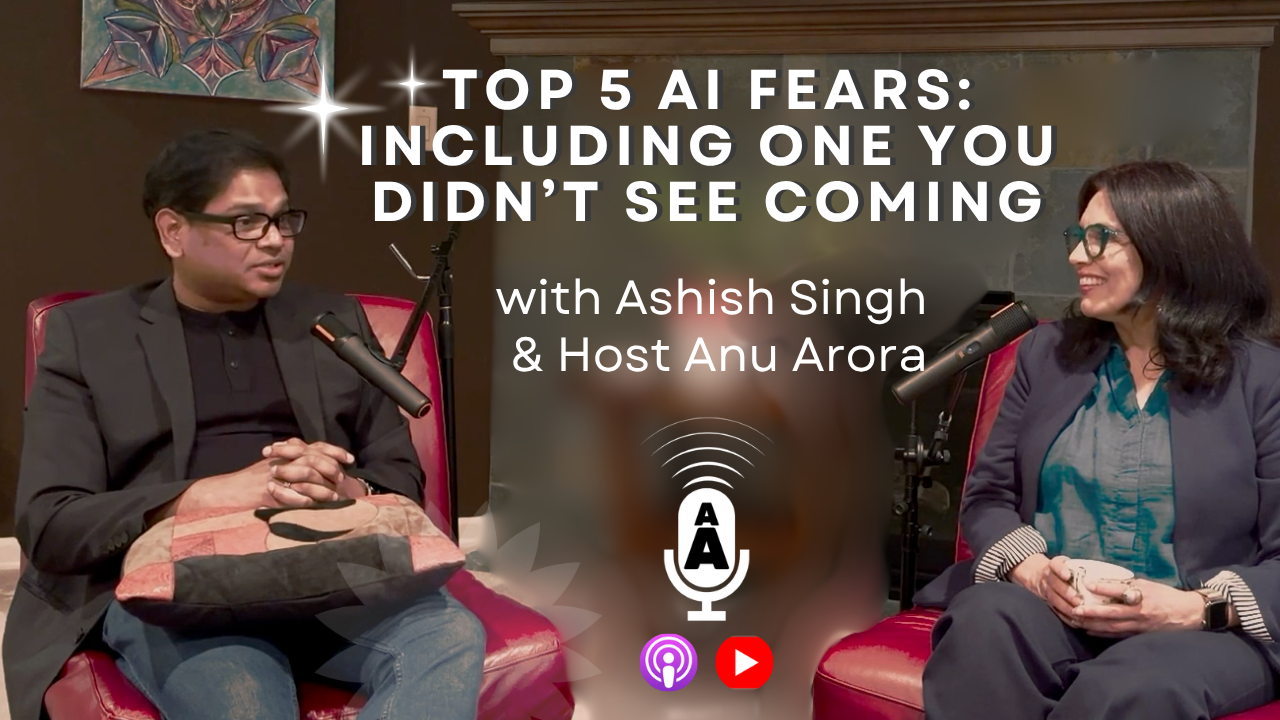
That friend is Ashish Singh, a technology leader at Amazon who has spent the last few years building with AI at work and at home, from a bedtime-story app for his daughters to a song that reached more than 5.4 million views. In this conversation, we work through five of the biggest AI fears I hear from clients and friends: losing your job, whether we still need managers and coaches, what happens to human intelligence, AI being used to harm people, and whether AI can replace real feeling in art and music.
Key Takeaways
The deepest AI fear may not be job loss but what happens to human intelligence when we outsource our thinking. Ashish compares it to photocopies of photocopies: each copy becomes less legible. He's candid that he hasn't solved this one for himself.
One way to protect human thinking is to keep certain spaces, like ideation, first drafts, and real conversation, for people first. Humans generate the ideas, then AI helps research, refine, and stress-test them.
The fear of losing your job to AI is real. When computers arrived, people who couldn't adapt lost jobs. What's different now is speed: computers took decades to become mainstream, and AI has taken a couple of years.
The best response to that fear is to start learning, and to start small and personal. Ashish's AI fluency began with a bedtime-story app he built in a few hours. Free plans and a hobby you care about are enough to begin.
For managers, the role is becoming more hands-on again: a leader can prototype an idea the same evening instead of waiting on a long process. For coaches and solopreneurs, AI is a way to scale expertise to far more people, not a replacement.
Accountability stays with people. Treat AI like a team member: the person sending a message still owns it, and pasting AI output without reading it erodes trust.
Voice cloning has made scams easier. If an urgent, emotional call asks for money, even in a loved one's voice, hang up and call back on a number you already trust, and protect your accounts with strong two-factor authentication.
In music and other creative work, AI can teach fundamentals and track progress, but a teacher still hears nuance and intention. The tool Ashish built graded his singing more strictly than his teacher did.
Quotes from this Conversation
"It is real. So, do something about it. And the best thing that we can do is learn." — Ashish Singh
"If we make 100 photocopies of copies, it's not legible." — Ashish Singh
"Giving credence to humans first before giving credence to AI." — Anu Arora
"It can teach you basics. But if you want to be an expert singer, you need a teacher." — Ashish Singh
Questions this Episode Answers
Will AI take my job, and what should I do about it?
Do we still need managers and coaches if AI can do part of their work?
What happens to human thinking if we rely on AI too much?
How can I protect my family from AI voice-cloning scams?
Can AI replace a teacher in music and other creative arts?
What's the best way for a beginner to start learning AI?
Reflection and Listening Invitation
By the end of our conversation, we agreed on this: human intelligence is still the supreme one, and AI is a tool to enhance it, not replace it. As Ashish put it, that's true "as of today."
I encourage you to listen to the full conversation. There were more fears we didn't get to, including how companies are reacting to AI, so Ashish will be back for another episode.
-
Anu Arora (0:03)
Welcome to the Mindful Leadership Podcast. Today we have a guest, a special guest, who has a point of view on everything about AI. Ashish Singh, welcome to the show, Ashish.
Ashish Singh (0:19)
Thank you, thank you so much, Anu.
Anu Arora (0:21)
Ashish Singh is a technology leader at Amazon, and I recently came across Ashish writing about AI, and of course, Ashish is a dear friend, so I know you from a long time. But this AI topics and your writing around that just had me intrigued so much that I had to bring you on the show.
Ashish Singh (0:45)
Super excited to be here and talk about AI and express my point of view. As you said, I have a lot of point of views.
Anu Arora (0:51)
So what? Why? Why do you have a lot of point of view on AI?
Ashish Singh (0:59)
First, because I consider myself lucky enough to be an early adopter of AI over the last few years, and both in personal capacity and professional capacity, I've been using it a lot, and I see in general confusion around AI and what its capabilities are, and what would it do to us as humans and to our race, and and as individuals, what does it mean for us professionally? So being close to it, based on what I have experienced, based on based on what I have learned, I just felt an urge to share that with the folks in our community to just help them feel a little bit more settled and have a clear path to what future holds for us.
Anu Arora (2:07)
I love it, and that's why you are here for our viewers as well. You know, what does future hold for you? How how does it not be that unsettling? So yeah, that is the reason why, Ashish, you are here, because people are unsettled, and confusion, I think, is a small word compared to how big this problem is. Not just the problem, the fear around it, the reaction around it. I mean, not just human individual reaction, the way even the organizations, large corporations are responding to it.
Ashish Singh (2:46)
Everyone is confused and trying to find their paths, and I'm also myself very confused that the teapot here doesn't really have tea that we can drink, or is it just for show?
Anu Arora (3:01)
But there is tea. We didn't get you tea. You said... I asked you what was the drink of your choice,
Ashish Singh (3:09)
And tea is my favorite.
Anu Arora (3:10)
You said tea, and I didn't ask AI to make it, and unfortunately, it can't make tea. So we we had not yet. Yeah, we. Oh my, oh my. I don't know what's coming. Yeah. This is not chai tea latte, no? This is the real chai.
Ashish Singh (3:27)
Real chai.
Anu Arora
Real chai. Real.
Ashish Singh (3:28)
I love it. Start there, before I...
Anu Arora (3:32)
With cardamom, ginger, the way you like it.
Ashish Singh (3:35)
Wow! Let's show it to the audience. It is real tea.
Anu Arora (3:37)
Real tea.
Ashish Singh
Yeah.
Anu Arora (3:38)
Yeah. Good. This is not that fake show where people just get empty cups. Mine is a little bit more fake than the real tea. Yours is more...
Ashish Singh (3:46)
More.
Anu Arora (3:48)
It is herbal, herbal.
Ashish Singh (3:49)
All right. Now that I have had a sip of this really delicious chai. The confusion around AI, I feel, it is just the nervousness of not understanding what the future holds for us, and the challenge around that has been that it is a fast-moving technology, and it has come to us super quickly, and it has kind of, in a lot of ways, taken over the world where we have been operating successfully, and the trades that we had learned growing up in our engineering, in our experience working as technology professionals, all of that is being challenged by AI, and that is what is, I think, causing the nervousness in older generations. When we learned a skill, we could live our life with that and earn our bread with that skill, and that is changing. Fast. And now every month there is something new launched with AI. You need to constantly upgrade your skill, and if you do not do that, then you become obsolete. So, what is critical in this environment is ability to learn and be a child.
Anu Arora (5:23)
You know, I was thinking of this. AI is a huge topic, and there are lot of discussions around AI. And I thought it'd be great to just bring the biggest fears today, you know, and then just tackle as many as we can in one episode.
Ashish Singh (5:39)
Yeah.
Anu Arora
And then we bring you back for the next set of fears, the next episode. The first one is, what will happen to my job?
Ashish Singh (5:49)
Yeah, and I think people had the same question back in the days when computers were invented, when computers made their way into professional setups back in the days, people like, this will take away my job. I don't know how to use it. I've never trained for this. And I can only imagine people were equally scared at that time. And the reality is that a lot of folks who could not upgrade their skills from calculators to computers would have definitely lost jobs, and equally is true today. However, as I was saying, the pace at which this is coming at us. Computers took a long time, several decades to become mainstream. AI has taken a couple of years, and it has taken over our, yeah. It's the hockey stick growth, and that is unnerving, and so the fear is real. I've seen it in my family, amongst my friends, amongst my colleagues. Everyone is scared, and it is real.
Anu Arora (7:16)
So, what's your point of view?
Ashish Singh (7:17)
So, my point of view is, it is real. So, do something about it. And the best thing that we can do is learn. In one of my articles that I wrote about this, I mentioned about how some of the employees at the largest of the corporations have this amazing benefit of unfettered access to AI, and which might not be true for smaller organizations who cannot spend billions of dollars to bring AI into their workspace, or even if it comes in, there are restrictions as to how you can use it and how much you can use it. And so, if you do have access to it, use it to the fullest. Try it out, both professionally and personally. Being scared of it is is a real thing. But at the same time, if you start trying it, you'll feel so enabled. Things for which we always needed sometimes other professionals to help us out, now AI can be that for you. And I started small when I started experimenting with it. Even before I started using it at work, I started using it personally, and I just one day, what I realized is, every night when I took the kids to bed, they would ask us for nighttime stories, and I used to tell them stories where I would ask them, "Hey, what characters do you want in them?" And they would tell the characters, and then I'm like, "Where do you want these characters to be?" They would say, "Oh, I want them to be in a jungle," and I was like, okay, then I would try to make up a story with that, and they would love it. And I was like, and very quickly I realized I was running out of stories. So I was like, what do I do? And I basically created a quick app where a kid could give their favorite characters, their settings, and then as parents, you could slide in something that you want to teach a kid, and you build that app. And I then started using that to tell stories to my daughters. And those are the small ways you could do it. And it took me literally a few hours to build this.
Anu Arora (10:03)
For that in action. Yes, I was one of the users, beta users of that product.
Ashish Singh
Yeah. So, although I'm sure you didn't use it on your boys because they're grown-ups, but it was pretty good. But it was something still fun for ourselves to just learn through this, and I was amazed how much I learned just building that. So...
Anu Arora (10:27)
And you built many other apps along the way. Then you did the music, you know, something with the music app. Yeah, and then you did something. Even when we were doing another recording, you were able to create my voice, and you know my avatar, yeah, an AI avatar, and that quickly because you just become so savvy at doing these things.
Ashish Singh (10:50)
So all the things. So for example, you touched upon music. Music for the longest time was inaccessible, music production, right?
Anu Arora
Right.
Ashish Singh
If you, if you, you could be a poet and you could write a song, and you could be naturally gifted to make the music for it, but creating a production-quality song that you can launch was really hard, and it was only available if you had the right connections, or you had, you know, a lot of money, thousands and thousands of dollars to spend to go to a studio, record it, and work with a production company to produce it, and then launch it. All that is accessible now with AI. You could have a tune in mind. You put it in one of the apps, and it would create a soundtrack for you. You could then just load that up, record that on your laptop, and it it does the job and it does it really well. So...
Anu Arora (11:56)
It became an Insta sensation. Yes, you want to talk about how many million views were there?
Ashish Singh (12:00)
Yeah, this was a song that we created for my daughter last year during Ganpati festival, and it all happened because we could not find a great song for her to sing in one of the performances that she was supposed to perform at one of the local events here. And I was like, "Let's write a song," and then like, okay, let's create a music for it, and it all, one after the other, with AI just came out so well that it's like, okay, let's produce the video for it, and we did it in a couple of weeks of time, and I could have never imagined doing that, and then we launched it on Instagram and YouTube, and we got over 5.4 million views. Yeah, that was, that was all like a lot of hard work, but it was also AI enabled that. Even with that hard work, two years back or four years back, I couldn't have done that.
Anu Arora (13:00)
Number one, we address the first fear. Update your skills. Know it. It's when you know it, it releases the fear. Releases. Now it is no longer this unknown thing which you have to be afraid of.
Ashish Singh
True. Very true.
Anu Arora (13:15)
The second one is the fear, as a leader, as a manager, what's going to happen to my job? Do do we need managers? When you have, you can check, AI can manage, and do. And of course, about me. I'm an executive coach. Do we need coaches?
Ashish Singh (13:35)
We might not. Your point of view is clear. I think it's all about effectiveness, and I think whatever jobs we do, being a leader or being a coach, I think it's the way we do that will change, and we'll do it at much larger scale with AI enablement. So, for example, I believe the role of a manager or a leader would become, or is becoming, I'm seeing this happening live, is becoming more hands-on. If a few years back, as a leader, if you had to, you came up with an idea, or your team came up with an idea, there was a long process before it could be live and launched, which is changing very fast now. I could have an idea this evening, and I could just sit and create a prototype even before I put engineering force behind it. At least I can build a small prototype to just validate it. And it is important now for the leaders to demonstrate that to their team and be equally hands-on. Which, if you talk to any engineering leader who has grown in ranks, who was an engineer in past, anytime you talk to them, they're like, oh, I miss those days where I could get my hands dirty and build something. And as you grow in ranks, what it meant for us was to just stay away from that and focus more on strategy and execution and let your team deal with actually building stuff. Now we are back where we could create things, and and that's the fun part of it. And I I am personally enjoying it.
To the other question that you had about, for for example, for coaches, right? Now with AI, what you could do is, if you have been coaching for years, you could assimilate that knowledge and create your personal avatar in many ways, and for example, with that knowledge, AI could create content for you that you can at scale launch on your whatever publishing channels you use, and help create a larger audience and help scale up your business as a coach, and make your message reach to much larger audience, which was very hard to do if you were a solopreneur. And that, I feel, is is enabling, and it it helps us scale ourselves much better. And I believe, and I'm talking now on behalf of you, as like as a coach, I think everyone wants to just make sure that whatever they have learned, they want to share it, and they want others to be more successful with their coaching. And what's better than reaching millions of your mentees versus just a handful that one could do otherwise?
Anu Arora (17:14)
This point of view is approved. I love this point of view. It's scalability. So for the second one, where the managers, you know, the fear of managers, that job is shifting. That's similar to the the, you know, career shifting, and go learn and shift as the work is shifting. And for coaches and solopreneurs, it's an opportunity for bigger scope, higher scalability, reaching millions. I love that. Awesome. So let's go to the next one.
Ashish Singh (17:53)
How many fears do you have?
Anu Arora (17:54)
It's an endless list. We will be able to get to some today, and then of course you're coming back.
Ashish Singh (18:03)
Yes.
Anu Arora (18:04)
We'll do another episode with the rest. Number three is, what happens to humans and humanity, human intelligence? Artificial intelligence, human intelligence.
Ashish Singh (18:20)
So there is, that is a real fear, and that's what I am more worried about than professional.
Anu Arora
At least you're worried about that.
Ashish Singh
If you rely too much on somebody else solving your problems, then you're not, I feel, you're not exercising your brain enough. So I feel that is a real challenge as a race we are facing, where if we just create photocopies of photocopies of photocopies over time, if we make 100 photocopies of copies, it just, yeah, it's not legible. It's it's not clear, and that's what happens when you're not doing real creative work and using your brain. So I think, personally, what I feel, we would have to intentionally make sure that we are engaging ourselves in problem solving much more deeply than we have done in past, because now we have a tool that can make us really lazy, and it can make us money also. There are so many ways where you could use AI to passively earn money for you, and then it would be about how do you still keep yourself creative, engaged. And I don't have a perfect answer for it. So this would be one which I would say I'm also, I've not figured out. I'm still scared of, and hopefully over time we'll learn to it.
Anu Arora (20:06)
Yeah, one of the things, as you were saying, an idea that was coming up is we create sacred spaces for ideation, creativity, which are, you know, off limits to AI. Let's just get together. Let's just create something together first. And now, you know, we've got all the ideas in there. And now let's just go back and say, okay, let's vet them through it. Let's get more research on it. Let's use the tool to to enhance it further, or, you know, create something out of what has been created by humans first. So giving space to, or maybe even giving credence to humans first before giving, you know, credence to AI, and over dependence. Then you are avoiding that over dependence and this thing rusting.
Ashish Singh (20:57)
Yes, and also realizing that how current-day AI works is it is nothing more than an autocomplete. How AI works is it just looks for patterns across the internet and says, okay, this thing has been repeated millions and millions of times, and there is some credibility associated with it. Hence, this would be the right answer for something. That's how it problem solves. We are still a little bit further away from general intelligence that our brains have. So, it is super important for us to understand that nuance and understand the capability of that tool, to not over-rely on it for things like you said, like ideation. It can be good for brainstorming, but you cannot just give the whole ideation exercise to an AI. If you have an idea, it can help you vet it better, faster. But it is the similar way where, if you have a team, ownership of a task might be with the team. Accountability is still with you as a leader. The same way, think of AI as a team member, and accountability is still...
Anu Arora (22:14)
I was remembering an incident where we were interacting with somebody, and there was a little bit of argument that was going on about who did what, and they had, I went to AI and checked it, and then they copied and pasted, and on top of it is, "Here is what I suggest the things you do, and based on what you described about Anu, here's the the things which might work with her." So all those, the the pretext to the answer, were also pasted. So humans are losing it completely. Not only are they asking AI to give you the answer, but they are also just copying and pasting it blindly.
Ashish Singh (22:59)
You you you touch upon a very interesting point here. When, as a human, let's suppose you you ask somebody a question or you want a response from someone, and if you get a response that you believe AI has created, and it has less human effort put in it, it does feel that it it it doesn't feel valuable, I would say, and it it feels it could breach some trust. So again, the ownership of the answer or response or communication still lies with the sender of that. However, they can use AI to polish their message better, and, yeah, not make the dumb mistake of just copying the prompt itself.
Anu Arora (23:51)
So, your point of view on this is that humans have to use their intelligence when using this as a tool, would that be correct?
Ashish Singh (24:01)
Yes, but do use it as a tool, because it does help create better responses. I feel like, I'm like, growing up in India, my native language is Hindi. Probably my dreams are still in Hindi, and it is important. It's sometimes very hard for you to articulate your message in English the way a native speaker would do, and those are the places where it does help you express yourself better and communicate better to others. And if there is a tool like that, why not?
Anu Arora (24:43)
Why not? Right? We used to use Grammarly, right? We always have been using some tool or the other, and now we have a much better tool. Why not use it? Yeah. So can we go to the next fear?
Ashish Singh (24:57)
Okay. Yes.
Anu Arora (24:59)
There is a fear that this AI could be misused against humanity, or crimes against humanity.
Ashish Singh (25:07)
Very true. That is another one that I think that I feel scared about as well. It is super easy. Like we were talking about voice cloning, it is super easy to clone your voice, and it is super easy to connect that to a, you know, voice agent and pretend that it is you who's talking, and then call your loved ones or others to scare them, so there are a lot of scams that can happen with that. Like, AI has given folks who want to scam others a tool that is very powerful. So I'm sure that they are gonna use it to their advantage, and then it becomes the responsibility of others, like cybersecurity folks, to similarly use AI to build the defense wall. So I think with AI being in everyone's hand, it is more scary, but awareness, and knowing what its capabilities are and how people can misuse it to just penetrate through your your personal life, your bank accounts, knowing that is helpful. And so I would want everyone to just stay connected to the world and understand what's going on around. And when you get a phone call in urgency, and somebody asks you for something, that sounds like your loved one, don't just trust it. Just call them back and try to verify before, you know, transferring money to them. Or when it comes to your own personal bank accounts, keep them secure. Use the various two-factor authentication, whatever is available today, the best in class.
Anu Arora (27:29)
Five, five-factor authentication. Yeah, and and yeah...
Ashish Singh (27:33)
Those technologies would be developed because, no, it's it's a world which is scary. So technology...
Anu Arora (27:42)
Has to, you know, move faster than. Yeah, I mean, it's, it happened with with the computers too, right? The security and privacy, they became such huge deals and have become. But people who are vulnerable no longer have to just be scared about those emails saying, "This is a prince from somewhere, and transfer that much money to my account." They have to now be also worried that this could be, "Oh, I am your son..."
Ashish Singh
Yes.
Anu Arora (28:12)
And sound like your son, yeah, and, "Transfer the money to my account." So they have to worry, not worry, just be careful about, be aware of...
Ashish Singh (28:24)
That this thing is going on. But the good news, that there will be more jobs created as a result, to build more secure systems. So there's a positive side to it as well.
Anu Arora (28:40)
So we're going to transition a little bit, because I still had a lot of areas where the list is never ending, because I was thinking of, how about the fear about, you know, corporations overreacting to this investment in AI and, you know, making these decisions, get rid of 10,000 people, and now we can invest that many billion dollars more into the infrastructure. That's an...
Ashish Singh (29:06)
Episode for itself. It's a big topic. We are going to leave that here.
Anu Arora (29:13)
Now I'm going to transition to, what are the things I haven't asked you? Where you said, okay, Anu, you are thinking of all this, but how about these one, two, and three? These are things which we need to pay more attention to. What would that be?
Ashish Singh (29:29)
Well, that's part of. I think you you have touched upon the most important, urgent ones. I think one thing that comes to my mind is, again, we keep talking about, like, learn AI. Like, how to really do it...
Anu Arora (29:50)
Yeah, is is the question.
Ashish Singh (29:51)
So my, I would talk about, like I said, where I was successful in my learning is: try it in personal life first, if you can, for whatever hobbies you have. Be it music, be it dancing, be it, you know, a sport. Think of how you can apply that with the problems in that domain, and you don't even need a subscription of an AI tool. Use whatever is available to you for free. Most AIs have a free plan. Start interacting with that. Start there, and soon you'll realize which one works for you. So, for example, for me, I have tried most of the mainstream ones, and for different problems now, I use different AI. So, for example, for more technical, more logical tasks, I would use Claude, and then for more of my creative work I use Gemini, because over time I've found them to be the best suited ones for those two different types of jobs. And sometimes I'll make them talk to each other, because sometimes you have to do a logical task, and one part of it is creative, so you would want Claude to talk to Gemini and say, "Help me solve just this part of it, because this is the creative bit."
Anu Arora (31:29)
Oh wow! You almost pit them against each other.
Ashish Singh (31:34)
Yes, yes, and and sometimes you, like, use them as peer reviewers, and and that just helps you get your task done better. So those are things, like, just start small, try it out, and see what works for you. And slowly, you'll just start enjoying this journey. And that's what I would tell the audience today to focus on, if they could take that one takeaway.
Anu Arora (32:06)
Nice, nice. One last question: You are also a musician. You're not just a technology leader, a writer, composer, singer.
Ashish Singh (32:16)
I would correct that. I'm a student of music.
Anu Arora
An actor. You've had multiple performances. So with that, if you were to walk through that journey, on how is AI helping you in that journey?
Ashish Singh (32:33)
Yeah, so it is helping in a lot of ways when it comes to creative journeys. First of all, like, I gave an example earlier about music production. But then also, how do you get better at music? So I take Hindustani classical music lessons. I was thinking the other day, like, I do get feedback from my teacher, but, like, how do I track that? How do I know how much have I improved? And so what I did is I quickly, overnight, build a tool where I uploaded all my videos. So whenever I take this online class, there are recorded videos. I uploaded last 20 classes, and I asked it to build me a tool that would go through those videos and come up with, like, rate my singing and rate how I was performing, and how on those musical aspects I was improving, be it stability of the notes, be it how I represent a raga, and it did a fantastic job evaluating all of those. And then another fun thing is, like, it also captured the moments of learning from those 20 classes, and it said, okay, here are some nuggets that you can reflect back on. And that is so... All of this was not possible.
Anu Arora (34:08)
That is amazing. The next question that was coming up, I'm not going to ask you today, we'll come back: what happens to people who give feedback? So again, so they are going to make them redundant, teacher?
Ashish Singh (34:24)
It will not. So it will just, I feel... So this is what I did. So I'm still learning from a teacher, but now I have just added a tool that helps me evaluate and track my progress better. And then to calibrate that, I actually asked my teacher, like, how do you calibrate? Like, it has given me these grades, and my teacher said, "I feel it was a little bit more strict than I would be." So she's saying a little bit better than how it graded me. But overall, I think, especially in creative field, there is so much nuance in music and learning music that it it is very hard for an AI to... It can teach you basics. It can definitely teach you basics. But if you want to be an expert singer, you need a teacher. Otherwise, like, if you look at it, like, YouTube has millions and millions of hours of online content available from best teachers of the world, but you cannot become a great singer by just watching those videos. And AI will definitely come in as an assistant, but you would still need that guru-shishya, the teacher and disciple system, to learn this creative art and learn the nuances of it.
Anu Arora (35:50)
And also, I think, Ashish, there are some things you feel, right? And it doesn't. Thankfully, doesn't feel yet. And your teacher can feel, right? You have that that kind of life in your voice, right? Do you get that? You know, the intention behind that music, right? Does it reflect in in your notes? Yeah. So those kind of things, it will not be ever able to, maybe not ever, maybe is not the right word, but doesn't do it yet.
Ashish Singh (36:29)
Yes, it it doesn't do it yet, and I feel I am pessimistic that it would do it in near future. Because there are so many layers to it, right? When you create a song, you just don't create it. As a musician, you're feeling something, and your song is your means to express that emotion. So you have to put in the right words for it, put them in the right rhythm, then put them in a tune, and that tune has to reflect the same expression, and then you have to vocally represent it, expressing the same emotion. Yeah, and all these layers that go into making a great song, it is very hard for a non-human to do it. Otherwise, like, look at it. Like, we have been creating music forever. In in different ways, humans have been interacting with music, be it nature, be it the music that we listen to today. But there is always new music coming every day. Like, and at the end of the day, these are just the seven notes.
Anu Arora (37:43)
Yeah.
Ashish Singh (37:45)
And you you still create so much new music with the same notes. So that's that's where the difference lies. And AI can definitely help you create something, but the expression is still with the...
Anu Arora (38:02)
So can we say then that human intelligence is still the supreme, and AI is a great tool to enhance, augment, and make you get better at?
Ashish Singh (38:17)
As of today, yes.
Anu Arora
But in future, how would you want to end today with?
Ashish Singh (38:25)
I would say AI is super enabling, and use it as an enabler now, and it will get more and more intelligent. Like, as the scientists of the world work towards general intelligence with AI, which is called AGI, artificial general intelligence, it will become closer to human intelligence, and when we get there, we'll deal with it. But for now, it is an amazing enabler. It it helps us do things that we have not been able to do in the past. As long as we keep understanding that and build that relationship with AI, we should be doing great, and we'll enjoy this.
Anu Arora (39:18)
Right. Thank you so much. This was amazing, and we have many more, you know, fears which we want to address in the next episode. So I'd like to bring you back sometime. But thanks for being on our show today.
Ashish Singh (39:33)
Thank you so much, Anu. Any time. This was so much fun, and the chai was awakening.
Resources
Episode Details
Guest: Ashish Singh, technology leader at Amazon
Host: Anu Arora, executive and team coach
Series: Mindful Momentum: Leader Podcast
Published: August 7, 2026 · 40 minutes
Watch on YouTube