
Early in our marriage, my husband would take the milk out of the fridge, check the expiry date, and say, “We all have an expiry date. I wish we knew it.”
I would roll my eyes. Death before breakfast? It felt morbid. Then we started joking about it, and somewhere along the way it stopped being a joke and became a small, steady reminder. We are not here forever. So, what does that mean for how I live today? These questions and funny memories surfaced quite a bit during my last Live on Substack with John Hopkins.
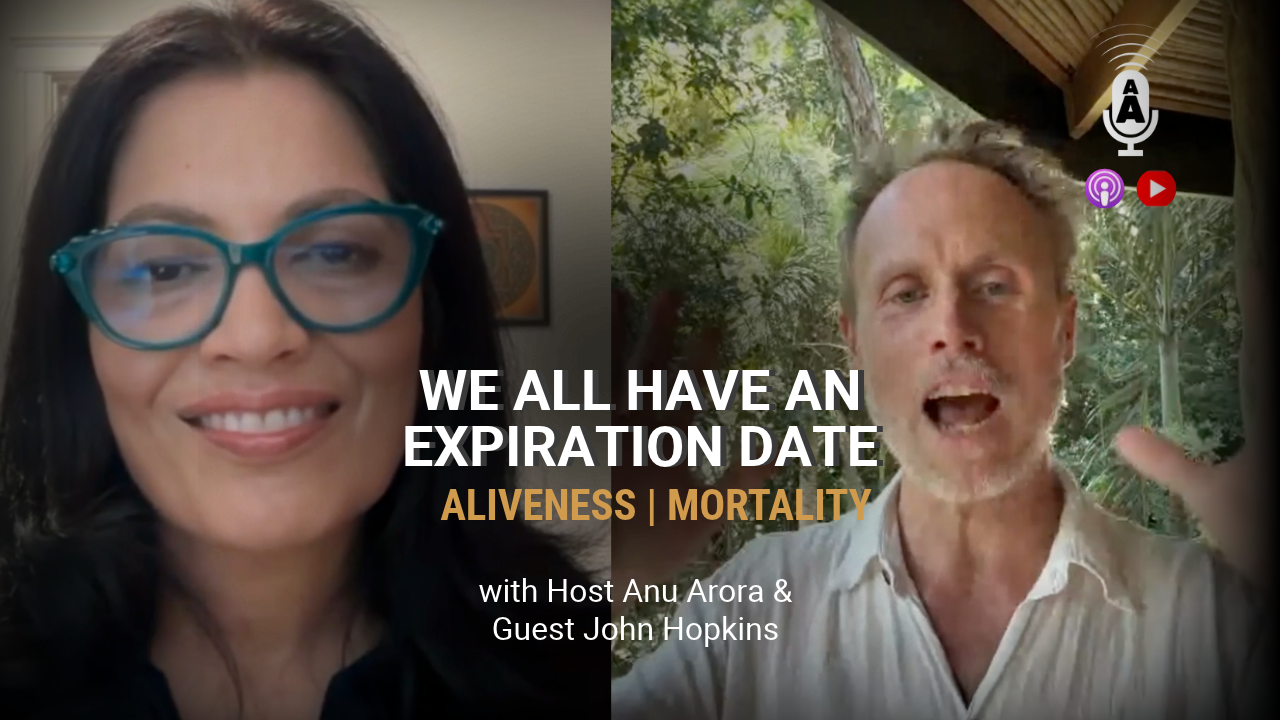
Last Friday, I chatted with fellow coach and Substack creator, John Hopkins, who goes by Hoppy. We opened with a short grounding meditation, feet on the floor, breath breathing itself, hands pressed together at the heart. It was a clear, intentional beginning to a really insightful conversation.
The panic attacks that pointed somewhere
Hoppy had spent his career as a film director and then founded a drone light show company. He told me he was building things from an extractive mindset and that his inner guidance system was asking him to be in service to something greater. That’s when the panic attacks started. They made him feel as if he were dying, and they stirred memories of near-death experiences from earlier in his life.
Then a question beckoned to him… maybe he was supposed to work with death. He said it charged at him like a rhino. He resisted it, then surrendered, and trained as a sort of midwife for the dying, an end-of-life guide. He sits with dying people, many of whom have no family with them, and helps them make their transition.
What slips away, and what stays
I asked Hoppy what people at the end of life say mattered and what did not. Wealth and status fade, he told me. What remains, he said, are the questions of whether you were brave enough and whether you were kind enough.
He believes we treat death as taboo, and that this makes us take life for granted, postpone what matters, and drift somewhat aimlessly. In his view, the fear of death is what rests underneath our other fears, and talking about it is how that fear starts to subside.
His support to the dying left him focused on what it means to be alive and gave him a desire to better understand and bring that feeling of aliveness and joy into our relationship with mortality.
Two-minutes to more alive
Near the end of our conversation, Hoppy offered to share the practice he constructed to help him stay focused on maintaining a sense of aliveness and I was delighted to share the experience with him on the Live Conversation. Here it is as he shared it.
When you wake up, before you reach for your phone. Take two or three big breaths, emptying the lungs fully. Remember that you are mortal, not morbidly, but as a reminder of how precious this life is. Be grateful for the day. Name one thing you will do today that you have been putting off. It can be small, like telling your children you love them at breakfast. Picture yourself in bed tonight, having done it, and feel how good that feels.
At night, in bed before resting your eyes. Breathe again and ask three questions. Did I remember I am mortal today? Did I remember to be grateful? Did I do the thing? If you didn’t, simply recommit tomorrow morning.
That’s it. That’s the whole practice. It’s simple and yet effective.
Key Takeaways
Hoppy's view is that not talking about death leads us to take life for granted, postpone what matters, and drift toward regret.
At the end of life, he says, what matters is whether you were brave enough and kind enough, not wealth or status.
He argues that normalizing mortality through gentle conversation replaces fear with courage and supports courage-based decisions.
Anu connects this to impermanence through a year of limited mobility and the Tibetan sand mandala tradition.
The two-minute aliveness practice has three prompts, morning and night: I am mortal, I am grateful, and the one thing I will do today.
Quotes from this Conversation
"Were you brave enough, and were you kind enough?" — Hoppy
"Life and death are two sides of the same coin." — Hoppy
"It protects you from unconsciously taking life for granted." — Hoppy, on the daily practice
"Death is a very difficult topic, especially for the Western cultures." — Anu
Questions this Episode Answers
Why do we take life for granted, and what does mortality have to do with it?
What do people at the end of life say actually mattered?
Is it healthy to think about your own death regularly?
What is a soul midwife, and what do they do?
What is the two-minute aliveness practice, and how do I do it?
How do impermanence and letting go show up in everyday life?
-
Anu Arora 0:01
So, since people are already here, and that gives us a moment to just settle in and ground ourselves. And any time we are arriving, sometimes we are arriving in haste. Sometimes there's so many other things going on, and I say, oh, we can just listen to this as well. And what if the invitation is just to be present here, as is, nothing to change, nowhere to go. You don't have to dress up for this one. You're not even on camera. Just coming in as is. I just welcomed a new granddaughter into my life, my first grandchild, and I'm just amazed and how children, babies, can can be themselves till the world conditions them to be different. And in that invitation, just getting in touch with the sensations that the body might present in this moment. As you arrive, your feet perhaps are in contact with the earth itself, or you're sitting on a bed. They are in contact with the bed. Wherever they are, whatever they are in contact with, you experiencing that.
Anu Arora 1:43
You're experiencing a body here in this moment through its various sensations. That's the beauty of the body; it is there in the moment, and we just connect with it. Now let's connect with our breath. Deep inhale and a conscious deep exhale. Another full inhale. Another full exhale. With the third exhale, we do a little sigh to release anything that you're holding on to. Inhale again and exhale with a sigh. And now let the breath breathe itself. Body knows naturally how to breathe. Aren't we lucky? We don't have to direct it. We take the first breath when we are alive. The first day we come alive, and then how do we continue to stay alive? Is the topic of today's discussion: What does aliveness even mean? Even though the breath is happening naturally, giving us all the tools we need to be alive, somewhere we're just living. We stop being alive today. With Hapti joining me, who talks eloquently, beautifully through experience about aliveness, I was so excited when he contacted me and he said, "This is what he does," and I'm like, "How beautiful is that? That this limited time on earth, the precious time on earth, that we not forget a moment to stay alive, to be here. Death is a very difficult topic, especially for the Western cultures. And I know I have followers all over the world, and you could be anywhere in the world, and you have may have traditions which are around preparing for death. I know the Hindu scriptures talk about vana prastasham, which prepares us. For this, the varagya, the principles of non-attachment, but somewhere it's forgotten. It becomes morbid, scary, and hoppy also makes it accessible. There's beauty in that. So we letting the breath breathe and act bent ahead of ahead of the meditation for a moment, but just coming back to the breath itself, the body breathing itself, annoying. This is a miracle. Miracle that human body breathing itself alive in this moment. When you are in touch with your sensations, and maybe you feel a sensation, maybe just experience bringing your hands together, if you would, for a moment. We call it the namaste position, but just fingers pressing into each other, the thumbs pressing, thumbs at the heart center in the center of the sternum, and just experience that touch as the index finger touches each other, the middle fingers touch each other. The ring fingers touching each other. And the pinky fingers, and you might experience those sensations. That is aliveness. I am here now. I can feel. Can feel the pressure of the fingers on each other, you might feel the warmth, the coolness, some sensations. Perhaps not, but still experiencing that my hand is in this position, and that is aliveness. Let's take a few more moments to be with ourselves, and slowly come back With everyone else in us. Thank you for joining us in this short meditation. So, Hafi, are we ready to begin? It's 9o'clock by my time, but it's top of the hour for most places in the world, so might be a good time to start.
John Hopkins 8:11
Let's do it. Thank you, by the way, for that lovely grounding meditation. That's just really perfect set scene.
Anu Arora 8:20
Yeah. So Hopi is joining. me from UK, and I am in Seattle in Washington State of United States. And as you know, I run the Mindful Leadership podcast and Substack, and Hoppy runs Aliveness, and he and I met through Substack, and the discussion was around how do mindfulness and aliveness meet. And I think we're going to get right into it. What do you say?
John Hopkins 8:53
Let's do it. Yes, I one small correction. I'm actually in the jungle in Costa Rica.
Anu Arora 8:59
You are.
John Hopkins 9:00
Yes, this is my new home, and it's quite windy. I'm hearing like big branches breaking in the background, so I'm hoping where I'm standing is okay.
Anu Arora 9:09
Are you are you outside?
John Hopkins 9:12
I am. Well, I'm on a I'm on a the the sort of terrace of the house I'm living in at the moment.
Anu Arora 9:18
Yeah, I was like, this is not a UK scene. I was just, but you are from UK and currently you are in Costa Rica. Is that going to be your permanent home or just moving?
John Hopkins 9:28
It is. Yeah, around a couple of years ago, my wife and I had a bit of a wake up moment where we realized that we'd been carrying a dream for a long time of traveling the world as a family because we have three children, and we just suddenly saw that you know if we didn't act on this dream that it might not happen, and that might be something that one day we might regret, and so we saw. Our house. We sold all our possessions. We got all of our everything down to one carry-on bag each, no check-in luggage, and we went traveling around the world. And as we traveled, we had a realization because we had so much time to reflect on what we really wanted in life that we wanted to explore living in a community, and just when we had that realization, we visited a community here in Costa Rica, and we loved it. And it had a school for the kids, and we're now living here. So this is our new life.
Anu Arora 10:34
Wow, wow! So let's start from that itself. I I was going to ask you different question, and I was, but I will come to that later. How did you come to this realization?
Anu Arora 10:51
It wasn't just one moment you woke up. I think there is something behind that, which is far more, you know, interesting than just waking up and saying we're going to travel and now we're going to settle in Costa Rica.
John Hopkins 11:07
Yes, thank you. Around three years ago, I had an epiphany that I was supposed to explore mortality, and you know, I'd spent almost 20 years working.
Anu Arora 11:22
Talk, talk about that epiphany. That is that is the moment.
John Hopkins 11:26
Yes. So I, you know, I spent almost 20 years working in entertainment. I was a film director, and then I set up a a drone show company in the UK, and we did big aerial light shows. Um, but I was lacking purpose in my life, and I realized over the years that I was building things. I think from an extractive mindset, where I was putting my own needs first, rather than being in service to something greater. And as I became, I think as my inner guidance system was crying out to be more in service, I found myself stuck in a job that culturally was at odds with the person I was becoming in the on the inside, and I was wearing a mask into work, and and eventually this led to me having a physical problem, I started having panic attacks, and as I had these panic attacks, I started to feel like I was dying, and it was triggering memories of near-death experiences that I've had in my life. And I started to ask the question: Maybe I'm supposed to work with death, and as soon as that question came into my mind, it charged at me like a rhino, and it was my purpose, and I could not resist it as much as I tried because I was like, please, please, just anything but this. But I, I surrendered into it. It washed over me like a wave. I had a, you know, a very physical reaction. All my nerve endings fired in my brain and my spine. And I started to train as an end of life guide, as a sole midwife. And as I went and started to sit with dying people, which was a completely new experience for me. I learned all sorts of things about not just about dying, but about how to live fully. And one of the things I learned was how many people get to the end of their lives and and suddenly realize they've run out of energy and they've run out of time to do the things that they knew they wanted to do, but because we, um, when we don't acknowledge our mortality and we pretend it doesn't exist and we we do not talk about it, what happens is we start to take life for granted, and we assume we have more time than we do because we're not aware of our mortality, and we postpone things. So this is the long-winded answer to your question, which was, you know, when my wife and I had this epiphany, we realized, oh, you know, we should act on this wisdom and follow our instincts, and even though this is a big leap and very scary, we know deep down we've got to do it, and we did it. And I think for both of us, it's been this amazing journey of discovery of like getting to know ourselves better, and we are now finding that we are living closer to our our true life values, and that would not have been possible had we not made a big, you know, life change.
Anu Arora 14:56
Thanks for sharing that. I know you shared a little bit of this with me the other day, and I, you know, as I hear it again, I get goosebumps. And for for a few reasons, I think one of it is you realize we all have intuitive abilities. We all are, you know, our inner self is telling us so many things at so many times, but we are so busy, and we are mostly ignoring it. We're like, okay. In fact, he'll say some of them, "Shut up! Don't tell me that I shouldn't be doing this, or I should be, you know, instead doing this." We just, I, I did that for many years. I said, "How could I leave a stable corporate job which pays so well when my kids are going through school or my you know we will we'll come up with all the logical reasons in the world why we shouldn't listen to our inner inner soul what is it telling us
John Hopkins 15:57
yes and you know the world we live in Justifies these decisions we're making for ourselves of why we shouldn't follow our instinct. Like you said, you know, you got a mortgage, you got kids at school, you know, you got a house. There's all these reasons, and it's very easy to convince ourselves that actually we're okay and we don't need to make any changes. And the the the issue I've witnessed with the work I've been doing is that if one does not listen to one's instinct and ignores it over time, that will lead to regret at the end of life. And having regret at the end of life is is not what you want. It becomes like a form of torture because you've basically just got to sit with the fact that you weren't brave enough to do it, whatever that thing was. Yeah, and you've got to sit with that in your final days, weeks, months, years, and it's not a nice place to be. So part of what aliveness is here to do is to disrupt this drift that happens with people without realizing, because we live in a society that has made death a taboo, and we don't talk about it. It creates a mindset where we take life for granted, we postpone and we drift, and it leads to regret. And on the flip side, the moment you start to acknowledge your mortality, not in a morbid way, but in a way that allows you to stop taking life for granted, because the moment you're aware of it, you're aware of the precious miracle of existence, and you suddenly are grateful for everything. You're grateful for your the people closest to you. You're grateful for the cup of coffee in the morning. You know, you're and then you're like, oh, I need to make the most of my time, right? And then intuitively, no one needs to tell you what to do. You will go. I need to do this and this and this because I've been putting them off, and I know deep down I have to do this, even though it might be a bit scary. I mean, that could be ringing your mum after three years and telling her you love her. It could be changing career or going traveling or anything, and the moment you start to do this and have this mindset, you will intuitively step into onto a path towards deeper potential and purpose in your life, and you know your health improves, your mental health improves, your relationships improve, your decision making improves because suddenly the things that matter most in your life become very clear when you're aware of your mortality. And what happens overall is your sense of being alive comes through, and there's excitement and there's joy and there's you know everything that aliveness represents becomes enhanced and so I'm trying to slightly change the definition of the word aliveness that exists in the dictionary at the moment, which is really the awareness of being alive and the joy of being alive. But if you come along with a little cherry and put it on top of the word, and the cherry is the relationship with your mortality, because after all, life and death are two sides of the same coin. That's when your true expression of aliveness comes into flowers, because it's when you come into relationship with your mortality, which after all is the only thing in life that's guaranteed. That's when you step into your deepest sense of aliveness, and from there you can be really present, and almost everything about you and your life becomes deeper. And more satisfying.
Anu Arora 20:02
Yeah, yeah. You know, I I was thinking of you were sitting with people who were dying, right? You were the sole midwife. What what was that like? Did you have you know? Did they have those conversations? Were there regrets? Were there, you know, what what did they feel? You know, they say the best best insights come from people who are dying, because that's the time and the whole life goes through. It just kind of goes through you. Yes, no, learn from that when when we get to the end of life, we are we you know we are at our most wise because we can look back and see all the things that mattered and what didn't matter. Yeah, but unfortunately, we've created a society for ourselves where we don't harvest this wisdom, what because to them right when you yeah learn what what really mattered what didn't matter give give us a few insights because that's yes no well what doesn't matter yeah what fades into irrelevance at the end of life is your wealth your status, and you know what really matters at the end of life, or you know it.
John Hopkins 21:30
Let's call it in the winter years of your life, when you're starting to lose your energy and ability to sort of have active, an active life, is were you brave enough, and were you kind enough? So it comes down to emotions of how you judge your life, not material things. And I, you know, when I had this epiphany that I was supposed to explore mortality. I was very scared. I had no idea how I would make a career. I felt like I was having to leave an identity behind, and that was very difficult to allow that side of me to die away. And I knew that I probably wouldn't have much support, and that I would have to just do this myself, and just trust that this is what I'm supposed to do. And then when I started studying to become a sole midwife, I realized what an exceptional honor and privilege it is to hold space at the end of life. It's a very sacred place to be, you know, and it's very magical as well. I felt studying about the end of life was I felt like Harry Potter going to Hogwarts for the first time, and I felt like I was leaving the the the Muggle world and and actually sort of touching into like the magical realm, you know. Yeah. And I realized what a what an amazing honor it was, and I found it very extremely fascinating. Wow. And then when I did start to sit with dying people in hospital, many of whom, by the way, were unconscious, but I was part of a scheme that has has people like me go and sit with people in hospitals who have no one else to sit with them, because of it's a very sad truth that in the West, you know, a lot of people die in hospitals now, and because there is almost no education around the dying process at all, even though it's the only thing in life that's guaranteed, none of us are prepared to deal with it. So many people, even loved ones, don't want to go and sit with their loved ones in hospital because it makes them feel uncomfortable, and they're not. They don't have the education to understand what they're feeling, what's happening, and similarly, the people who are dying are not equipped to process, to understand, and that's why death is is is a bit of a mess. And I see this being a major problem for humanity because by by by not talking about death, we fuel our fear of it. And what I've learned from my work is that all fears, all smaller fears and anxieties, if you trace them all back through our wiring, they come back to the grandmother fear of death, which sits silently under everything else, and pulling all the strings. And we're spending billions of dollars trying to fix mental health anxiety disorders. And you know, many of our mental health problems come from a fear. And you know we make fear-based decisions all the time without realizing it to keep us safe. And you just go on the news and you look at what the governments are doing and how we are. No one trusts each other, and there's fear everywhere, and we're going to war because of it. And I'm kind of like, guys, I think the elephant in the room is we don't talk about our mortality, and therefore we're all living in fear. And the moment you start to normalize your mortality, just through just gentle conversation, is the moment your fear of death starts to slowly subside, and it becomes replaced with courage, and when you have more courage, you have more love, and you can make courage-based decisions, not fear-based decisions, and you start to feel alive, and not feel somehow dead.
Anu Arora 25:55
Yeah, it is about also normalizing the conversations, as you are saying. Yes. What is the is your program aliveness then about that?
John Hopkins 26:06
That's it. I mean, I spent 15 years working in advertising. I directed TV commercials, and I got quite good at understanding how to sell an idea. And so when I first was like, oh gosh, my big idea is to make death accessible. Yeah, that's quite a big challenge. But I was kind of like, come on, I like a good challenge. And so it took me quite a long time to arrive at aliveness, which is the outcome of normalizing your mortality. And I realized people in our society they need to know what they're going to get, and it needs to feel good. So, what I'm doing is I'm saying aliveness is the feeling you will get from normalizing your mortality, and that's why I'm leading with that word because it gets people engaged. It gets people to sit at the table and start to have the conversation, and they know that the benefits are incredible, and the ultimate benefit is feeling more alive. But in order to do that, you have to have this conversation. But it's it's a very important conversation to have, and I feel like our species, in order to avoid our destruction, needs to have this conversation because I see it as a central blocker to human cultural evolution. Actually,
Anu Arora 27:33
yeah, and I totally agree. I also agree the stigma around it. I remember early on in our marriage, you know, we take out a carton of milk from the fridge, and my husband would look at the expiry date, and he'll say, "We all have expiry date," and he says, "I wish we knew." And I would say, "Why would he talk about death early in the morning? You know, so morbid." And then later on, we started to joke around it, and then it became very normal. But when he takes it out and he still says it, and sometimes if he doesn't say it, I say it. And it's not every day, but once in a while we'll notice an expiry date on something and think about our own expiry date. And we don't know it, but we wish we knew it. And then we would talk about it, and now it is we've normalized that conversation. It's not morbid anymore. It's a reminder that you know I am not here permanently. The impermanence of me being here, and what does that mean to live? What does that mean to be alive today? And and that brings a new level of appreciation for life itself, and this we take for granted. For example, I I've been a hiker. I've you know went and did Everest base camp, and so I thought I could permanently hike. It's it it's something which is there, and I do it, and I'm still young, and I'll be hiking for the next three decades. And then something came up, an injury, a hiking injury, which became really bad, and that became a cyst in the spine. And now there was just like a series of things which kind of almost incapacitated me for an entire year, and lying there on the bed, I was thinking, "Oh my God, this whatever I'm thinking of is permanent." Look at the impermanence. I was mobile yesterday, hiking for hours together, and here I am, and I can't walk. The doctor was saying that you know we start with 1520 feet a day, so from from miles and miles it became a few feet a day, and Happy I was reminded of this Tibetan practice of sand. Mandalas, where lot of Tibetan monks will come together, and they'll bring these, they'll ground these rocks, different colored rocks. So he'll have different colored sands, and they'll make the most exquisite, beautiful mandalas. For sometimes it could take for months to get that thing completed. It could be a size of a house, a small house. It'll be that large, and there'll be that many people who would be working on making this beautiful, exquisite piece of art. And when they finish making, they look at it, they admire it, and you know what they do next? They destroy it. They just either start drawing lines, they'll mix it and destroy it in the sense in a very beautiful way. Now it becomes the spiral of different colors together, but they're teaching themselves the art of letting go, art of not getting attached to what it is right now, and this is how it's going to be. And the reality is, we'll all age. Hopefully, we don't become too sick before we die. But now the you know data tells us that more people are living longer lives not due to healthy aging but due to all the means that they can extend their lives. That means they can't do all the things they wanted to do in the last 10 years of their lives, and that's a huge reminder that this is the moment to live, live fully, to be alive.
John Hopkins 31:49
Yes! Wow! Thank you. Beautifully put. And you know, I've actually built what I call the aliveness practice, and I'm trying to make all of this as simple, easy, and powerful for people as possible. But I've I've built a two minute daily practice. It can be even quicker if you want. And the idea is that, or the invitation is,
Anu Arora 32:19
should we do should we do it together?
John Hopkins 32:21
Yeah, I mean, I can, I can, I can, I can explain it to you now. It's basically my suggestion or invitation is when you wake up in the morning and you are lying in bed, but you haven't touched your phone yet, and you're still in that lovely kind of dreamy State. You remember that you are mortal, and after you remember that, you remember to be grateful for today, and then you remember to do one thing that day that you've been thinking about, that you know is important, could be small, could just be this at breakfast this morning. I'm going to tell my children I love them, or it could be today is the day I'm writing my letter to my boss to tell him I'm changing. I need something. Whatever it is, the scary thing, the thing that where we are pushed to our edge, and those can be little things or big things, and we commit to doing this in that moment. And what I like to do is a little extra. I once I see what it is I need to do. I imagine myself lying in bed at the end of the day, having done it, and how good it feels to have done the thing I committed to. Okay, and that's your morning 60 seconds, and then when you get into bed at the end of the day, as the as the bookend of your day, and I'm lying there again. I check in with myself, and I say, "Was I aware that I was that I'm mortal? Was I grateful? And did I do the thing?" And that is the two-minute daily aliveness practice. Because what what it does is it protects you from unconsciously taking life for granted, which is what many of us do when we are not aware of our mortality. Beautiful. And from that place, it it means you can live in gratitude for that day, and you are doing the little things or big things that will mean one day you get to the end of your life, and you can look back and go, "Ah, I did it. I was brave enough, and I was kind enough, and now I can die in peace." Beautiful, beautiful.
Anu Arora 34:55
Should we do some practice together? Because people, many people who. Woke up this morning, didn't know your practice, so maybe they can do it right now.
John Hopkins 35:05
Yeah, sure. Do we want to take a moment to just?
Anu Arora 35:09
Yeah, let's let's do it. Yeah, I I hope people would like that. I love experiential work together when I come on podcasts. Yeah.
John Hopkins 35:19
So so why don't we all just close our eyes for a couple of minutes now, and just drop in? I like to take two or three large breaths. I find when I'm lying in bed, I take a breath that fills my lungs up as far as they go, and then I release, and I get every last bit of air out, and you'll be surprised by how much extra air might come out. And I repeat this two or three times. So let's do that now. And I find this drops me into my more intuitive alpha state, and then when I'm feeling comfortable and I'm lying in bed at the morning. In the in the morning, just waken up, and I remember that I am mortal, not in a morbid way, but in a beautiful way that reminds me how precious this life is. What a miracle it is that I am alive and conscious, and I have a whole day ahead of me of opportunity. And then I remember the one thing I'm planning to do today. I may have made a list of these things. Sometimes you can just spontaneously, or if you listen to your instincts, allow it to tell you what's what matters most Today, for me, it's usually showing more love to my family in various ways, and then when I've had this little moment myself, I feel ready to step into the day. But before I do that, I just imagine myself for a few seconds lying in bed at the end of the day, having done the thing I committed to, and for a second I imagine how good it's going to feel that I did it. And I find when I add that little extra visualization in, I'm much more likely to do the thing that I've committed to do. to do. Okay, and then now let's imagine we are lying in bed again at the end of the day, and again I do my breathing, I settle myself, and then I check in. Did I remember that I am mortal today? Did I remember to be grateful? And did I do the thing that I set out to do? And it's okay if you didn't, but perhaps tomorrow morning you can recommit to that thing. And you know this little practice doesn't take very long at all, and it just keeps you aware, keeps you grateful, and it keeps you accountable to yourself to make sure you do the things that matter most to you in your life. That will bring you the most amount of joy, Freedom, peace, and aliveness.
Anu Arora 39:49
Thank you, thank you, Hoppy. It's simple enough, but very profound. I felt a sense of expansiveness. It's just heart, kind of as if it felt that my heart expanded to accommodate more, to create space for life itself. What a beauty! What what a gift it was for us to connect. It got surrender pity, isn't it? People who think alike, they connect and they talk, and then other people come with us on this journey. And is so grateful to everyone who has joined. And please, please reach out to Hoppy. His link is there. Hoppy, you'll also share this. You know, live. Will you'll have the the YouTube, not YouTube, the video available, which you can share with everyone, and of course you can put it on YouTube as well. Is there anything people want to ask? And I think they can ask through message before we end, it seems like there is nothing that's showing up. So why don't we end with a little bit of short practice, just to say, even something like your practice we just did, but bringing your hands at the at your heart and saying, for today only, just even every morning, and I do this as very similar practice to you, and for today only, I will not worry, but today only I'll be grateful to everything around me. But today only I'll extend love and kindness to everyone I meet. And thank you, everyone, for joining. Hoppy, is there anything else you would want to add at the end?
John Hopkins 42:08
No, just to say thank you. It's been such a pleasure to meet you, and I hope this is just the beginning of a relationship. And thank you for your support and all the serendipity. And it's just been a wonderful conversation.
Anu Arora 42:23
Thank you, and we are going to have more. I can see, see and feel that. Bye, everyone, and thank you, everyone. Thank you for being.
John Hopkins 42:32
Have a nice weekend.
Anu Arora 42:34
Bye, and to Costa Rica. Enjoy.
References
John Hopkins (Hoppy)
Aliveness newsletter on Substack. Its tagline is "Stop drifting and start living the life you keep postponing," and it offers a six-part mini-course.
LinkedIn profile. Founder of Aliveness | Helping people wake up to what matters before it’s too late | Creator • Guide • Speaker