
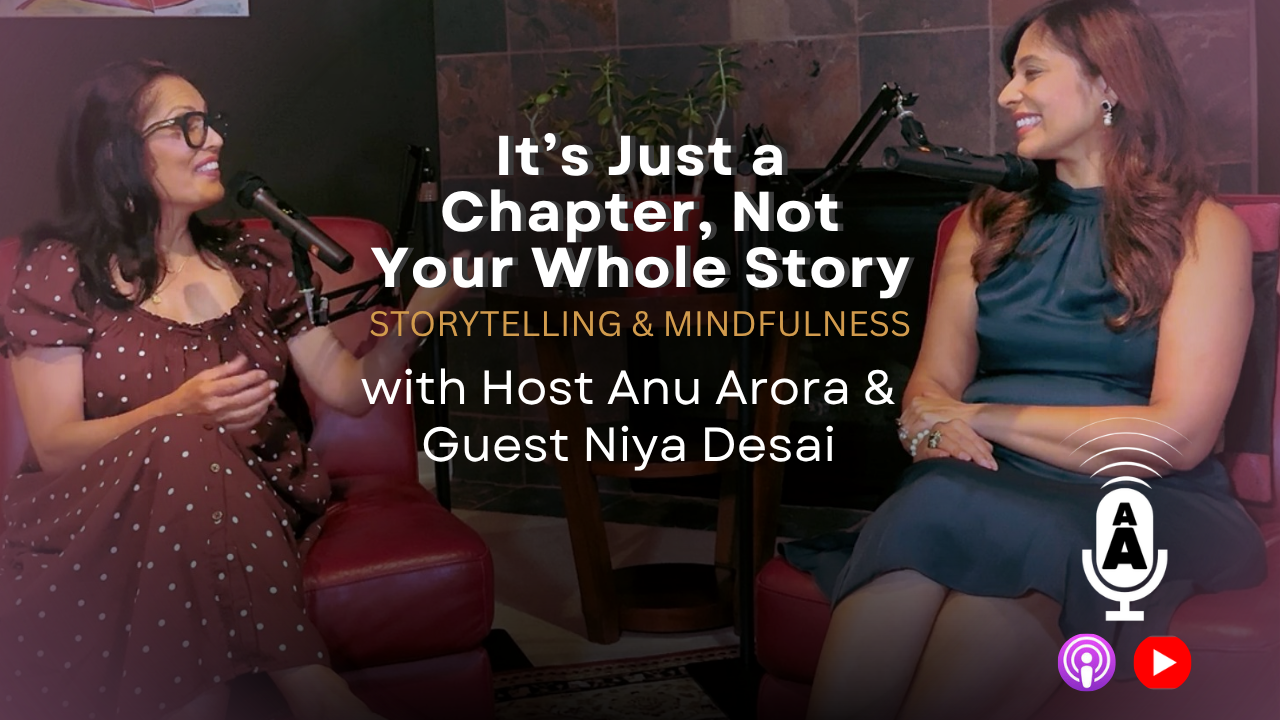
Niya Desai was 24 when she moved to the United States on an H-4 visa. She had a master's degree in journalism and advertising. She did not know the visa meant she couldn't work.
She thought it would take days, then weeks, then months. It took eight years.
In this conversation, Niya tells me what those years did to her sense of who she was, and how she found her way back through storytelling. She also shares what she learned interviewing founders on her own show: that obscurity is expensive, that self-trust comes before anyone else's advice, and that comparing your life to someone else's is a race that doesn't exist.
Near the end, she said something I haven't stopped thinking about: whatever you are going through right now is not part of your struggle. It's part of your story.
I wrote more about this on Substack in a letter-style essay: Read "The Chapter You're In Isn't Your Whole Story" on Substack.
Key Takeaways
A hard season is a chapter, not the whole story. Niya describes her eight years unable to work as a small chapter and the foundation of who she became.
Trust yourself first. Self-trust is built in, but social media and comparison can make us ignore it. Listen to what your heart wants before you seek anyone else's advice.
Stop comparing your life to other people's. Niya learned from the leaders she interviewed that comparison pulls you away from your own vision.
Don't confuse identity with productivity, a paycheck, or a title. When worth is tied to what you earn or achieve, we lose ourselves in the process.
Obscurity is expensive. Founders who can't share their work with the world keep it to themselves, so visibility matters.
Find a mentor who isn't your spouse. Someone who tells you the truth and holds you accountable cannot be replaced.
Naming what's present takes away its power. Recognizing fear, or a struggle you didn't have words for, helps break the loop.
Mindful leadership is creating a pause between what happens and how you choose to respond. In Anu's words, it's wisdom and compassion, the two wings of mindfulness.
Quotes from this Conversation
"I realized that obscurity is expensive, and everybody needs to be visible in today's world, whether we like it or not." Niya Desai
"Whatever you are going through right now, it's not part of your struggles. It's part of your story." Niya Desai
"Sometimes the most powerful thing a leader can do and say is, 'I don't know. Let's figure it out.'" Niya Desai
"I don't think being wrong is a leadership failure." Niya Desai
"Mindful leadership is creating a pause between what happens and how you choose to respond." Niya Desai
"Wrongs are not wrongs. Wrongs are the way to the next rights." Anu Arora
"Wisdom and compassion, the two wings of mindfulness. Bring them both, and then you can lead anyone anywhere in the world." Anu Arora
"You can't delegate without oversight. You can't delegate without mentoring." Anu Arora
Questions this Episode Answers
How do you rebuild your identity after years of being unable to work? Niya Desai describes spending eight years on an H-4 visa, going back to school, and moving through several careers before finding her voice through podcasting and storytelling. Her view is that the hard years were a chapter that became the foundation of who she is.
Why does visibility matter for founders and leaders? Niya says obscurity is expensive. If founders can't bring what they're building to the world, it stays with them, so sharing your story and your work is essential.
What did six- and eight-figure entrepreneurs teach Niya about life? She names three lessons: trust yourself first, remember that the chapter you're living in is not permanent, and don't compare your life with anyone else's.
How can you tell if you are reacting instead of responding? Anu suggests noticing where the reaction shows up in your body. For her, it's in her belly. She pauses, relaxes that area, and sends it compassion before she responds.
What leadership habits are worth unlearning? Anu learned that delegation without oversight or mentoring doesn't work. Niya learned that leaders don't always need to have the answer, and that saying "I don't know, let's figure it out" builds trust.
What is mindful leadership? Anu defines it as wisdom and compassion, the two wings of mindfulness. Niya defines it as creating a pause between what happens and how you choose to respond.
If this conversation resonates, I invite you to watch or listen to the full episode above, and to read the companion essay on Substack.
Resources
About Niya Desai: Niya Desai is a mindset coach, podcast host, speaker, and video storytelling strategist who helps founders, leaders, and high-performing professionals communicate with greater clarity, confidence, and authenticity.
Her own journey has been anything but conventional. After moving to the U.S., she spent years unable to work because of visa restrictions, navigated significant personal and professional setbacks, rebuilt her career from the ground up, and ultimately found her voice through storytelling. Today, she uses those experiences to help others overcome self-doubt, lead with intention, and show up more powerfully in both business and life.
As the host of The Niya Desai Show, Niya has interviewed entrepreneurs, executives, and changemakers whose stories reveal the human side of leadership. Her work has been featured on KING 5 News, and she is passionate about conversations that remind us that success is built not only through strategy, but through resilience, self-awareness, and the courage to evolve.
Connect with Niya
Website: https://niyadesai.com/
About Anu Arora: Anu Arora is an executive and team coach, speaker, and host of the Mindful Momentum Leadership Podcast. She works at the intersection of mindfulness, neuroscience, and leadership — helping mid-level managers and senior leaders navigate complexity, burnout, and the gap between performance and presence. Subscribe to her newsletter at mindfulleaders.info.
-
Anu Arora 0:03
Welcome to the Mindful Leadership Podcast. Today on our show we have with us Nia Desai.
Anu Arora 0:10
Nia Desai is a storyteller strategist. She's a mindset coach.
Anu Arora 0:17
She's also a host of Nia Desai show,
Anu Arora 0:22
and she says while we were just preparing for this conversation, she says one of the things she works with people on is to help them realize their own potential. They are complete in themselves. They don't have to be different or tell another story. It is their own story that she brings to life.
Anu Arora 0:46
Thank you so much.
Niya Desai 0:48
Thank you, Anu. That was so lovely.
Anu Arora 0:50
Yeah, and so glad that we found each other.
Niya Desai 0:53
Yes, I'm really glad too. I just loved learning a little bit about you and your husband, and it's so beautiful what you're creating right now. Thank you for doing what you're doing.
Anu Arora 1:03
Yeah, yeah. And one of the reasons I create this and talk to people like you is the stories you bring, you know, to to light. And for our viewers to see how these beautiful stories are not without struggle, not without challenges, not without a lot of introspection, introspection, reflection, challenge, courage, and difficulty. So we see all of it in these stories, and Nia has her own story, a beautiful story, which she just shared with me on how she came from India and then she couldn't work and she had so much education and what kind of journey it took for her to arrive here. So Nia, from your own words, I mean, just give us the the key reader digest version of that story, and take us through how are you where you are today?
Niya Desai 2:08
Yeah, I would say it was a very interesting story. I was just 24 years of age when I moved to US, got married like many like many other individuals who would come to the U.S. and it was a little naive, I would say. And when I moved here, I came on h4 visa, but I did not know that I wouldn't be allowed to work. And I know a lot of you what you're thinking. How is that even possible? Well, it was possible a couple years ago that you can come naive? Not anymore. I'm not talking about the Gen Zs, Gen Alpha, Gen X anymore. But yes, that's who I was. And actually, two people published articles on me that how were some of the immigrants who came were naive enough to not know you couldn't work in this country. So I thought it'll be just days and weeks and months, but that converted into eight long years, and I pretty much forgot that I had a degree in journalism and advertising, had a master's in that, and when eventually I got the work permit, I was already 30 pregnant with a kid, so it was a difficult journey where you go through so much in the past eight years that you start forgetting what your story looked like, felt like.
Anu Arora 3:24
You start doubting yourself. Did I have any talent? Did I have any capability? We forget who we were. Absolutely,
Niya Desai 3:34
absolutely. We've gone
Anu Arora 3:35
through this. Many of first generation immigrants will relate so much with your story,
Niya Desai 3:41
yes, totally.
Anu Arora 3:43
Yeah, yeah. Keep keep going. Yeah.
Niya Desai 3:46
So you know, once I realized that I could work, I remember going to University of Washington because I had to study all over again. I had lost all my 20s not being able to work, and here I was sitting in my drawing room, and thinking, "What am I going to do next? And so I just took up the best thing that was marketing, very trending those days. I went to U Dub, studied marketing, and got job in a startup. And it felt different because you know most of my friends that time had become managers, were at senior positions in that eight years of me not working. The good thing that happened with me was I did not compare my life to theirs, but I did for the first eight years. I did constantly. That was a struggle, and I realized very later in my life, which was also part of my healing and journey to become a coach. And we can talk more later about it. That knowing that the eight years of my life was sounding very brutal to me when I was living it, but as now a more mature woman, I realized that it was a tiny chapter in my life, and that is the foundation of who you become. And if we forget that, we're never going to. Move forward in life, but if we understand and realize that those chapters is what brings you and makes you who you are today, I think it's the most beautiful thing that can ever happen to somebody.
Anu Arora 5:11
Yeah, yeah, and there's so much richness in them. You are in a new country, you are figuring out ways to be in this country, and the kind of things we go through as first generation immigrants, our kids will never even understand it, and that builds a lot of resilience. It builds a lot of courage. Yes, and the risk taking ability also, I think, is a lot more as a result.
Niya Desai 5:39
Oh yes, absolutely, I agree, 100%
Anu Arora 5:43
Yeah. So then, what happened next?
Niya Desai 5:47
So I actually worked in startups for a couple of years, and then I was pregnant with my second kid. So I had taken a couple of pauses in between my jobs, but what happened in the process was I kept on quitting jobs, and of course I don't think I made my husband happy with that, but I made myself happy, and that was equally important for me because I'd lost so much in that eight nine years of my life. I was still trying to figure out who I was as a person. My identity was lacking, and you know that's what happens. Is you see, identity is connected to opportunities, but it's also the other way around, right? You can collapse your identity completely by thinking who you were, not by who you can become. Yeah, and that is so important. So for me, I always used to question myself, and then I did project management because my husband thought I'm so good at handling home and work. So I just got some credentials in project management. Next, I found myself in Fred Hutch, and next I found myself working in Microsoft. But when COVID happened, I really had to analyze that I I can't do this. My kids were struggling with COVID, so I just took a decision to quit again. And again, I don't think I made my husband happy because two people getting two salaries is really important, you know, as we all know in the world that we are living. But thanks to him for being really supportive as well, and I think that's what is the foundation for who I am, because of him, he allowed me. He let me be what I wanted to pursue in life, and I did four different entrepreneur journeys, from selling clothes to starting some YouTube channel. Only when I was turning 40, and now I'm revealing my age. That's not fair. I won't say how many years back. It's totally okay, but I
Anu Arora 7:40
won't do mine.
Niya Desai 7:42
So I suddenly had this-you know-maybe you call it spiritual, maybe you call it a calling, maybe you call it any word. I remembered that I had a degree in journalism, so I started my podcast, and I went with no mentorship, no knowledge, no expertise. I just started scripting the whole show the way I envisioned because I always believed that I wanted to be the voice for women. So I started a women show called Women in the Making, and I interviewed around 30 different women from the Seattle area, all walks of life, pretty successful. So one of the stories that I got to life was, you know, about a very senior person in T-Mobile sharing, the struggles that she came from. You know, her parents were not educated, and even from getting water, they had to walk a mile. And from there, her journey to, you know, being who she is today, and even today, she had to prove herself, and you know we sometimes see a lot of chauvinism around us, and how she has fought for herself even today when there are these groups that you know every company would have, and they were talking about the fact that the reason she is a leader is because she had to probably done some things to be a leader, and as women, we sometimes go through so many challenges, which are not supposed to be part of our life because we already are living a journey.
Anu Arora 9:13
Yeah,
Niya Desai 9:13
and so I really enjoyed listening to these stories of these women who are so resilient
Anu Arora 9:19
and bringing them to life and helping others also see this because there's so many other women who might be in that situation, and then to be able to look at someone like that and say, "Yeah, I can do this.
Niya Desai 9:34
Yes, you know what Maya Angelou says, right? If you don't like something, change it, and if you can't change it, change your attitude.
Anu Arora 9:43
Yeah. So it's
Niya Desai 9:44
pretty much that. And so I did 30 episodes with 30 different women, and then I realized something. Yeah. I was like, I enjoy listening to women's stories, but you know, men are great allies too. Yeah.
Anu Arora 9:56
Yeah. So
Niya Desai 9:57
I changed the name of my show, and I. To be my own identity, the Niyadasai show. That was my evolution, where I started interviewing men from around the world virtually, and I interviewed entrepreneurs who were six to eight-figure entrepreneurs. So I interviewed many, many successful people, and it gave me a different perspective of life. You know, as much as I loved doing what I did, I was like, "This is amazing what you can bring, because these journeys of people are important.
Anu Arora 10:29
Yeah,
Niya Desai 10:29
and they bring the best out of you, and you are spreading the right expertise to the other people to learn something about entrepreneurship and many, many more things.
Anu Arora 10:44
What is it that you learned from these interviews? I mean, just in terms of that changed your life.
Niya Desai 10:53
I realized that obscurity is expensive, and everybody needs to be visible in today's world, whether we like it or not, and it's an important factor. The reason we interview is we have to be visible.
Anu Arora 11:11
Yeah,
Niya Desai 11:11
right. If somebody tells me that I don't like talking, I'm sorry, but you have to talk.
Anu Arora 11:18
Yeah, yeah. To
Niya Desai 11:19
be someone in today's world, you have to be visible, and that's what I do with my storytelling as well. So I interview, I bring a lot of founder stories to life. So these are founders who are creating something for themselves. So through social media, through podcasting, you know, I love just writing scripts about what can we bring to life,
Anu Arora 11:42
and they are founders not just for bringing this to themselves. It's also that they want to bring it to the world, and if they don't know how to bring it to the world, then whatever they're founding will stay to themselves, stay to really themselves. So you know, you are helping them again with visibility and obscurity is not going to help them get there. What what a beautiful lesson!
Niya Desai 12:07
Yes.
Anu Arora 12:08
What else? What these? What did these six to eight figure entrepreneurs taught you? Ooh,
Niya Desai 12:15
that's a tough one, Anu. I'm glad you asked me that question. A lot of life lessons, self trust. Number one, I would say, we forget that self trust is inbuilt within us, and we ignore that for a long time, or we ignore that most of the times. And it could be many reasons. We are all surrounded by social media, so self trust becomes a betrayal, and we have to remember who we were even before who we became, and it's always important what your heart wants you to do before you reach out to somebody else or hear their advice. Other than that, I think number two for me would be Remember that the chapter that again, like you're living in your life, is not permanent. It's just part of your story. So, would you want to change it? Would you want to live it? Or how would you want to define your future? We
Anu Arora 13:17
are, you know, we are not the victim ever in any story, and we have the capability to be our own heroes. Yeah,
Niya Desai 13:27
and the third one, which is the most important one, is not comparing your life with others, which is very hard in today's world. But I learned this life lesson from almost most of the leaders that I interviewed, that if you are in the limelight of comparing yourself with others, and if they have a Mercedes and you want one, you will get one by by hook or by crook. But what is at par for you to get that Mercedes, and so I think for me that has been a very big life lesson because we've never compared my husband and I have never compared our life with anybody else. We live the way we want to live. For us, traveling is the most important, probably more than cars or whatever. So you know, I think you have to believe in your vision and make sure you're aligning with your thoughts and act on it.
Anu Arora 14:27
Yeah, yeah. There's so many words you used in the lessons you have learned, and which comes to mindful leadership. Which brings me to that because those are all the principles of mindful leadership, and it seems like you are practicing that in your life, where you're trusting yourself, your own intuition. You're recognizing that what you want is important, and it doesn't have to compare with anyone else in the world. You are not running this race with others. There is no race. There is just this recognition of who you are and how to live fully in who you are. And then you also talked about alignment, which is we are aligned as as a couple, we are aligned as a family, we are aligned, and all these are principles of what mindfulness is.
Niya Desai 15:24
Yes.
Anu Arora 15:25
So, I am here running a show on mindful leadership. Right. And what does that evoke in you when I compare this to mindful leadership?
Niya Desai 15:38
So I think for me, mindful leadership probably means being aware, being aware of your surroundings, being aware of who are the leaders that you're trying to follow, who are the people that are part of your journey, trying to build you from there, and that is a very important thing for me to live with. And I think I shared with you a little bit about my healing journey, and healing for me was was not from a trauma. Healing for me was trying to understand who I wanted to become, and that took probably 15 years. And everybody is on their path. Everybody have to live their life chapters. For me, it was important that I reach out to myself first before I reach out for help. Of course, we have enough options available, but when I started learning more about mindfulness, about what does healing in general mean, because it's such a big word for people to know, right? What is healing? Now you can heal from trauma, you can heal from pain, you can heal from a child's birth, you can heal from something that's happening around you. What was it for me? It was everything. I did not know I had depression with my kids. I had no idea when I went with my second kid to fill a form at the doctor's clinic, they make you ask these questions that you have depression, and I said no. First of all, I was not sure if I had depression. I kind of started recognizing it because it was not the first kid; it was the second kid. And then I thought they will take my child away from me if I write it was yes. So there was no awareness, and later in life, I realized that that was important because they needed to. Not going to take my child
Anu Arora 17:30
away. So much fear when we don't know what we don't know. No, there is so much fear. You, I'll tell you one story just to you know interrupt it for a second, but I can't stop telling. The first time I got a ticket, you know, I was driving late at night. I was doing a second shift. I was working at Microsoft, and I had the you know police car came in, and I was frozen. I was frozen, and the first thing they said was keep your hands on the wheel, keep your hands on the wheel. Otherwise, we will. Otherwise, I was ready to get out of the car and tell them I'm sorry, I'm sorry. But they said otherwise, we'll have to take action, which means they'll shoot me, and I was just so
Niya Desai 18:19
scared terrifying. Yes,
Anu Arora 18:21
terrifying. But we didn't know. We didn't know that you don't get out of the car. We didn't know that you don't run for the glove. Go to the glove box because then I was the second thing I was doing is going to the glove box to to get my insurance papers out, and now I feel so silly. I even thinking about this. But I can imagine when they ask you, "Do you have depression? You say, "What if they took my child away? Yes, right. So
Niya Desai 18:52
yeah, it was all part of the story, and and it's about recognizing that you have this problem, and it's not a problem, right? I'm just using big word here. Yeah, it's recognizing that this is what you're going through, and knowing that there is help available, because we talk about so many different issues that women have to understand and go through in today's world. We just don't encounter too many people talking about it. Yeah, you're recognizing that these things were present, that the fear was present, and I think when we recognize that something was present,
Anu Arora 19:30
we take the power away from it.
Niya Desai 19:32
Yes,
Anu Arora 19:32
but if we don't recognize it, we are just constantly in that loop of fear.
Niya Desai 19:38
Yes,
Anu Arora 19:38
so yes,
Niya Desai 19:39
so true.
Anu Arora 19:40
Came out of it and yeah, worked on it, and then the healing through that helped you get to the other side. Yes,
Niya Desai 19:48
absolutely, and I think that's the most beautiful thing that one can do to themselves is recognizing, act on it, and then become the version that you always wanted to become. And there is no end to what you want to become, but I think it's about the content, the happiness that you feel. I feel happy right now, and if that is what your future version looks like, feels like, there's nothing like
Anu Arora 20:14
it. I love it. I love it. I'm happy right now, and if this is what it looks like,
Niya Desai 20:21
yes,
Anu Arora 20:21
then that is it.
Niya Desai 20:23
Yes. Because you know, for the longest time, Anu, I thought, you know, you're confusing identity with productivity, and that's a tough one to crack.
Anu Arora 20:33
Identity with money, not even productivity. How much do you earn? What's your paycheck? What car you drive? What home you live in, and then we forget ourselves in the process.
Niya Desai 20:45
Yes,
Anu Arora 20:46
we lose our souls in the process. So true. And you're saying no to that, and you're helping others recognize that.
Niya Desai 20:53
Yeah. So it's you know eventually you need to understand that you have to become more resilient. You're becoming the best version of yourself. You're becoming the woman or the man that you can stand for. If you have kids, then be that foundation and the pillar for your kids to remember who you are when they grow up, and they can recognize that what that's what my parents preached or taught. Maybe they hate it right now, or they dislike it, and I have younger kids, and probably you have older kids, so you can give me more life lessons because you have boys, and I have two young kids. But I know that probably they don't understand what I'm teaching right now, but I also recognize that they will tell somebody else that this is what my mom taught me, and it is for the best. So I know that they don't like everything I say right now, but I don't care.
Anu Arora 21:48
But that's okay. It it will stick in. You know, you can trust my words. Yeah, you know, it never felt like it was anything was you you know seeping in. Yeah. yeah, it's all sticking now. All the life lessons for me are coming from them. It's the other way around. I look at them and we feel very proud. We feel that you know what we were and how we went through life because we didn't know if we were doing it right or wrong. We were young parents and we were experimenting, and like we are all doing. And when they, when we learn learn from them now at this age, then we feel like yeah, we must have done it right.
Niya Desai 22:36
Yeah, yeah, absolutely.
Anu Arora 22:38
Yeah. So, what's your aspiration? I'm very curious. Where do you want to take this journey, or you just want to have that mantra? If I'm happy now, that's it. Tomorrow, if I'm happy, or is there an aspiration that goes?
Niya Desai 22:56
Yeah, I do have an aspiration. I do want to have any other sideshow on television someday. That's my aspiration. That's what I dwell to do someday. But I really preach by what Michelle Obama says. This is your story. This is what you live by in your story, and you have to create it. And I think I'm in the process of creating it because it took me so many years to find my story, and now I'm the happiest version of myself.
Anu Arora 23:24
How do you how do you create it? Because it'll be for the benefit of our viewers too. How are you creating the best version of yourself? You're creating your story.
Niya Desai 23:35
The number one most important thing I would say is having the right people beside you, and I don't think anything is more important than that. Whether it's your spouse, it's your friends, it's your coworkers, it's your mentors, and the thing that I lacked the most in my life was mentorship. So I do want to reiterate, if I have not done it before that having a mentor in your life and that can't be your spouse, so you have to find somebody else who can tell you and beat you up for not doing the right thing, or following a path, or like just doing something that was important, or just you know, an accountability. Yeah, exactly. So having a mentor in your life cannot be replaced, and I abide by that law. It's like a law for me. Wow! I have the right people around me. I, if anybody believes in the power of universe, and it took me a long time to realize this. All I have started doing a couple years back is telling the universe, please take away any toxicity, any toxic people from my life. I'm not praying or like doing any magic voodoo stuff. It's all simple stuff that I write in my notebook. And you know what? Things just started happening for me. It was simple things like right. And to be honest, I did not have any toxic people. But when you start working with people, you will find people who bring toxicity with you. And how do you take that away? Is you can have arguments, you can have long pauses between those conversations, and you know you will have discouragement towards the end. So for me, I had to figure out a fine line between that because I'm in a people's business. I'm able to meet all kinds of people.
Anu Arora 25:34
You have to protect your energy. Yes,
Niya Desai 25:36
exactly. So I think that's the most important things that I've done. If I answer your question,
Anu Arora 25:43
yeah, yeah, that's wonderful. So you are creating your life by surrounding yourself with the right people. You have the support. You are protecting your energy. You are walking the path, and you are being happy. You gave us you. Yeah, you gave us a formula. Yes, and there's so many things I am learning from you, which I can bring into my practice. So thank you so much
Niya Desai 26:10
for
Anu Arora 26:12
doing that. Let's go into some of the you know I'm again going into the mindful leadership. We want to do rapid fire, like you were talking about.
Niya Desai 26:23
Yes, I have something for Anu. She did not know this, but when I run my podcast and whenever I do work with my clients, I love to do rapid fire, and I know you all love it too. So I do have some questions, and I'll bring that up if you want to do it. Let's do it. Let's try. Okay, can't my phone. Okay,
Anu Arora 26:44
my phone. Stop.
Niya Desai 26:56
I'll read out question for you right now. So you want to
Anu Arora 27:00
cup a couple? You know.
Niya Desai 27:04
Yeah. The 111,
Anu Arora 27:05
word. I think those are we like this, you like that, and then what
Niya Desai 27:09
do you realize when your wrong is called other?
Anu Arora 27:12
Uh huh.
Niya Desai 27:13
You want to do it?
Anu Arora 27:14
We can do like one. Yeah, yeah, yeah.
Niya Desai 27:16
So I would say, okay, Anu, I'm flipping it.
Anu Arora 27:19
Yeah.
Niya Desai 27:19
We'll do a podcast. We'll do a rapid fire.
Anu Arora 27:22
Yeah.
Niya Desai 27:23
I will also answer my version.
Anu Arora 27:24
Yeah.
Niya Desai 27:25
And you also answer your version. Yeah. So the viewers get like two different versions.
Anu Arora 27:29
Yeah. I think
Niya Desai 27:30
that'll be fun. Right.
Anu Arora 27:31
Right. And then
Niya Desai 27:31
whichever question question you want to edit, begin to see. Yeah.
Anu Arora 27:34
Yeah.
Niya Desai 27:35
Who does the editing, Pradeep? You. You have some. Oh, that's really sweet. You have a whole tribe behind you guys, like
Anu Arora 27:43
you say, right? I need a tribe, and I have also a tribe, and that's how I'm doing it. Start,
Niya Desai 27:50
okay, Anu. Here I am. So, if anybody has watched me before, they know how much I love rapid fire. So, how about we flip the script a little bit, and by the way, this was not a scripted show. But flip it, and we bring some rapid fire. You will answer your version, and I will answer my version. And I think that will be really fun because everybody gets to watch two versions of the same question. You want to do it? I
Anu Arora 28:16
love it. Okay, bring on questions
Niya Desai 28:18
on my phone. So let's start with the first one. What do you do when you realize you are wrong?
Anu Arora 28:27
The first thing I say is, "Oh shit, and then the ego says, "Oh, I can't be, and you know it's fighting me. And there are times when I'm, you know, questioning, I start with self-blame, and then I go into that my higher self. I always ask my higher self, "How do you see this? What do you see about this? And there is always learning in it. Always there is compassion and learning, and we-if we don't make mistakes, we'll never learn.
Niya Desai 29:05
Oh, that's so beautifully said.
Anu Arora 29:07
Yeah, wrongs are not wrongs. Wrongs are the way to the next rights.
Niya Desai 29:15
It's a great line. I love it. And my version was, I have come a long way, so I would say 95% of the time, I try to own it quickly, and I don't think being wrong is a leadership failure. Refusing to acknowledge that's a failure, so I do own it quite a lot, and I I think that maturity that has come in me, I'm very proud of that. And I mistake, I do make mistakes, but we'll go back to the next. Now go to the next question because this is supposed to be a rapid fire. Okay, what's one leadership habit you've had to unlearn?
Anu Arora 29:55
Too much trust, and I I was one. The people who just would let people go and say, "Okay, go explore this, and not supervise enough, right? Delegation was my big thing, and I had to learn that you can't delegate without oversight. You can't delegate without mentoring. You can't delegate without sometimes holding their hand, and you can't delegate without sometimes micromanaging.
Niya Desai 30:32
Yes,
Anu Arora 30:32
so you have to make choices based on who is on the other side.
Niya Desai 30:37
Right, that's a good one for writing in your notes app. Anu really nailed something very important for me. One leadership habit I had to unlearn was feeling like I've always needed to have the answer. And sometimes the most powerful thing a leader can do and say is, "I don't know. Let's figure it out. And I think that creates the foundation for anybody who's watching a leader, because a leader needs to realize that if you always tell somebody, "I know, then you up them for failure, because they need to hear, "I don't know. If a leader can say, I I don't understand this, and you're laying the right foundation by people allowing people to make mistakes. If a leader can remember that if somebody's sharing their story and not comment on it right away, that gives that person an opportunity to witness that story because not necessarily they needed to get an answer or you know get a solution for it. People,
Anu Arora 31:52
in fact, when you say I don't know and let's find it together, are more inclined to find their own solution. So this is a wonderful, you know. Sheer yes. Thank you.
Niya Desai 32:04
Okay, number three. I'm sorry, I went over. How do you know when you're reacting instead of responding?
Anu Arora 32:12
I am very in tune with my body. One of the biggest things as a coach is I learned. I didn't know this. You know, the first time, when I started going through the coaching program, almost you know over a decade ago, it was like feel it in your body. Where do you feel your anger? Where do you feel your emotion? I'm like no, it's my, it's in my head, right? Everything is in my head, and everything stayed in my head, but I can now sense it quickly, and the place where I feel my reaction is right in my belly, and that helps me in the moment because our our bio reactions are very quick,
Niya Desai 32:58
very quick. You know, even
Anu Arora 32:59
before we can think, we can feel it in our bodies, and I feel it. And I sometimes need to sit down, and just send a lot of love to that place and relax that area, and say it's going to be okay. This is okay. This is okay, because I have in that moment recognize, and I am reacting, and I need to respond.
Niya Desai 33:20
Oh, that's beautiful. Love how she said, "I I love my body when something's acting on it. And how many of us actually say that? I don't think I've said this. I've learned something so so lovely. Put your hand here and say, "I
Anu Arora 33:36
love you, my belly. I mean,
Niya Desai 33:38
how beautiful is this? I mean, I'm trying to find a much better word than beautiful, but genuinely, this is not something that everybody does. And you know, something that somebody else taught me sometimes was, when you're walking in your house, you know, entering your house, sometimes you deal with people negativity. So small thing that we all can do is when we walk in our house, we just say, "Hey, I'm coming as the best version of my house. So we are leaving things behind because what happened outside the house just brings that energy inside. And so I tried to do quite a lot of that. That's the clearing, right? That's like clearing the energy. So you're not probably yelling at your kids because something just happened 10 minutes ago. Maybe it was somebody who was trying to cut you in the traffic light or something like that, right? It it's the smallest anger that possibility possibility of entering your home. And when somebody had taught me this, it just stayed with me for the longest time. That how I mean how how many of us can actually do this? And when you enter, you just release everything and just enter with the warmest.
Anu Arora 34:54
And it it changes, isn't it? Changes the whole chemistry of your relationship with other. You're not carrying it forward. Yes. What a beautiful practice. Another one for viewers too. Yes.
Niya Desai 35:07
Okay. The next one. What's harder, being misunderstood or being challenged?
Anu Arora 35:13
Being misunderstood. I like being challenged.
Niya Desai 35:16
Yeah.
Anu Arora 35:16
I love challenges. Look at me. I'm in sitting here, and I'm going to do podcasts one after the other and calling all people from different parts of life. I love challenges.
Niya Desai 35:28
Yes, and I think the same for me. I have the same answer that being misunderstood because being challenged can make you better. Being misunderstood can make you question yourself. So I think we are on the same path. Okay, the next question: respect or trust, which matters more?
Anu Arora 35:48
This is a hard one, really hard one. I know. I want both, but if I was to rate them respect, and I think as a woman, it matters even more, because there are times we are second guessing ourselves, right? And there are times when we are questioning. We were always asked to question our our environment, our circumstances, the way we were brought up. Even though we might have had the most supportive environment in the house, but our system was built the way it was. And when I came to U.S. I thought it's going to be the most advanced nation in the world, and now I'll have a different level of support. But I had a different kind of struggle. Not a different level of support. Right.
Niya Desai 36:40
So respect, nice. For me, of course, both are equally important, but I would vote on trust because I feel that respect comes from your position, and trust has to be earned. So just I think it's what you say: point micro, one second difference in those, but those are very important part of anybody's life. What's your biggest leadership blind spot?
Anu Arora 37:10
It's a blind spot. I don't know. I like that. I can go first.
Niya Desai 37:17
You go first. I think for me is taking too much on myself and perfecting myself, and that's not to prove a point for me. It's to please myself. So I am a pleaser, self pleaser, not a people pleaser, but a self pleaser, and I think that takes sometimes my family time away because I'm not content with the outcomes, and I'm still learning to get better, to have better time management, and to not be perfect in everything that I do. But that's who I have become. So again, I'm trying to be that version, but also laying a foundation
Anu Arora 38:00
that you don't have to be perfect. You can show the unfiltered version of yourself to the to the world. That's well said. Yeah, that's wonderful. Now coming back to me again. I think I have areas that I'm working on, and there are many areas which I'm aware of that they are areas of you know improvement. Like if I were to give my rating and I write my review and performance, I would say Anu, you can work on this and work on this and work on that. But at the same time, I am also just trying to be. I am in that phase of my life where it doesn't matter. You know, I am not trying to be a perfect version of myself. I am not. I am flawed human being. I have a lot of you know quirks about me. Yeah, and that makes you the most charismatic person too. Even just saying that, yeah, yeah, yeah. I have challenges. My husband can attest to that to be with, and yet I enjoy being in the skin I am in because I never could be in that skin. I had to be somehow perfect, and I refuse to be perfect. I refuse to be flawed. I I want to be flawed. That's
Niya Desai 39:33
amazing. I love it. Okay, the last question: Can you be a good leader and still disappoint people? I think we all know the answer to that.
Anu Arora 39:42
Yeah, I mean, if you are a good leader, you will disappoint people. That's a given. Yes. Good leaders have to give the bad news. They have to give feedback, which is critical. But what they can do with is the two wings of my. Mindfulness, wisdom, and compassion. If we are wise in our, you know, leadership, and if we come with compassion, we can say the most bitter truths with courage and kindness both.
Niya Desai 40:19
So true. So well said, Anu. Love it. And the last one. For you, are you not going to respond to that? Did I not do it? No. Oh my gosh. Oh no. Yes, I need to respond to that. Okay, I have the same answer. That yes, a good leader will always be disappointing people, and it starts from themselves because they have experienced and lived that version with somebody else. And it's not like they want to live that version with themselves or disappoint other people. But as a leadership role, you cannot make everybody happy because that's what makes you a leader, and you always have to remember that that leaders are not born; they are made. There's a reason why this was said by someone.
Anu Arora 41:12
I love that.
Niya Desai 41:13
Okay, the last question is define mindful leadership in one sentence,
Anu Arora 41:23
wisdom and compassion-the two wings of mindfulness-bring them both, and then you can lead anyone anywhere in the world.
Niya Desai 41:31
And for me, I would say mindful leadership is creating a pause between what happens and how you choose to respond.
Anu Arora 41:44
That's the Viktor Frankl's quote, right? Yes. You know, between it is, yeah, yeah. Between reaction, between stimulus and response. Yes. There lies a space, and in that space lies your freedom, and so the more we can increase that space, the more free we can be.
Niya Desai 42:06
Totally, and I think with that we are done with the rapid fire. I hope you guys enjoyed it. It was wonderful. I enjoyed it. Oh my gosh, that was fun. Yeah, that does bring us to the end of the show. What would you want to leave our viewers with? First of all, Anu, thank you for doing what you're doing. This is beautiful. I love the setup. I love how you're creating a safe space for people to speak about mindfulness, speak about you know the journeys that people have had because we all come from different walks of life, and no one journey is going to be the same. But what matters is every chapter encloses another chapter for you, and the journey encloses another journey for you. And like I always feel that the story that I had was a small chapter. Eventually, I became the author, and that is very important for all of us to remember that whatever you are going through right now, it's not part of your struggles. It's part of your story,
Anu Arora 43:17
and it's a chapter, and might be the most important chapter of your story. So true. I will not forget this. This is such a beautiful metaphor to carry forward. When we look at our life, everything that's happening to you is a part of the chapter, and these are the chapters that come together to build your story. And I can just walk like a book. Thank you so much for coming, Nia. I have appreciated every single moment of today's conversation.
Niya Desai 43:54
That means a lot, especially coming from you. So I appreciate. I hope I was able to add value, and I hope I can bring the audience something new that they heard not heard before. So keep listening to Anu. She is amazing. And if you've not subscribed and followed and shared, you have to do that now.
Anu Arora 44:12
Wow! Thank you so much for doing that. Thank you.
Transcribed by https://otter.ai
Episode Details
Guest: Niya Desai
Host: Anu Arora, executive and team coach
Series: Mindful Momentum: Leader Podcast
Published: October 28, 2026 · 44 minutes
Watch on YouTube