
A few weeks ago, I was sitting peacefully in the Ram Dass Legacy Retreat. It’s a place where love and awareness meets Bhakti and Buddhism — and that’s when it hit me.
AI > AI
On one side was the path of Bhakti: heart, devotion, deep presence, and unconditional love. On the other was the Buddhist practice of clear inquiry, observing the mind, and mapping the inner landscape. Together, they represent what can only be called Ancient Intelligence. Thousands of years of human devotion culminating in an understanding of what it actually means to be grounded, aware, and awake.
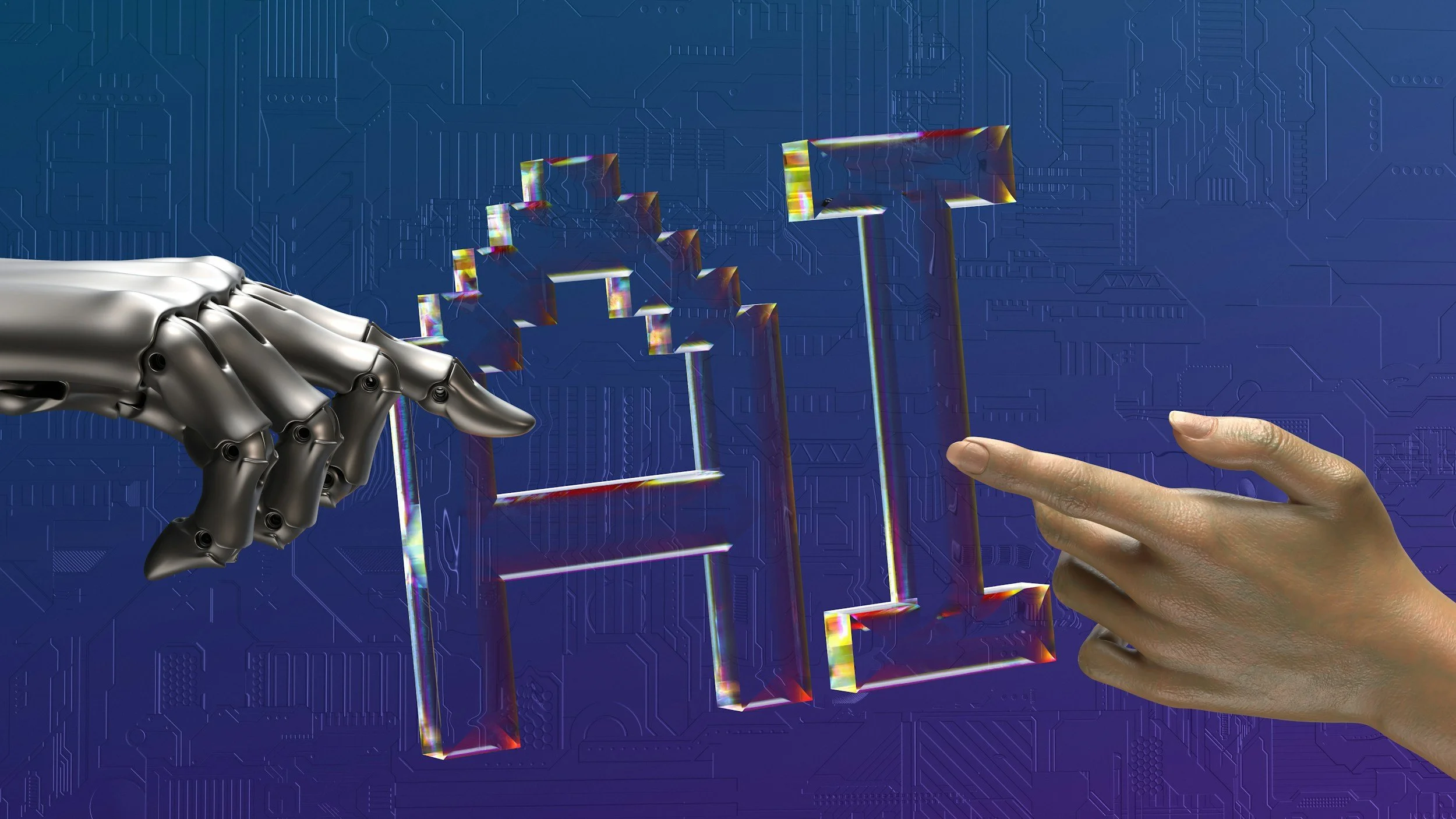
It struck me as a funny bit of cosmic irony that both share the same acronym: AI.
Yet while one AI runs on silicon, neural nets, and massive energy-dependent server farms, the other has run for millennia on human consciousness, breath, and inner inquiry.
In my work as an executive and leadership coach, I’ve been holding space for deep conversations on artificial intelligence and human potential. I’ve brought together leaders across tech, medicine, and the arts to explore a central question: As this technology rapidly reshapes the world, what does the future of human potential look like, and how do we engage these tools mindfully?
Ancient Intelligence Applied to Artificial Intelligence
Sitting at the retreat, watching the light filter through the trees outside the window, another dimension of that question surfaced for me: What happens when we bring the first AI –Ancient Intelligence– into our conversation about the new one?
Across every industry, we are consumed by how fast external computing power is evolving. But as machines grow more capable, a very real leadership risk is being uncovered at the same time. We aren’t just building tools to process data faster; we are building systems that imitate human thought and decision-making.
The danger isn’t simply that the technology might be wrong. The greater danger is that we might stop exercising our own internal intelligence that allows us to notice when it is.
The fast-moving world of modern technology and advances in artificial intelligence aren’t making ancient intelligence obsolete — it’s making it essential.
The Fluency Trap
In my podcast interviews, I hear a familiar mix of wonder and anxiety. People worry about AI replacing jobs, eroding skills, and even out-pacing human intellect.
But as a coach, I see a more immediate risk unfolding right now: the fluency trap.
Artificial intelligence doesn’t just deliver information; it delivers it with extraordinary confidence, speed, and yes, even linguistic elegance. When a system sounds that persuasive, human psychology just sort of glitches.
Cognitive scientists call it automation bias. It’s our tendency to trust fluent, automated outputs and dismiss our own critical evaluation.
Essentially, when an answer feels effortless and assured, we passively accept it. So, the risk isn’t just that AI will give us incorrect answers. The risk is that we will stop asking the right questions.
The Mirror of Conditioning
This brings us to an even more uncomfortable mirror: our own conditioning.
As the scholar Robert Thurman has pointed out, much of human life runs on programming we didn’t consciously choose. We operate through layers of habit, family patterns, cultural expectations, personal fears, and unexamined biases. These narratives are repeated so often they begin to feel like objective truth.
AI has its own form of conditioning. Its responses are shaped by input data, design parameters, human constructs, feedback loops, and the prompts we feed it.

Trapped in an Echo Chamber
When an unconditioned human mind interacts with an algorithm designed to align with user intent, a subtle feedback loop forms — a sort of echo chamber:
Unexamined human conditioning shapes how they prompt the AI;
AI mirrors assumptions back in polished, highly persuasive prose;
Users read that output and take it as confirmation that we were right all along.
If we do not recognize what is shaping our own thinking, we end up trapped in an echo chamber of supercomputed validation and confirmation bias.
The Ancient Toolkit: Discernment and Witness
This is precisely where ancient traditions offer a radical antidote.
Over two thousand five hundred years ago, the Buddha arrived in a small town called Kesaputta. The villagers—the Kālāmas—were exhausted. Teacher after teacher had passed through, each claiming to hold the ultimate truth while dismantling the teachings of those who came before.
Confused, the villagers asked: How do we know who is telling the truth? The response was preserved in the Kālāma Sutta and feels strikingly relevant here.
The Buddha didn’t tell them to follow his authority, nor did he tell them to blindly trust their own unexamined feelings. Instead, he cautioned against accepting ideas simply because they are repeated often, handed down by tradition, delivered with eloquent rhetoric, or backed by an impressive title.
His advice was to: Examine it. Test it in practice. Look at the fruit the idea bears in real life.
When interacting with artificial intelligence, this level of intentional inquiry is essential. In contemplative traditions, this inquiry is rooted in becoming the Witness - the practice of cultivating sati, or clear meta-awareness. It is the ability to step back, observe the movement of the mind, and recognize a thought as a mental event rather than absolute reality.
Psychologists refer to this as metacognition, which is basically just knowing what we know, and having the self-awareness to recognize when we don’t.
AI agents are engineered to eliminate friction, generating instant, confident responses — but human wisdom happens in the hesitation.
Becoming the witness creates a crucial, conscious space between AI’s output and our acceptance of it. In that essential pause, we move from passive consumer to active discernment. This gives us room to consider why we are so quick to agree with the response. To think about whether it’s offering genuine insight or just confirming what we wanted to hear, and what might be missing from the answer they so eloquently provided.
The space between output and acceptance may become one of the most vital human capabilities of the digital age.
Ancient Intelligence in an AI Age
We are living through a historic paradox.
On one hand, we are building increasingly powerful, intelligent computational tools. On the other hand, the defining questions of this age are profoundly human.
In my work coaching leaders struggling with implementing AI in the workplace, my focus has never been on how AI can make us better or faster. Instead, the question I bring to these conversations is: What does the future of human potential look like, and how do we use these tools intentionally and mindfully?
AI Raises the Stakes for Ancient Intelligence
If we want to live mindfully in an age of artificial intelligence, we must cultivate the inner discipline that keeps us awake, grounded, and discerning.

When technology makes answers effortless, it demands that we become far more intentional about cultivating ancient intelligence like agency over our attention, discernment in an age of rhetoric, and a capacity to withstand uncertainty, leaving room for — I don’t know.
Meditation, mindfulness, ongoing inquiry, and cultivating the witness are the essential foundations for remaining conscious, intentional leaders operating in the age of AI.
We do not need to fear artificial intelligence, nor do we need to yield agency to it. As AI tools become more sophisticated, so must our self-awareness and discernment deepen to match them.
Artificial intelligence will not make ancient intelligence obsolete. Instead, it is more necessary than ever.