
I Want My Patient Back: One Doctor's Hope for AI in Medicine
When was the last time your doctor looked you in the eye?
I ask because I've spent much of this year on the patient side of that question, and I know the feeling of talking to someone who is typing. Barely listening. Hardly engaged. Appointments are hard to get to begin with. Once you're in the room, your time together is short, and the person across from you is often looking at a screen, hunting for records that should already be there.
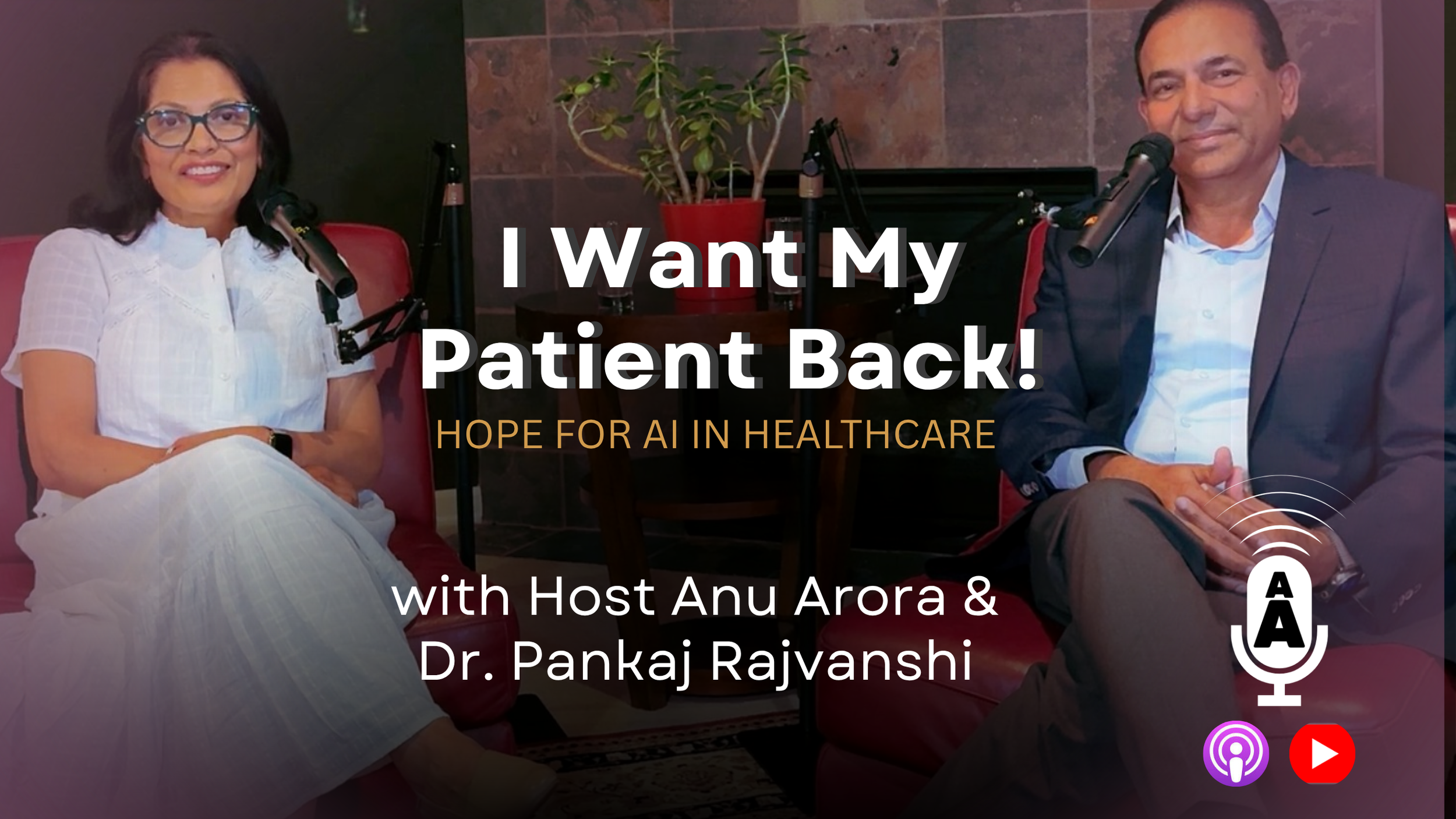
I recently sat down with a friend of fifteen years, Dr. Pankaj Rajvanshi, a gastroenterologist and liver specialist who also works in obesity management. What surprised me was his reason for being excited about AI in medicine. It's not efficiency or insights. He wants his patient back, and he thinks AI can help with that.
He hopes AI will absorb the data gathering, the synthesis, and the insurance paperwork. In his words, the intelligence layer goes to the machine, and the judgment and connection layer comes back to the doctor. That's where wisdom and compassion, the two wings of mindfulness, come in.
We also talked about the risks: over-reliance on AI, patients skipping the visit, and whether these tools will widen the gap in who gets care. He's hopeful, but not naive.
Key Takeaways
The biggest care gap in healthcare is the time between visits, when no one is looking after the patient.
AI can take on documentation, chart review, and back-office work, so the doctor's attention can return to the patient.
Machines can answer "What can I do?" Only a human who knows you can answer "What should I do?"
Over-reliance is a risk on both sides of the exam table: doctors may lose their judgment, and patients may skip the visit.
Doctors who embrace AI will likely be ahead of those who don't, but Pankaj doesn't expect it to replace them.
Whether AI deepens or narrows health inequity is still an open question.
Quotes from this Conversation
"So the intelligence layer has been done by the machine, and the judgment and connection layer I want it back to me."
— Dr. Pankaj Rajvanshi"What AI cannot replace is the judgment of which direction to take."
— Dr. Pankaj Rajvanshi"The bigger question for me… is what should I? And who's going to tell me that? That's wisdom or intuition or my connection with you."
— Dr. Pankaj Rajvanshi"It's a tool that aids us to take care of patients. And if you don't embrace the latest tool, you will be behind."
— Dr. Pankaj Rajvanshi"Healing doesn't happen just because you got the right diagnosis. Healing happens when you connect at a human level."
— Anu Aror
Questions this Episode Answers
Why is a gastroenterologist excited about AI in healthcare?
What does a doctor actually do in a 15-minute appointment?
Will AI replace doctors?
What can AI not replace in medicine?
What are the risks of AI in healthcare?
How does this connect to mindful leadership?
If this conversation resonates, I invite you to watch or listen to the full episode above, and to read the companion essay on Substack.
Resources
About our guest: Dr. Pankaj Rajvanshi, MD, FAASLD, Dipl. ABOM, is a physician and healthcare entrepreneur working at the intersection of clinical medicine, metabolic health, and artificial intelligence. Board certified in Gastroenterology, Liver Disease, and Obesity Medicine, he brings more than two decades of clinical experience to his work, with a growing focus on the thoughtful use of AI to reduce administrative burden, personalize care, expand access, and ultimately create more time for the human connection at the heart of medicine.
About Anu Arora: Anu Arora is an executive and team coach, speaker, and host of the Mindful Momentum Leadership Podcast. She works at the intersection of mindfulness, neuroscience, and leadership — helping mid-level managers and senior leaders navigate complexity, burnout, and the gap between performance and presence. Subscribe to her newsletter at mindfulleaders.info.
-
Anu Arora 0:03
Welcome to the Mindful Leadership Podcast. Today on our show we have Dr. Pankaj Rajvanshi. Pankaj is a dear friend of mine. He is a gastroenterologist. He is a liver specialist, and he is also working in the field of obesity management, but more than anything else, what I admire about Pankaj is his intense curiosity, his passion for innovation, and his desire to help people in need. He's one of the people, and of course, when do you go to a doctor when you are in crisis? He's one of the doctors who I could pick up my phone, call, and he's always there. Welcome, Pankaj. It is such a pleasure to have you today.
Pankaj Rajvanshi 0:55
Thank you, Anu. Thanks for this invitation. It is always important to talk about issues that are coming towards us in new environments. For example, in healthcare, the way AI is advancing, or it's advancing in other fields. So, thanks for the invitation.
Anu Arora 1:12
Yeah, it's our pleasure, and it's my pleasure to have you here. One of the things I remembered when I was thinking about our conversation today was, and you may not remember this. This was about 15 years ago. You and I met in the local library, and you had this brilliant, innovative idea. And I was that time immersed in technology. I was working for a high-tech company, and this was at the intersection of medicine and technology.
Pankaj Rajvanshi 1:46
I think I recall that time because it coincides with something that we started at that time.
Anu Arora 1:52
Yeah,
Pankaj Rajvanshi 1:53
I think all my life I have been driven by this fact that as physicians or healthcare providers, we touch lives one at a time, and I've been internally driven by this fact that how can I multiply that up?
Anu Arora 2:11
Yeah, yeah. And
Pankaj Rajvanshi 2:12
technology seemed a way that maybe you can impact a larger number of patients with single intervention, and I think that's where we met because at that time we started a company which is actually up and running in India right now, and we wanted to impact diabetes care. I think the idea was way before its time. That's what I was thinking. This day and age would have been incredible. Yeah, because if you remember, we I have my background in training and growing up in India, and the way we cared for diabetes there was patients would line up and based on one blood glucose reading, will prescribe something and then move on.
Anu Arora 2:55
Yeah,
Pankaj Rajvanshi 2:56
compared to the continuous data from the glucometer that could come in, and we could make a more informed decision, but didn't exist, and that's the solution we actually wanted to start. How do we bring in chronic disease management in resource poor countries, which India was at that time? And so I think that's when we met, and that idea did come to fruition. It is up and running.
Anu Arora 3:21
Yeah, yeah, and that's what is fascinating about you-that you are ahead of your time. You know, even before AI became mainstream, we have been talking about this. You know, we had conversations last year, year before last, and you were saying, "How do I bring AI into medicine? How for the benefit of humanity? Can you talk about that? You know, why are you so excited about this this topic?
Pankaj Rajvanshi 3:47
I think because, as I said before, how do you impact patient lives? How do you impact human lives? If you look at our healthcare system, we talk about internally. We talk about care gaps. If you look at technology solutions, or even you know other industry solutions, we're looking for where are the gaps in executing something in healthcare. We talk about care gaps. Where in a patient journey do we have gaps that we can address? Right. The way our healthcare system is set up, we provide point of care solutions. You come see me, I bill for that, and that's it. You come back in three months, six months, or not. In between that time, there's no care for you from me in a proactive manner, so I would say the biggest care gap in our healthcare system right now is the gap between patients being seen in person or with televisits by a physician. How do you care for that patient in that time? Can only be enabled by either a lot of people working, or there is a mechanism to get reimbursed for that time that someone can call you and take care of you, or some innovative solutions with technology. Because in the end, that's what will help you more.
Anu Arora 5:18
Yeah, and doctors are expensive. I mean, if you want to add more doctor hours, the healthcare becomes even more expensive. More
Pankaj Rajvanshi 5:25
expensive, and then there's a shortage too.
Anu Arora 5:27
Yeah.
Pankaj Rajvanshi 5:28
So that's where I think we are heading in a direction where there might be a unique combination that may emerge that will help the physicians. Yeah. And help the patients.
Anu Arora 5:38
Yeah. Yeah. And I
Pankaj Rajvanshi 5:39
hope that the cost is not the forbidding
Anu Arora 5:42
time. Yeah, yeah, that that makes sense. But you have had you know two decades over two decades of you know as a practicing physician. What have you learned about your patients? What what heals them, you know. I we know it's not just diagnosis of the right condition. What have you learned?
Pankaj Rajvanshi 6:09
I think as you mature in your healthcare provider journey, when you are coming out of practice, you are like gung ho. Oh, diagnose, treat. Let's fix this. Let's fix that. But as you grow into practices and you see that that is, it's a little bit beyond
Anu Arora 6:29
that.
Pankaj Rajvanshi 6:30
You know, making diagnoses, prescribing medications, all that is there, which is basic. But your connection with that patient, your understanding of their concerns,
Pankaj Rajvanshi 6:42
the
Pankaj Rajvanshi 6:43
unsaid fears. How do you connect with that? You know, for example, see if I order a CT scan. The first question I am asking is that, what did the CT scan show? Whereas you are sitting across me, you have more questions than that,
Anu Arora 7:01
yeah, and they're
Pankaj Rajvanshi 7:02
not necessarily what the CTS can show.
Anu Arora 7:04
Yeah,
Pankaj Rajvanshi 7:05
what's going to happen to me? Well, what will happen to my family? Is there something that the CTS can didn't see? Now, these are all when those results put into context is where my role is. So I think as we, as I have grown in my practice as a physician. That's that's what it has been the biggest learning. That how do you connect one to one with the patient, intuitively perceive their fears, and try to address the comprehensive, you know, approach to their outcomes, and that I think has come with experience, and and some people just have it intuitively.
Anu Arora 7:46
So it's the connection to the patient. It's what they really want to hear. So how does then AI fit in? You said it fills the care gap, and you are very gung ho about how to bring AI into the filling those, you know,
Pankaj Rajvanshi 8:05
when you saw your physician last time,
Anu Arora 8:08
yeah,
Pankaj Rajvanshi 8:08
how many times do you think that person looked into your eyes?
Anu Arora 8:12
So don't get me started on that. I have had the last nine months of harrowing experience and have gone through a lot of health challenges this year, and I can write a whole book about that. So yeah, it's been difficult to get in front of the doctors. It's difficult to get appointments. Even when you get appointments, the time they spend with you is very limited, and it leaves a lot to be desired for a patient who is just going through a lot of health challenges?
Pankaj Rajvanshi 8:43
Exactly. So I think those are all the things that you just mentioned should be solved by you. And I'll try to break it down for you. So when I see a patient, what do I do? I spend a lot of time in acquiring data or acquiring information. I'm trying to review your chart before you come in, or when you are in the room. That's why I'm looking at the computer, not you. I will see who did what test, where, did I even get those records in? Then I'll talk to you, ask you questions, and then synthesize that into the current. Then I'll say, what insurance do you have? Whether this medication will be covered or not? And if it's covered, then do we have to get pre-authorized? Insurance is going to deny this. My 15 minutes are coming up. I'm not going to get paid for this visit at this level if I continue talking. So there are a lot of this operational and documentation and pre-authorization back office stuff that's on my mind. So what I want AI to do is to take all that.
Anu Arora 9:56
So all these things are then removed.
Pankaj Rajvanshi 10:00
Removed, so I can have my patient back. So I can have one-to-one conversation with you, because the all this thing that I am doing there has been taken care of. So when you walk into the room, my screen should tell me a blurb on last 15 years of your history, synthesized into one paragraph, has given me five bullet points. That hey, you need to talk to Anu about this, this, this, this. It should have a predictive tool that tells me that the trajectory she is going, she will likely get a heart attack at age 62, you know she had this family history that's relevant. Oh, we just had a new tool that reread her CT scan from three years ago, and now with the AI tools, we can see an early start of maybe a pancreatic lesion. Then maybe we'll catch your pancreatic cancer early. So all this should have been done for me.
Anu Arora 11:04
Yeah, yeah.
Pankaj Rajvanshi 11:05
And if that's already done for me, I can then sit down and say, "Hey, let's talk about what's going on. Right? And even they have shown in studies that in inpatient setting that when doctors walk into a patient's room. If they talk to the patient standing up versus sitting down, patient satisfaction changes.
Anu Arora 11:27
Yeah, because
Pankaj Rajvanshi 11:28
so people who sit down
Anu Arora 11:31
in the chair
Pankaj Rajvanshi 11:33
actually spend less time, but were perceived to be way more connected to the patient. Right. So similarly, I now have time to review all what your issue is and discuss with you on what to do about it. So the intelligence layer has been done by the machine, and the judgment and connection layer I want it back to me.
Anu Arora 11:58
Yeah, yeah,
Pankaj Rajvanshi 12:00
and that's that's what my that's why I'm gung ho about
Anu Arora 12:04
AI. I love what you said. I want my patient back because you know what, patients are ready to get the doctor back. Yeah. So so I think it's coming. I think that that's why
Pankaj Rajvanshi 12:17
I'm gung ho. That's why I'm very optimistic.
Anu Arora 12:19
Both sides are ready. Yes. Right. That's all. So, how do you plan
Pankaj Rajvanshi 12:24
to do it? How do I plan to do it? I think we'll have to rely on our leaders, healthcare leaders, to make smart choices about bringing these solutions to us. So, majority of physicians in our country are employed, so they don't directly make decisions about implementation of new technologies or solutions into our practices. If it was only my practice, I can choose. But if I work for somebody, we have a system that can that will choose. Now, they have their own struggles because the healthcare leaders are struggling between the fight of efficiency and throughput with your mindfulness concerns. Are we increasing efficiency, replacing humans, or are we keeping clinician time and patient connection in mind, so that those two forces will have to
Pankaj Rajvanshi 13:28
combine, connect,
Pankaj Rajvanshi 13:30
and solutions come to us. And I think I'm hoping that that's the direction we'll go
Anu Arora 13:36
because it's a yes and. It's not either or.
Pankaj Rajvanshi 13:39
Yes,
Anu Arora 13:41
right.
Pankaj Rajvanshi 13:41
Yes.
Anu Arora 13:42
So, what's something which is irreplaceable? Right. I mean, AI can do this, AI can do that, but then there are so many things which AI probably can't replace. At least that's how I think about it. But I want to know from you what can AI not replace?
Pankaj Rajvanshi 14:03
I think AI can replace a lot of things. AI can definitely think better than
Pankaj Rajvanshi 14:13
you.
Pankaj Rajvanshi 14:13
AI can definitely acquire data better than you. AI can definitely synthesize data better. It can remember everything, which I will likely forget. I mean, I trained in India where we had to do rote learning in on our rounds. The one attendant used to carry books in a cart, and our chief used to ask us to quote our response from the page number in Harrison's internal medicine textbook, and we could.
Anu Arora 14:52
Yeah.
Pankaj Rajvanshi 14:52
So we were at that time when we were memorizing, we were that machine.
Anu Arora 14:56
Yeah. Yeah.
Pankaj Rajvanshi 14:57
But the judgment we. Didn't allow judgment came much later, so I'll give you a very flip example right now. Like in our hospital, where we have residents or trainee doctors, when they write their differential diagnosis, meaning this symptom complex could mean this, this, this, we see so many more because they're now going directly to AI and pulling up a long list of possibilities that patient could have that could lead to more testing. That could lead to more, you know, maybe even potential harm. So, what AI cannot replace is the judgment of which direction to take.
Anu Arora 15:37
Yeah, yeah.
Pankaj Rajvanshi 15:39
But but to be honest, I mean, all those things-the way doctors think and reach a conclusion-are coming through AI, and I think in the end it will be judgment and connection, because I will be able to put that with you in context, rather than being in a room with you and have this feeling that I know something that you don't.
Anu Arora 16:04
Yeah.
Pankaj Rajvanshi 16:04
Versus I know that you know everything too. Let's put this in your perspective, in your own context, because I know you as a human being, and I think that part is not.
Anu Arora 16:17
Yeah.
Pankaj Rajvanshi 16:17
I'll become your partner rather than a provider.
Anu Arora 16:20
Yeah. And I like that because humans now are also the patients who are coming to you are coming so much more informed. They have the same tools available. They have the access to a lot of information, whether they understand it or not, and they even ask AI to give it to them in a form which is digestible to them. How has that changed your interaction with them when the patient comes to you and say, "I know this is what I used to talk like that, and I'd go to in my l4 and l5. Here's what's going on, and I'll explain it, and the doctor's like, "Okay, you are talking all the jargon, and where did I get it from?
Pankaj Rajvanshi 17:04
Google, Doctor Google, at that time. So that's a big. So you know we are part of tons of online social media physician communities, and these questions come up. And I think there are two two schools of doctors in this. Some who think that that affects care. You know, we even talk about this VIP syndrome where people who are too well informed or too well connected get a different care because there's a bias gets introduced. Versus people like me who who want patients to do. Actually, Mark Cuban just recently had a tweet saying, "Hey, we should teach our patients in the waiting area to learn how to look up things because it will make their visit better, our life better. And I kind of agree with that. That if you came in informed, so remember I just talked about I spend a lot of time in acquiring data and synthesizing it. The next step, the barrier is that then I have to translate that into something to discuss with you.
Anu Arora 18:13
Yeah.
Pankaj Rajvanshi 18:13
But if that step is also you have taken a little bit of charge of that you came in with your questions, some research questions. Then now, rather than being a provider who knows it and is going to tell you, I will become your interpreter, advisor, partner to look at the data and have true shared decision making,
Anu Arora 18:43
but this is what you believe in. You said there is a another class of doctor who have the VIP syndrome. So for them, what is the risk going to them and getting all this information from AI going to them? Are they going to be now not wanting to treat you. This is for my own. Yeah, I think
Pankaj Rajvanshi 19:08
I don't know how to answer that in a correct manner, but I think a lot of egos will be thrashed because I'm telling you now that AI is superior than us in intelligence, it remembers more than I do.
Anu Arora 19:26
Yeah. Okay.
Pankaj Rajvanshi 19:27
So this over time will become, you know, so ubiquitous that we'll have to adapt. And similar things will happen with the newer generation coming in, they're getting trained about it from early on. So I think it will balance out at a level that we'll start having a different kind of conversation.
Anu Arora 19:54
Good answer.
Pankaj Rajvanshi 19:56
Yeah, it would. It will happen. It'll be whether you, you know, accept it or not. You have to embrace.
Anu Arora 20:06
Yes.
Pankaj Rajvanshi 20:06
What's coming? It
Anu Arora 20:08
is, but at the same time, are they afraid? Because one of the questions I have been asking, I've interviewed a few people on AI, and you know, few in tech and other fields. I've been asking: Are are people afraid of their jobs? And and in the tech workforce, it's very clear that jobs actually are being lost. They are afraid for their jobs. How about in the medical field? Are the doctors and the allied fields afraid that this will kind of replace them?
Pankaj Rajvanshi 20:40
No,
Anu Arora 20:44
no,
Pankaj Rajvanshi 20:44
because I don't feel that AI will replace doctors, and it is actually a segue into what you just said about the doctors who don't like this.
Anu Arora 20:58
Yeah.
Pankaj Rajvanshi 20:58
So you'll have two kind of doctors.
Anu Arora 20:59
Yeah.
Pankaj Rajvanshi 21:00
So doctors who embrace
Pankaj Rajvanshi 21:02
it,
Pankaj Rajvanshi 21:03
they will definitely be ahead of doctors who do not embrace it. So you know, for example, Vinod Khosla made this provocative statement a long time ago, saying that by this time, radiologists will be obsolete because images can be interpreted better by AI, and I think that has not happened and will not happen. But what might happen is that the radiologists not using AI might be obsolete. So similarly for all specialties, or this will be a next big tool. This will be the next stethoscope, or a blood pressure machine, right? A CT scan. It's a tool that aids us to take care of patients. And if you don't embrace the latest tool, you will be behind. So I don't think it'll replace us. It'll make us, I think, better.
Anu Arora 22:07
Yeah.
Pankaj Rajvanshi 22:09
So I think we are all in for a better health for most people.
Anu Arora 22:17
Yeah, and one of our challenges in our healthcare system, apart from the fact that you don't get to see the doctor, or you when you get to see the doctor, you just they're busy, you know, taking notes and finding your history, which you know they should have had it, and then you know not having enough follow-ups, and there is no con continuation. Another challenge is the we don't have the democratization of the medical system. It's just so expensive. You know, we were looking at our own bills, and we have insurance, and on top of that, we had you know HSA, which we had been putting money for 20 years, and that we were able to wipe it in just a year, so it's that expensive. So I wonder how is this, you know, AI going to help with democratization? Is it something that's going to happen or not happen? What what do you
Pankaj Rajvanshi 23:20
think I'll answer your first question partway, and then we'll jump into it. I I really enjoyed the latest essay that Bill Gates wrote on the AI and its kind of threat. I mean, this the first time some leading voices actually have come out and put a word of caution, right? So he used a couple of terms, and then one that stuck with me was he said "human reserved. That in all fields we'll have to earmark certain jobs as human reserved, Where deliberately we are going to say, "Hey, this will stay with the humans, and I think that should happen now. And physicians start, providers should start taking charge of protecting that domain, because otherwise, different forces will drive physicians out. You know, for example, if you are governed by an insurance company, if there was an AI first clinic, who stands to benefit from it right now financially? Someone who pays for your package,
Anu Arora 24:37
insurance company, insurance, right? So they
Pankaj Rajvanshi 24:39
might want to send you to an AI first or AI agentic platform to sort things out?
Anu Arora 24:46
Yeah, which might they might already be doing, right? Yeah.
Pankaj Rajvanshi 24:49
So, so we need to first earmark those human reserve things because before the physician replacement talk when becomes large. There'll be a much bigger loss in our workforce, like medical assistants, care coordinators, people in the back office, receptionists. You know there are AI receptionists who do a very good job of making appointments. Yeah. Right. So we have to carefully select that what you automate and what you don't, because that human element is gonna go away. So, so that was about the job part that you were asking. The second thing, talking about this inequality, and that is the high biggest risk.
Anu Arora 25:35
Is
Pankaj Rajvanshi 25:36
AI going to become a tool for providing better care to wealthier people, or is it going to democratize?
Anu Arora 25:46
Yeah, yeah.
Pankaj Rajvanshi 25:48
So people, so we use a word called access frequently. In that, do you even have an option to go see a provider? Can you even get into healthcare system because of your social or educational or you know other denominator backgrounds, and is AI going to make that gap even wider and create more health equality issues? Is not clear, and it might, and that's why, you know, unless we are mindful from get go that we don't leave people behind in that respect, it could create a even a bigger
Anu Arora 26:35
inequality, right? But
Pankaj Rajvanshi 26:37
but I feel that so that's where I think going forward, and people start talking about it, there'll be more and more emphasis that you know, the even model training for machines have biases. Have they even data on ethnic minorities or people who have not seen a physician for 10 years, can they even make a judgment or decision on those, you know, patients? So the models may be skewed. The access to that model using internet in a remote area might be skewed. So this, these are all Big risks,
Anu Arora 27:22
very valid challenges and risks.
Pankaj Rajvanshi 27:25
Totally.
Anu Arora 27:25
And who is looking at
Pankaj Rajvanshi 27:27
it? No one.
Anu Arora 27:30
No one, isn't it? We
Pankaj Rajvanshi 27:31
haven't looked at providing care to underserved until now.
Anu Arora 27:36
Why should we? Why
Pankaj Rajvanshi 27:38
do you think it'll happen going forward? But I. I think the ray of hope there might be, and there are some companies working in this space, that there might be able to do innovative things where they may be able to serve those populations for a fraction of the cost of money, and that might increase the access.
Anu Arora 28:05
Yeah, because that's one problem we need to solve for humanity. Exactly.
Pankaj Rajvanshi 28:11
Yeah, I mean, if you, I've been extremely influenced by that book by C. K. Pralhad, Fortune at the Bottom of the Pyramid. That's where the forces of monetization and solutions at very low cost come in because of volume, and I'm hoping that our systems will be able to support that
Anu Arora 28:37
scale and
Pankaj Rajvanshi 28:38
scale and come come to a level that that it might be you know possible to provide those solutions, but that's a real risk. Though I worry.
Anu Arora 28:51
Yeah, that's a risk I worry too. Yeah. What are some other risks with this? So if you were let's let's look at this in a little bit different way. So let's say that you and I sit together again here 10 years from now. What would have failed this? That's one part of question where you say, okay, here's how this whole thing failed and crashed, the doom scene. Yeah, let's let's paint that, and then we'll say that the other scene where because we took care of this, this is why we are in this 2036 and pure medical nirvana through AI.
Pankaj Rajvanshi 29:31
Yes, I think there are risks on both ends, the patient and the physician.
Anu Arora 29:36
Yeah,
Pankaj Rajvanshi 29:38
I think our bigger biggest Risk is, I think, over reliance on it. And for example, the most. I'll ask you first. What do you think are two most common AI tools used by physicians? Any guesses?
Anu Arora 29:59
I don't know. Maybe Claude and ChatGPT.
Pankaj Rajvanshi 30:02
So for their personal use, right? Is those
Anu Arora 30:05
two? Was I right?
Pankaj Rajvanshi 30:06
Or
Anu Arora 30:07
Gemini? No.
Pankaj Rajvanshi 30:09
So lot of people, as normal people, we might use it for our, you know, personal uses. But two biggest AI use cases. One is ambient AI for listening and creating our documentation.
Anu Arora 30:26
Okay.
Pankaj Rajvanshi 30:26
So I get paid at a certain level if I can document A, B, C, and D when I saw you.
Anu Arora 30:35
Yeah. Yeah.
Pankaj Rajvanshi 30:35
And the insurance company will pay me at that level if I did document A, B, and C and D. If I skip D, I will be reimbursed at a lower
Anu Arora 30:45
rate.
Pankaj Rajvanshi 30:46
So this tool then is one taking away my typing, so I get talking and it's transcribing. Two, it's also looking at your revenue cycle, so it's making profit for you. So that's one heavily used
Pankaj Rajvanshi 30:59
tool. So
Pankaj Rajvanshi 31:00
ambient, like now in many practices, you'll go in. Doctors will not be looking at the computer; it's already there.
Anu Arora 31:05
They ask though; they say they
Pankaj Rajvanshi 31:07
start talking, and that so it'll start transcribing in the lab. The other tool that we use quite a bit is clinical intelligence. So there are a couple of tools that models where I can input any medical issue or any clinical questions I have because I don't remember, it will give me very precise information. Now, what's going to happen is that if I start just relying on that, I will start losing cognitive discrimination, and if I'm in training and coming out, and from day one I'm just relying on that,
Anu Arora 31:47
never learn.
Pankaj Rajvanshi 31:48
Never, never learn the judgment aspect or intuition aspect. I do believe that you know there are also studies that are taking that judgment and actually, in the end, solving patient problems better than physicians even now, so that might come. But in that process, if that happens, I am becoming obsolete because of lack of judgment, because lack of that discriminatory power that I could apply to the as a top layer.
Anu Arora 32:20
Because that was your magic, right? That will what will stay the magic, right? Everything else will be replaced, but that judgment, judgment and discretion and wisdom, wisdom
Anu Arora 32:31
will is what will stay.
Pankaj Rajvanshi 32:34
So, so that's one risk. The second risk is, I don't think there's any AI system that tells patients everything 100% correct. It's just like autonomous cars or everything has a fail rate, right? So we will also not want patients to over rely on what they read. They should also use it as their assistant, and then two of us sit down and go through it. So it should not replace your doctor visit.
Anu Arora 33:08
It
Pankaj Rajvanshi 33:09
should make you a smarter patient to come to, because in that, if you replace it with a doctor visit, you might get potential harm, delay in care, or wrong advice, or you know having a complication. So I think that will be the big risk at patient.
Anu Arora 33:33
Both sides.
Pankaj Rajvanshi 33:34
So both sides. I think that's where I think I feel that it's actually going to bring us in a space where we both will be able to meet and dissect things out, and we'll have a relationship.
Anu Arora 33:49
So it's going to get better. That is going to get better. That is the other side. If things go well, the patient and the doctor are connected. Connected in different, it's a human connection, which is what the differential you were talking about, yeah, right. How it's going to
Pankaj Rajvanshi 34:05
evolve, yeah.
Anu Arora 34:06
You know, you found out that healing doesn't happen just because you got the right diagnosis. Healing happens when you connect at a human level and say, "What's your worry? What's your problem? What's what's bothering you? How does it impact your family, and people are able to discuss that with the doctor. And goes back to our Veda. I'm, I'm just. I mean, that's
Pankaj Rajvanshi 34:28
that's why we all went to medical school. It actually gives me goosebumps to think of this fact that you'll be able to have that kind of care we can provide again.
Anu Arora 34:38
Yeah, it reminds me of our ancient Indian way of you know where the Vaidya would come to your house, or I mean it won't go that far, but you could go to Vadhya's house multiple times, or see them and see them at a human level.
Pankaj Rajvanshi 34:54
Yes, so I think the future might be that. That's the best possible scenario, but it can change in multiple different ways.
Anu Arora 35:05
Yeah, yeah, yeah. It's been so interesting so far. What else is on your mind with AI? I know you have been thinking a lot of you know how would you kind of expand it. I'd love to know where you personally want to take it in in your field, of course.
Pankaj Rajvanshi 35:25
No, I I would. So I've come a full circle on this thought that we have a lot of technology available, and how do we start applying it to patients and and in all industries, that's the biggest focus right now. That where does it fit into my workflow? And everyone has a different workflow. And so, and how do I bring in what kind of technology to automate what kind of patient experience, and have achieve all these outcomes that you know we are more efficient. Patients get better care. We have better connection. We are able to enable tools in between your visits, etc. So that that would be Travis to do something in this field. It will be actually in applying these tools to a real clinical
Anu Arora 36:22
practice, and if there's anyone in the world who can punkah it's you, that I know. Thank you very much, but yeah,
Pankaj Rajvanshi 36:29
these are you know you keep evolving, you becoming a different version of yourself, and if you look at life and history of humanity-it's always evolving. Things change. If you don't keep your mind open and flow with it, you'll be stuck and be left behind.
Anu Arora 36:49
Yeah, yeah. We are evolving, and I also want to connect it with mindful leadership. You know, this is mindful leadership podcast, and the two wings of mindfulness are the wisdom and compassion, and wisdom is which you have talked about-the discretion, the judgment. How do I bring that when data is there? And that's what mindfulness is. How do I mindfully connect to what's available? And then the second thing is the compassion, which I never lose humanity, and you've talked about that too. So in a way, I'm seeing this full connection to it. But I would wonder how would you connect it with mindfulness?
Speaker 1 37:36
Yeah, I think it's going to bring more compassion, in my opinion, there is an interesting study where you know how you send message to your doctor through my chart and portals, and it could a bot could respond to you. And in that study, the bots were found to be more empathetic, and then we, you know, so busy providers are so busy, they don't have time to write or even respond to you in an empathetic manner. But it doesn't mean that they don't care. Care,
Anu Arora 38:19
yeah,
Speaker 1 38:19
right. And I think once we get that time back,
Anu Arora 38:23
yeah,
Speaker 1 38:24
I think that will bring opportunity for compassion again. Right, that's what I meant by saying I want my patient now.
Anu Arora 38:33
Yeah, yeah, yeah.
Speaker 1 38:35
Right. So I think it is heading in that direction.
Anu Arora 38:39
Yeah, a lot of people who are watching this will be very excited about this. So, is there anything else you want to tell them? Or no, I think if
Speaker 1 38:49
providers are listening to it, or other anyone who's listening to healthcare leaders who choose these applications or decide which platform to bring in, help us. You know, there are two questions we ask when we see a patient: What can I do? And that the machine can tell that intelligence data. The bigger question for me, as a you know mindful person, which gives me immense satisfaction, is what should I? And who's going to tell me that? That's wisdom or intuition or my connection with you, because I'm able to take what can I do, put it into your context on your relationship with me, and said, you know, this is what we should. And so, making sure that all these solutions that come down, keep that piece in mind. And the second request or. Vision will be that hopefully we don't replace too many humans in the healthcare field by these two, because then we'll at some point start losing connection if it goes beyond a certain.
Anu Arora 40:16
Because humanity cannot be replaced by AI. Yeah. be a great place to end today. Yes. So thank you so much, Pankaj, for joining us on Mindful Leadership Podcast. Really, really appreciate you and appreciate this conversation.
Episode Details
Guest: Dr. Pankaj Rajvanshi, MD, FAASLD, Dipl. ABOM
Host: Anu Arora, executive and team coach
Series: Mindful Momentum: Leader Podcast
Published: October 14, 2026 · 40 minutes
Watch on YouTube