
There are moments in life when something small gets started… and you don’t realize what it might one day become…
It could be a conversation. A walk. A group chat sent to a few people.
Over time, momentum builds, and something shifts.
Simple Ideas Have a Life of Their Own
Recently, I sat down with someone who has experienced this first-hand. What struck me wasn’t just what he built — but instead, how he built it.
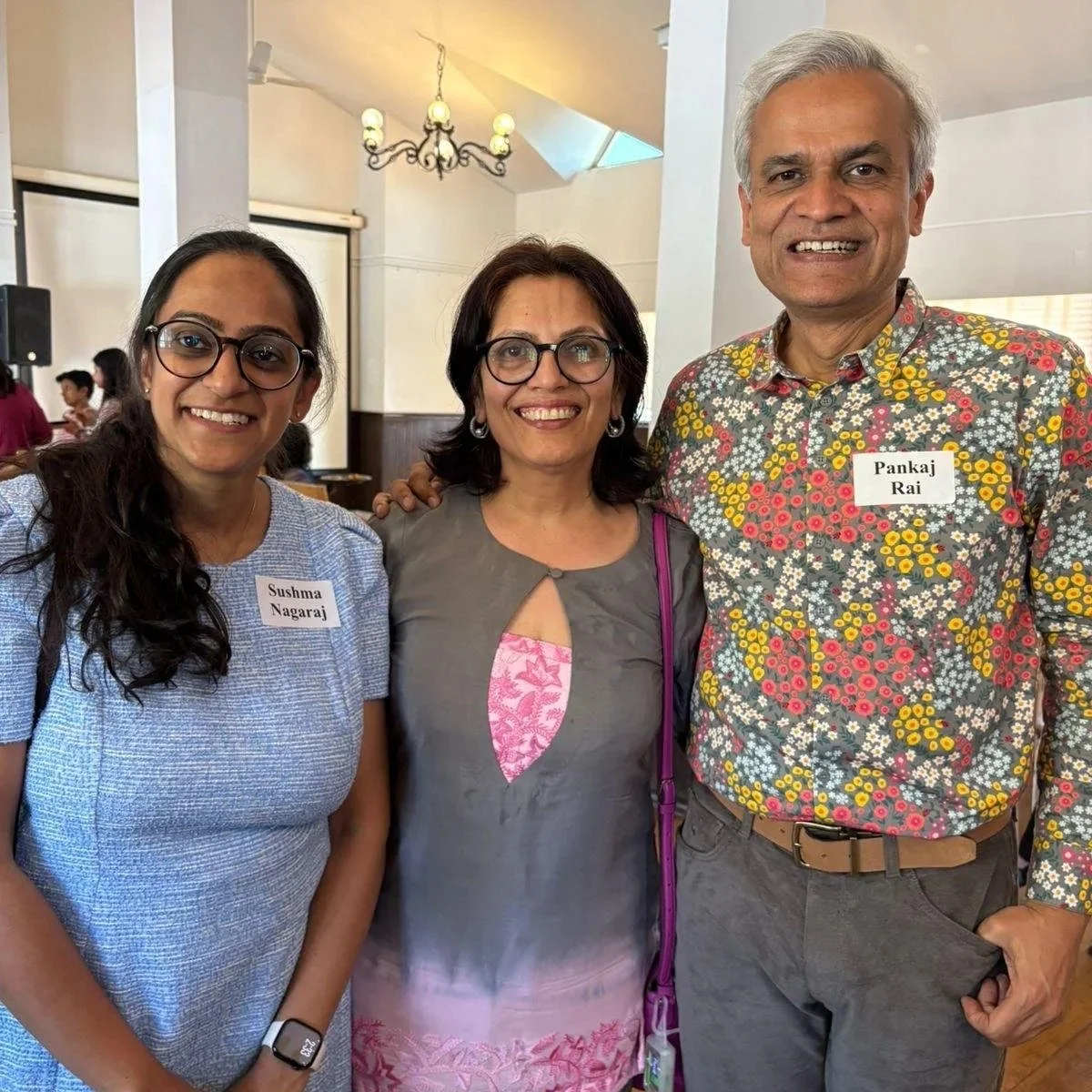
Sushma, Anu and Pankaj at the Women’s Networking Event in Bangalore
It didn’t start with a structured plan or even a vision. It started with curiosity and a simple desire to connect. From there, something organic and beautiful unfolded.
A small group gathered. Those invited others. Circles expanded. What began as a WhatsApp group for women in analytics became a community of over 1,500 people—spanning multiple disciplines, varied interests, and all life stages.
And to think, all of this developed out of trust and curiosity.
So much of what we are taught about leadership is rooted in theories of absolute control. Authoritarian direction. Singular focus.
But when I spoke with Pankaj Rai, I we talked about leadership that creates space for others. That invites participation and doesn’t direct. When we stop trying to control everything, something more beautiful, more collective, more alive, and more universal can begin to emerge.
There are moments when we hold on tight — out of fear, out of habit, out of a belief that if we don’t, things will fall apart. And yet, the opposite is often true.
When we allow space… things don’t fall apart. They have room to expand.
Making Room for Expansion
This idea of expansion came up in another way during our conversation as we spoke about curiosity. Curiosity that allows you to ask questions without needing conclusions. To engage without outcomes.
In a world that values efficiency, productivity, and results, curiosity can feel… inefficient and ineffective. Yet, it is often the very thing that leads us to the most meaningful connections.
Our conversation also led to a reflection on success. What does it mean individually and as a collective? What defines success. Oftentimes, in moments of retrospection, we realize that it is not just our own effort that brought us to where we are but rather it is the people we have connected with along the way. The conversations we’ve had. The doors that we’ve opened and that have opened for us. There is a humility in recognizing that our success is not individually won, and a responsibility to open doors for others, creating space for them to grow and expand.
As Pankaj and I moved into a reflection on technology and AI, we began to consider opportunity. We are living in a time where the tools available to us are unlike anything we’ve ever had access to before.
The potential of engagement with AI is immense. But it also brings to mind access. Who has access to this life-changing technology? How do we ensure that the benefits of what we are building extend beyond the technologically engaged? How do we create inclusive systems?
Trend-Setting Not Trend-Spotting
It’s easy to observe what is happening, to notice what is emerging. But there is something very powerful in choosing to act on it and in being open to the experiment. To attempt. To create. Even when the pathway is not clear.
And perhaps that brings me back to where this reflection began. To the idea that not everything needs to be fully formed before it begins.
Sometimes, all we need is a moment of curiosity, a willingness to connect, and the flexibility of letting something unfold.

We often think leaders have all the answers. But what if leadership is about asking better questions? What if it is about creating spaces where others can step forward? What if it is about trusting that something meaningful can begin to emerge —even when we are not in control.
This kind of leadership creates a lasting impact in the relationships it nurtures, the communities it enables, and the opportunities it opens up for others.
In a world that is moving quickly, that kind of centered leadership matters more than ever. So if you’ve been holding on tightly to a dream, perhaps this is an invitation to loosen your grip just a little. Stay curious. Create space for expansion. See what might emerge.
Key Takeaways
Pankaj's women's network grew without a grand design. It started as a WhatsApp group to help a friend find women for a Women's Day analytics panel, expanded to women in digital, then became a broad women's community during COVID, and now has more than 1,500 members and its own in-person events.
Letting others lead is what allowed the community to grow. Pankaj makes every member of his groups an admin and describes himself as a "zero to one" person who plants the seed and lets others take it further.
Curiosity leads to community. On a morning walk, Pankaj invited a stranger reading Macbeth to join his group, and by the end of the walk he was part of the running group.
Running gave many women in the network something that was entirely their own. Pankaj notes that women often have an identity derived from their roles as daughters or wives, and a 5K or 10K builds independent confidence and a sense of achievement.
Success is rarely individual. Pankaj credits his father, friends, and luck for much of his path from IIT Delhi to IIM Ahmedabad, and points out that people measure success in very different ways.
Earlier generations chose careers by elimination because opportunities were scarce, which Pankaj calls trend-spotting. In a time of abundance, people can experiment and become trend-setters, creating a path that is uniquely their own.
AI is a general-purpose technology, like the steam engine, electricity, and the internet. Early uses tend to be simple, and the transformational ones come later, so Pankaj encourages people to learn it the way they once learned to drive.
AI is far more accessible than past technologies, since anyone with a mobile phone can use it. But Pankaj warns that democratization is necessary, not sufficient: institutions also need to change for the benefits to reach everyone.
Turning intuition into intention through simple frameworks makes good habits repeatable. Pankaj uses a four-part health framework (sleep, eat, exercise, and expression) and a three-part networking framework: share something useful, seek insight, and offer to help.
Pankaj doesn't believe in regrets. He sees life as an agile sprint, where you try your best, learn, and move on, and aims to be satisfied but not complacent.
Quotes from this Conversation
"I think curiosity leads to community forming." — Pankaj Rai
"I'm probably a zero-to-one guy who just plants the seed, initiates, and lets someone else grow it." — Pankaj Rai
"Trend-spotting is a good mental model for scarcity, but in abundance, there is an opportunity to be a trendsetter." — Pankaj Rai
"Democratization is a necessary, but not a sufficient, condition." — Pankaj Rai
"None of our success comes just on our own." — Anu Arora
Questions this Episode Answers
How do you build a community that keeps growing on its own?
What does it mean for a leader to let others lead?
Why is curiosity such an important leadership trait?
What's the difference between trend-spotting and trend-setting?
How should individuals approach learning to use AI?
Will AI reduce inequality or make it worse?
What's a simple framework for networking?
-
Anu Arora (0:02)
Hi. Welcome to the Mindful Momentum Leadership Podcast. Today, we are excited to have with us Pankaj Rai. Pankaj Rai is the Group Chief Data Analytics Officer with Aditya Birla Group, based in Bangalore. I had the pleasure of meeting Pankaj in Bangalore during my recent visit to India. I remember, it was on January 31, in the afternoon. I had gone with my niece to a women's networking event, and she said, why don't you come along, and it'll be nice for you to see how women interact with each other, what networking events look like in a city like Bangalore. And intrigued, and interested, and curious, I was there. And as I attended the event, it turned out that this group, I think it's about 1,500 women... it is 1,500 women plus one man, the founder of this group, and that is you, Pankaj. And everyone who spoke there, every single senior... and these were very senior women, CFOs and CEOs and founders of their companies... they talked about how, you know, you being there as a catalyst and an ally has given such a powerful forum to women. And I knew I had to bring you here for my podcast. So welcome, and thanks for being here.
Pankaj Rai (1:37)
Thank you. Thank you. Great to be now interacting over a podcast, over the seven seas, after Bangalore, in person.
Anu Arora
Yeah. My first question is this: what has inspired you to be who you are, so invested in the growth of women?
Pankaj Rai (2:00)
I think, you know, the way you describe that meeting that you attended, and what you saw... see, many a time, I mean, you would also agree that when we see the final outcome, which is what you saw, it doesn't necessarily tell you a lot about how we got there. So let me tell you the story of that event, and then you'll probably have a different flavor of what you may have had so far. Because many a time we see the final thing and say, this must be that. But sometimes the story is different.
So in this particular case, what had happened was, I have been in the data analytics type of field, and this field doesn't necessarily have too many, or at least historically didn't have too many, women. So I remember once upon a time, a friend of mine said, "You know, it's Women's Day, and I'm trying to do a women-only panel for analytics, and since you are in the field, why don't you introduce me to some of them?" So I'm a very WhatsApp guy. I said, "Okay, you know what I'll do? I'll just create a WhatsApp group. I'll add all my friends who are into analytics, and why don't you just chat with them and bring some of them onto the panel." So that's how that group was initially called Women in Analytics. And it stayed for some time, because that event got over, people forgot about it. Then someone from there itself said, "Oh, I want to do something in digital." And then one of them asked me, "Do you know more people beyond this group?" And I said, "Yeah, why don't I add a bunch of other people who, quote unquote, can be called digital?" So that group grew. It was renamed Women in Digital. And again, that event... So this was all event-based. We want to do a panel, and we want people on the panel.
And then some of those started to know each other. They would interact a bit. And then COVID came. So during COVID time, I'm sure all WhatsApp groups' engagement must have increased, because people were not going anywhere. They were just engaging on the groups they were part of. So this group also started engaging. People were talking to each other. And then someone said, "Oh, why don't I bring some friends of mine and add them here? It'll be good to chat." So people started... and whatever groups I make, I make everyone the admin. I'm saying, "I'm not the owner of the group. You all are. It's a community." So people started adding other people. It became broad. Then people said, "Oh, so-and-so is doing HR and digital, why don't I add them also?" So the scope creep, as they say, started happening. And then someone said, "Why can't this just be a women's group? Why does it have to be digital?" Sure, why not? So net-net, the origin went from analytics to digital to whatever, and now eventually it became a women's group.
And then some of the women within that said, "Oh, many of us don't know each other. We've just chatted on WhatsApp." And this was again during COVID, so people weren't meeting. So some of them, Sandhya Sriram is one of them, who you probably met that day, who organized it, and many others over there said, "We'll organize a get-together. We'll meet each other face to face." Yeah, I think that's how the first event, I think three, four years ago, happened. I think that was organized... Supriya... in Koramangala Club. And, no, this was in KGA, I think. And then after that, the same volunteering group, they'd come together, they'd organize an event. So I think the one you came to is probably the fourth or fifth. So I think it was just organic growth. People started meeting each other, and then started... you know. And since I was the sort of, you can say, originator, I was always invited, and I tried to make time and attend them. And I had also added many people who I knew. I mean, all my friends who were women, I said, "You know, there's a group. Why don't I add you there? You will also have a good network." So this is the origin, and so forth, Anu, of what you see over there. It's very, very organic, with no specific purpose.
What has also happened now, in that WhatsApp group, people have formed smaller communities, also on social impact, on entrepreneurship, on jobs, and all of that. So it is just growing organically. I think at this point in time, I see Sandhya, the CFO, taking the lead and bringing in other volunteers. But I think it's the community driving it, and they do what they do. I'm just a participant. And since the group has already reached 1,024, you can't add any more people, so there's little scope to add people there. People do get their friends along for these events. So that's slightly larger. I think the unofficial number is 1,500.
Anu Arora (6:00)
Many subgroups there. Yeah. So when you look back at even this organic growth of the group, what's it about you? Have you ever reflected on what kind of enables that kind of movement? Because what you created was not just a group. You know, even though it was event-based, and then one event became another event, and another event became a small women's group, and then it expanded, and now it has subgroups again. There was more than just, you know, getting people together. Have you had a chance, or maybe people have told you, what's it about you that kind of starts movements?
Pankaj Rai (6:45)
Yeah, hard to say. I think the thing that comes to mind is curiosity. So whenever I meet someone, I'm just curious in general to know more about them, to know more about what they know, so that I can, through them, get their own experiences. So I have found... so this morning, I go for a morning walk. This morning, I was walking around with my group of friends over here in Koramangala, around the lake, and then we see this young boy sitting there on a chair reading a book called Macbeth. So I was intrigued. I said, "Oh, wow. I haven't remembered Macbeth in a long, long time." So I just said, "Hey, it's interesting to see you read it. Why don't you come walk with us?" And then we discovered that he started walking with us. He's a tech person from Jaipur, and he's moved to Bangalore to work, and now he's part of our running and walking group. Already added to the WhatsApp group. He'll probably come for a run. And so that's how organically many of my groups have become. I have a running group, a cycling group, many types of groups, and the idea is to bring people together on a common theme that you are interested in, and it's fun. So I get to learn about different things through these runs. In fact, my running group goes by this thing that, you know, you are doing a conversation. You know, you're talking and running. So I learned a lot from those folks. So I think curiosity leads to community forming, is my guess.
Anu Arora (8:10)
Yeah, there are a few other things I also heard as you were explaining the formation of the women's networking group. One was, you were enabling everyone. You said, "I wasn't the admin." You know, anybody could take leadership. Like Sandhya is taking leadership now, and everyone is a leader. And that's something I saw also during that day. The second thing, which I heard from everyone, is that you show up. You're there to support, you're there to listen, you're there to engage. You're there with your curious eyes and ears, engaging in new conversations with new members. You took time to speak with me. There were so many people present that day.
Pankaj Rai (8:57)
I think, you know, whatever narrative you bring to any situation, there can be a counter-narrative also. So let me just give you a counter to a couple of things. It's hard to sometimes say which is which. And we can choose the narrative, as they say, from a glass half full or half empty perspective, and we would never know. So the counter to enabling everyone else could be, and I don't know which is the truth: I'm very lazy. I don't want to take ownership and leadership in bringing people together, organizing events, and all of that. So I would rather someone else do it, and I show up, and I don't have to take the sort of responsibility of doing all of those things. I'm quite happy initiating it, as they say, the zero to one. I'm in general not interested in one to 10 or 10 to 100. So I think in some ways, I'm probably a zero-to-one guy who just plants the seed, initiates, and lets someone else grow it. So that's one.
The second one, about showing up: I think I'm curious that maybe in this event, when I go, I'll meet some new people who I don't know. So in this case, I met you. I didn't know you. You sounded interesting. So why would I spend time on other people that I already know? I would rather spend time on someone I don't know. So I just think that there can be several different narratives to anything that is happening around us, and we tend to choose the narrative that shows us in a good light. I just think that I don't have to be shown in a good or a bad light. It is what it is, that's how I see it. It is what it is. I don't necessarily have to put an adjective to it.
Anu Arora (10:28)
Okay. Adjectives are for me to decide.
Pankaj Rai (10:32)
Absolutely.
Anu Arora (10:34)
There was another narrative which I heard. And now you can give me a counter-narrative, or you can, you know, give your perspective on that. And that was how many women got engaged in fitness because of you, right? Especially working women. It's a hard life in Bangalore. I had to travel once or twice to places as far as Koramangala. I was staying in Jayanagar, and that was quite a commute. People do that kind of commute every single day for work. And these women have homes and, you know, busy careers, and they are at very senior leadership levels. They don't really consider their own health and fitness. And you brought that into the equation. And so many of them took to running as a result. And we heard stories of them doing triathlons as a result, from nothing to triathlons. So how would that... health and wellness, your interest there, and how are you bringing people along? And you just told me the story of Macbeth.
Pankaj Rai (11:48)
Running group, yeah. So I've just been, you know, meeting people and encouraging them to join the running group, because I think I just enjoy running with new people and learning from them through those conversations. So that's been the theme since 21 years ago, when I came here, and we have a very lively running group, and we meet, and we sort of do breakfast and things like that together. I think as far as women are concerned, one of the things that I have observed is that this is one activity where they are on their own. There is no one else, and there is a sense of achievement in doing something on your own. Because I think one of my women friends told me that there are some studies which say that women in our society tend to have a bit of a derived identity. You know, you're a daughter or a wife or whatever. Sometimes the identity is not getting formed on your own, because you're not on your own doing many things. You are just either helping, or not necessarily leading it, so to say, right? I think running and fitness is one area where you are there, you are on the podium, you are on your own. You are doing the 5K, you are doing the 10K. So I have found that this type of activity helps build identity, helps build fitness, helps build, you know, a sense of confidence.
And one of the things in my mind also has been that I have two daughters, and many of the ideas that I learned from these groups are something that I can also share with my daughters. So my elder daughter also started this. They were both running a bit, but now she's on her own. She went and did a routine marathon. The younger one has just taken up boxing. So I do think that physical fitness, we all know, is good for everyone, but in our society, sometimes women tend to do less of that, because of whatever societal constraints and so on and so forth. And I think running is a great place. Anyone can do it. You don't need any gear, you don't need anything else. You can just go into a park. There are so many other people. There's no constraint, and so forth. So that's how I think many people took to running, because I encouraged them. I said, "You know, I'm doing it. My daughters are doing it. Why don't you just show up at Cubbon Park one day?" And I think people enjoyed the community, enjoyed the sense of achievement, and, of course, enjoyed the breakfast.
Anu Arora (13:55)
Yeah. Oh, I want to talk about the breakfast too, the coffee and breakfast. I think there's something about that too. I think the identity is one thing, but also that social interaction, and, you know, it's away from your regular thing. It's not with the family, you showing up, getting the kids ready. It's your own conversation you're having.
Pankaj Rai (14:25)
Yeah, I think, if you think about it, you know, we are all tribal, right, humans? And I think every animal wants to belong to a tribe. I don't think anyone wants to be alone. So I think this activity gives you a sense that "I'm here because of me." In many other places, you are there because of your kids, or your husband, or your parents, or whatever. You may not be there because of you. Maybe it's your school or college group or whatever. I think here you are there because of you, and there are so many other people of different age groups, and there's a sense of community. So I do think that many of these things probably contributed to the outcome that you see. But many of these things have been happening organically. It wasn't as if there was a grand design behind all of this. Things are happening organically. I didn't go this morning thinking, "I'll find someone reading Macbeth and I'll recruit him." It just happened.
Anu Arora (15:13)
Whatever you do, Pankaj, becomes a grand design. You didn't intend it, but here he was. This guy was from Jaipur. He was reading Macbeth. He came along, and he's a part of the running group. Amazing, amazing. Give our readers and listeners a sense of your, you know, background. Where did you grow up? What were some of the key influences in your life? How did you become who you are today?
Pankaj Rai (15:52)
My dad grew up in a village in UP, Eastern UP, close to Banaras, Ghazipur, and you can think of him as a "Super 30" guy, who ended up in IIT Bombay knowing only Bhojpuri, not even Hindi, and did well for himself. Got scholarships to go abroad. But his parents were worried that, you know, already the guy has gone to Bombay, which is too far; going abroad will be hard. So they said, just find a government job and do the government job, which I think was the thing those days, that government jobs are stable. So he, of course, found a government job in a company called Fertilizer Corporation, in the public sector, and got posted in the Gorakhpur factory. So my growing-up years, from zero to eight, nine years, were in the Gorakhpur factory. And then, of course, he was a driven person. He wasn't going to be satisfied retiring in a factory town. So he went to Delhi in a bigger role, and therefore most of my growing-up years, from age eight to 34, about 25-odd years, we spent in Delhi.
He sent me to a school called Modern School, Barakhamba Road, which is not known to send kids to IIT. So later on, some people asked me, "If your dad wanted you to go to IIT, why were you sent to that school?" And the interesting story is that his IIT Bombay class had 14 kids from one school who spoke very good English. So he always felt that, you know, my son should know English, which he didn't know. So many times, you know, as we have heard, parents tend to fulfill their own unmet dreams through their children. Maybe there was a bit of that over here. So I did learn English in Modern School, and I was sent to IIT because my dad taught me and made sure that I went there. Every evening he'd come teach us maths. And my younger brother, two years younger, was also told the same thing. So both of us landed in IIT Delhi, two years after each other, and studied electrical engineering.
But after that, he sort of left us alone: "Okay, you know, I made sure, now you do what you want to do." And after that, usually, in those days, people would go abroad. I wrote the exam, the GRE, which I did. But the SOP, which is the statement of purpose, asked you to think what you want to do in the future. After writing two SOPs, I realized that I had no interest in doing a master's in electrical engineering, and engineering, let alone the bachelor's, which I had done because my dad said so, and I was reasonably good in those subjects, and I got there. So the option then left was that you do an MBA, because what else could you do? So then I took the CAT exam, and I got into IIM Ahmedabad.
That also was funny, because when you look at my profile on LinkedIn, like I said, you see the final outcome, and you have a view that, "Oh, this fellow must be really smart, because IIT, IIM, all kinds of stuff." But like I said, IIT was purely because my dad made sure that every evening we were studying for several hours, and if he hadn't done that, I wasn't going to go to IIT. At IIM, what happened was that they used to have a group discussion, and in my case, they did not have a group discussion. Because every other college where there was a GD, I didn't get a call. So I got only one call, to go to Ahmedabad. My suspicion is because they didn't have a GD. Everyone was given two minutes to talk, and I spoke something, because I just couldn't talk in front of too many people. So I did learn English in Modern School, but I didn't learn enough to talk over each other. So I landed up there, my suspicion is, by a chance of luck, that they didn't have a GD over there. Also, I got placed only on the fourth day, when everyone else was placed. And I got two jobs: selling light bulbs for Wipro, and doing consulting work for a startup company called Feedback Ventures. And my friends told me that there's no way you can sell light bulbs, you better do consulting, which is probably easier. And that's how I went over there.
So I think the main point in this story, in my opinion, is that a lot of things are based on luck. Many things are actually driven by other people. In this case, if my dad wasn't as driven as he was, I wasn't going to go for it on my own. It's him who made me go there. And then, of course, in IIT, there were some other friends who were also preparing for the GRE and all, and they said, "Let's study together." So I do think that your environment contributes a lot more to your life's success or failure than we give it credit for. And that is what has happened with me, and even in the future, all my job changes happened because some friend of mine was there and said, "You know what, this will be good for you," and I followed their advice. So to me, I think pretty much everything happened because there were people around me who were telling me something, and I was following their advice. So it's hard for me to take any credit for anything.
Anu Arora (20:24)
And, but you were open. You were open as things were coming along. You were open.
Pankaj Rai
And I don't think there is... I can give you a counter-narrative there as well. I said maybe I was lazy and just picking up the next thing that was coming along.
Anu Arora (20:40)
Maybe. Now, I think after a while, I'll be agreeing to everything: "probably lazy." But here's what I'm also hearing with the laziness, is that none of our success comes just on our own. There's nothing like this individual climbing Mount Everest. Even if we climb a mountain on our own, there is this whole team of people who are enabling us to climb a mountain. And of course, you're saying that the success came through, you know, the right people showing up at the right time, and, you know, sometimes asking questions, sometimes helping out, sometimes encouraging. And you were then willing to come along.
Pankaj Rai (21:24)
But success is also a complex word. So I'll give you another anecdote, which just happened a couple of days ago. A very close, good friend of mine from college days was here, and he was telling my wife... and he's done very well for himself, very well with this and that. So he said, "You know, I used to look at Pankaj and feel that, you know, he's not very ambitious. I mean, he could have done so much more, and he was just settling for whatever he was. But now, when I look back, I think maybe his definition of success was different from mine. Maybe I was giving a lot more weightage to monetary success, and he was giving weightage to..." So the point I'm making is, your success parameters could have several variables, and sometimes you also don't know, and other people don't know. If I were to tell you that Shah Rukh Khan is successful, I have no idea, because I don't know what his metrics for success are. He could say that, you know what...
Anu Arora (22:25)
Yeah, yeah. It's like what you were saying: what I see is different than what you see. And we have very limited data when we're looking at the other person, and we are forming opinions based on that, and that may not be truly reflective of how they think, or of what we are thinking about, right?
Pankaj Rai
Exactly.
Anu Arora
There's something I want to double-click on, and that's SOP. You talked about SOP. Where did that come from? The idea that you want to look at what your purpose is, and this, and this, and the master's of engineering didn't fit in. What was that?
Pankaj Rai (23:06)
SOP. SOP, thanks to your country's admission process, where you're expected to write a statement of purpose before you get accepted to any college. So I'm referring to that SOP, which I started filling in. And before that, no one had asked me what my statement of purpose was. My dad, of course, never asked me. He knew what my purpose should be, and he made sure that I got there. So the first time someone asked me, and after writing two SOPs, I realized that is not what I wanted to do. Because they said, "Why do you want to do a master's?" and I would say, "I actually don't."
Anu Arora (23:42)
It's so important, isn't it? That reflection rarely happens. I know, growing up, I didn't go through that process of reflection. I wanted to become an engineer because my father was an engineer, and I just adored my father. And when I was growing up, people would ask you, "What do you want to be?" And I said, "I want to just be like him." He was a civil engineer, and he'd wear that hat, and he'd go for, you know, his irrigation duties. And I wanted to wear a hat like him. And that's how I decided to become an engineer. But I don't think we reflected on: is that what we truly want? Or is this, you know, again, does my heart light up? Do I want to do a master's of engineering or not?
Pankaj Rai (24:39)
But on that one, what I have observed is that I think you and I both grew up in an era when there was scarcity of everything: opportunities, food, I mean, what have you. I think we were growing up in a scarcity era. I think the mental model for decision-making in those days was based more on elimination rather than passion, because you could have had passion for anything, but if the opportunity did not exist, you couldn't pursue it. So I think, in general, there were just a few choices, and a couple of them you just didn't like. In my case, I didn't like biology, for example. So I had also got admission to become a doctor at Maulana Azad college, but frankly, I was clear I did not like biology. I was very scared of blood and dissection, you know, when we were asked to do that. So I said, "No, this is not something I can do." So I eliminated biology and went into engineering, and then I eliminated engineering and went into MBA, not because I enjoyed MBA. So I don't think many of us... I mean, some people probably followed their passion, but a lot of us just followed what was given to us.
So I think my theory on this... and I try to create some frameworks out of the patterns that I observe. So I see that trend-spotting, I call it trend-spotting, was the decision-making framework. So my father spotted the trend of doctor, engineer, and sort of set us up on that trend. I think the opportunity for our next generation is actually trend-setting, because trend-spotting is a good mental model for scarcity, but in abundance, there is an opportunity to be a trendsetter, and you can do what you want. Anu, you are doing what I don't think you would have imagined, but you are now a trendsetter, because you have found your passion through your own experimentation and moved along a journey which is uniquely your own. You're not following anyone else's trend. But I think you couldn't have done that 30 years ago, because you would have had to follow, you know, something that already existed. So I do think that if we follow the right mental model today, it's actually very, very liberating, because everyone can almost create their own unique path. But they have to get out of the mindset of trend-spotting, because today also, everyone will ask me, "So what is the trend? What's working, what's selling? What can I do?" So I do think that we are still using an old mental model, when the new data supports a totally new, liberating mental model of trend-setting. It is hard, because you have to experiment, you have to try. But there is fun in trying. I mean, we do it in sports. I tried many sports. I didn't like cricket. I enjoyed running. Fine. So I do think that we can do the same thing in our professional life which we did in our sports life or extracurricular life. We tried a bunch of things, and then we moved on to something. And then later on, tried a bunch of other things, and then we moved on to something. I tried squash much later in life. I enjoyed squash like anything, never played before. Maybe later in life, I may try something new. I'm planning to try swimming. Hopefully I may enjoy that as well. So I do think...
Anu Arora (27:32)
I learned it as a child, but then never did it, and now I want to learn it again. Yeah. But one thing, Pankaj, is that I think to be a trendsetter, you have to stay open to new experiences. And that brings me to the AI question, which I bet everyone is asking you. The world is changing so fast. People are now panicking a little bit about what they had taken for granted for years. This IT profession was your golden ticket, golden ticket to the US, to the West, and also a secure job. And it may not be that anymore. Things are shifting fast. So what do you see? And I'm not going to ask you what the trends are, because we just answered that question: are we going to follow the trend, or are we going to set something which is going to be a new trend? Within this, there is an opportunity. So how do you answer that question?
Pankaj Rai (28:43)
Yeah, first, let me just give you a small lesson on that word "trend" itself. A lot of people ask me about trends. So I say, just think about... deconstruct this word "trend." A trend is a bunch of people doing something, taking something in a certain direction. Action, or kinetic energy, creates trends. So I say, do you want to be part of that, or do you want to wait for some other people to do it, and then become part of that? So my basic point to people is that, you know, the trend will be created when someone does something. Why are you a bystander? Why don't you become a part of that trend and create that trend, versus wait for someone else to create a trend and then follow it? So that's one thing: bias for action. And if you become the creator, then the trend is what you create, versus the trend someone else creates. So that's one part, on the trend.
But I think if you just think of any technology or any invention, it is created to help us do an activity better, but it makes us do things differently. So when we were running, and we figured out a horse could take us faster, then we had to climb the horse. It's a new skill we had to develop. If you don't want to develop the skill of climbing the horse, you could still be running and, you know, get tired. And when the car came in, the car was faster than the horse, could go longer distances, but then we had to learn driving. So my view is, if you look around, many inventions came around; we humans created them because they would make us do things better, but then we had to learn them. When we invented the computer, we had to learn the computer. We invented languages of computers; we learned the languages. So I do think that if there is a good trade-off, that, you know, if I learn this thing, I can do it better, we have always done it. Now, suddenly, when AI comes in, my view is it's pretty much the same. Of course, it is a smarter technology, faster technology, all of those types of things, but at the end of the day, in my mind, it's another technology which can help us do things better. Might as well learn it. And when we learn it, it's fun, right? If you had not learned driving... think of someone who doesn't know driving: scared, and whatever, all of that. But once you learn it, it's liberating. But you have to make that investment to learn it. And everyone learns pretty much everything over a period of time.
In fact, I must quote my dear friend Alok Aggarwal, who lives in the Bay Area, founder of Scry AI, and he has written a book on 100 years of AI. He's a seasoned guy. He was part of IBM Watson, and he was also the founder of Evalueserve. So he's an authority in the field of AI. So that book on 100 years of AI talks about four foundational technologies that came into being. He talks about the steam engine, the electric motor, the internet, and now AI. He said, look at the steam engine, look at the electric motor, look at the internet. All of them took probably a generation for all their uses to come about. I mean, the steam came in, but the engine probably got invented much later. Similarly, the electric motor came in, but the real value of it came much later. The internet came in, but a lot of things... So the point he was making was that when the technology comes in, people start using it. First they use it in simple ways. Then they figure out complex ways, more innovative ways, and that's when the power is really unleashed. Think about, you know, even the steam: initially, maybe it was just boiling water or doing something, but later you are moving machines, then you are moving, you know, factories and all of that. But that took a long time for people to figure out. Even if you think about electricity, someone would have figured out, "Oh, I can make a refrigerator and use it for doing something," right? So I think future generations will experiment more and figure out more transformational uses of that technology than the initial ones, who cannot get out of their old mindset. They'll only tinker with it and say, "Oh, I'll use it for this." So right now, AI is like that. We are sort of tinkering, saying you can do this. But I'm sure this technology also will allow us... and the trendsetters will tell us what else is the art of the possible. So I do think that we should just all embrace it, figure out what it can do.
I have been just using simple... you know, we have, within our office also, a ChatGPT-type thing in Microsoft Office. So I can go into the chatbot and say, "How am I doing on this project?" It can go through all my emails, all my folders in the last one year, and tell me how we are doing, and it will tell me better than what anyone else can. It's very simple stuff. So I think this technology can do as many things as we would like it to do. You can make it a personal tutor. One day, I went and said, "I don't know this subject. Can you create a course, two hours a week for the next 12 weeks, so that I can learn it?" It asked me a few questions and created a course. I did one session, I didn't do the rest, but I'm just saying, I'm trying to test out what all it can do. So I do think that it's limited by our own imagination, how we can use it, and different people will use it differently. Just like electricity, people are going to use it for 100 different things. So I do think that this is a general-purpose technology, like electricity, the steam engine, and the internet, and all of us should embrace it and go on to the next level of productivity and innovation, which we all strive for. But we are scared, and we are waiting for someone else to set the trend and follow it, which is the old way. I think there's an opportunity for everyone, anyone sitting in a village, to use this technology and do something that helps improve their lives.
Anu Arora (33:50)
To be the trendsetter. And yeah, and stay curious, like you always are.
Pankaj Rai (33:55)
Yeah. And some of those technologies, if you think about it, were not easily accessible. This one, anyone sitting anywhere with a mobile phone has access to these technologies. So I think it's far more democratic and liberating, and will have a much bigger impact on lives than the other ones had. I mean, frankly, look at the internet: TikTok and Instagram are making influencers of people sitting in remote places. Who would have imagined that? So I do think that this can be very, very transformational for everyone, not just the people in cities and the people who are privileged. I think it can be a big enabler. And at least in India, the whole digital public infrastructure and the whole push of the government to make everything digital, the idea is to improve the lives of the common citizen. So I do think this is going to be transformational.
Anu Arora (34:43)
And also make it a level playing field for everyone. Otherwise, you know, think about the time when we were growing up. Only certain people had access to even books and, you know, information. And I remember that I had uncles who lived in the UK, and they'd send us a couple of magazines. And we were just shocked to see a whole new world that existed, you know, across the seven seas. And now there's nothing like that. I was in Bangalore, you know, this time I happened to stay in Bangalore for an extended period, and I saw there was nothing happening in the US that people in Bangalore didn't know. They knew even more. So having that access to information makes it so much more powerful for anyone anywhere in the world to have a chance at life.
Pankaj Rai (35:41)
The counter-narrative to that, what I observe, is that while everyone has much more access to technology for everything possible, like cell phones, books, internet, all of that, I think the value capture in the economy is skewed, and we have seen the Gini coefficient, or the inequality of wealth and income, still increasing. So I do think that while the technology is enabling, I think the institutional mechanisms, whether it is taxation, or whether it is ease of doing business, or any of those types of things, I think many of those institutional mechanisms probably also need to change. Because unless you create that mechanism... you know, you've seen it in the US also, where there's a study which says that people who are privileged, their children are getting better education than the ones who are not.
Anu Arora (36:29)
Yeah, yeah. But somewhere, one of the factors was not having access to how to, for example, how to apply to a college, right?
Pankaj Rai
Yes.
Anu Arora
What does a good SAT look like? People who were able to get a counselor, paying thousands of dollars, had a better chance of getting admission into the college. But now, you know, with ChatGPT and other tools, that access is there. So I think, from that point of view... But yeah, there are other factors which are still unequal, and the world is unequal.
Pankaj Rai (37:06)
I think we have always seen that, you know, if you are the privileged one, you will figure out newer barriers to entry for the unprivileged in some way or the other. So I remember there was this big scandal where people were sort of having some other folks helping, you know, make fake CVs, or fake whatever, whatever, and trying to get this. Or there are these mechanisms where you can give a large donation and then your kid gets admission. And there could be many other ways in which you can use your influence to get ahead of the curve. So I do think that there are many things that are there, and we have to just keep making sure that some of those are reduced, so that the benefit of this democratization actually reaches everyone else. So I think democratization is a necessary, but not a sufficient, condition for the utopian society that I think you and I try to...
Anu Arora (37:57)
Yeah, institutional roadblocks need to be removed. That is true. That is true. When you look at your own life, would you say you are satisfied with where you are?
Pankaj Rai (38:12)
Many a time, there are two questions that are sometimes asked, to answer the question that you made. One is: what regrets do you have? What if you could go back and change something? This question is often asked, and intuitively, I've always felt that there are no regrets. Because I'm sure there are things that went wrong, but then one learned from them and moved along. So I actually don't resonate with that regret question at all. In my opinion, it is framed wrongly, because, to me, regret is usually about things that went wrong. But, you know, we always learn in hindsight through things going wrong. So, to me, having regrets about things going wrong is probably the wrong narrative that people are building. I mean, I'm just using harsh words. You know, one tried their best, and whatever came out is what it is. It's like the agile product management process, where we have sprints, we have retrospectives, we add new features, things go wrong sometimes, we learn from that, we move along. So to me, life is like an agile sprint. You just keep learning, and there's no regret. And so you should technically always be satisfied, but striving for more. That's the way I look at it: satisfied, but not complacent.
The other one is that, you know, I think this was also asked in some other forum, where they said, "So, what is your bucket list?" So the first one was looking at the past. This one is looking at the future: what else do you want to achieve before you kick the bucket, so to say? And my thing was, frankly, I'm marked to market right now. I'm done, if that's what you want. So I think being in harmony at any point in time is the feeling I have had, not that I wanted to have it, but that's how I have. And why it is the way it is, it's very hard to judge. But that's what I said, that sometimes I don't have adjectives or definitions. It is the way it is. I know it is what it is, but why it is, I can add any number of narratives, but I don't know whether any of them will be correct.
Anu Arora (40:17)
So then, you know, at this point, it seems like you are in harmony. Would that be it?
Pankaj Rai (40:26)
Yeah, and that has been the case all through the past as well. I won't say always. I would say always. I think since this question started getting asked, I was aware of it. I may have been, but since this question was not asked, I can't say it. But since the question started getting asked, I said, "Yeah, this is what it is." Now, maybe that was the realization that came when the question was asked. It was always there, or it wasn't there, I would have no way to tell.
Anu Arora (40:52)
Yeah. When you get up in the morning, how do you look at a day? I'm now very curious. I'm just totally off the script. Actually, I was off the script from the very first question. I'm just curious.
Pankaj Rai (41:12)
Yeah, yeah. In fact, that question is also asked: what makes you get up in the morning?
Anu Arora
It's a little bit different question. How do you look at a day?
Pankaj Rai (41:23)
Yeah. So for me, pretty much everything has been processed, so there is a framework and then an approach, and everything happens by default till an exception has to be made. So my day looks something like this, or I would say, rather, a week would look like this. Monday to Friday, when I have to go to work... So okay, I have a health and fitness framework which sort of explains, not defines, my day. And that framework has four variables. I call it the SEEE framework, S and triple E, and they stand for four variables that I think are relevant to have a healthy life: sleep, eat, exercise, and expression, especially for your mental health. So, to me, eight hours of sleep is what I figured out I need. So weekdays, 10:30 to 6:30 is the typical sleep time. Seven to eight is the typical: go out for the walk with my friends, have coffee, come back. 8:30, leave for office. During that one hour, or whatever the commute is, I'm talking to someone or the other, or listening to a podcast. Then in office, also meeting people, doing what I do, coming back, again this type of podcast. Then with family, watching Netflix, or, you know, having a chat, or whatever, things like that. Go to sleep. So that's the weekdays.
The weekend is slightly different, because we do a long run on Saturday, because we are all marathon runners. Then we have to prepare for that, so that one begins much earlier. Sometimes I may not get eight hours of sleep, so I'll do that, have breakfast, come back and sleep. So I want to make sure I sleep. And then evenings on weekends are usually badminton. And then there is other social stuff: you may have to go for shopping, or some other social engagement, and all that. So therefore there's no time to think. This is all processes. It happens. If someone is meeting me during the weekday, there's a place called Aloft hotel near my campus. It's assumed that if I'm meeting someone, "Okay, come over to Aloft, we'll have coffee." If I'm meeting on the weekend, there's a cafe called Terabytes near my house in Koramangala. People know that we'll meet there, usually in the second half, because in the first half, I sleep. So in general, the life is very well documented and known to all, and people would come for a run in the morning, or coffee somewhere else, or whatever in between. Therefore, one doesn't have to think much. I tell people that I don't use my CPU much of the time. I don't even have too much storage. I don't necessarily remember a lot of things. So maybe because of that, I keep my mind free, and I go to bed.
Anu Arora (43:45)
I love it. Processized, documented. I think it brings ease to your life. And I think sometimes we can make our life more complicated. But don't give me a counter-narrative to that.
Pankaj Rai (44:01)
No, no, I'm just validating that. I told you earlier that I was lazy. But human beings are lazy. I think evolution did make sure that we remain lazy till a threat or an opportunity showed up. So I'm just following evolution, to say that at this time, there is no threat nor a huge opportunity, so I can remain lazy.
Anu Arora (44:29)
But also, I think you're not making your life overcomplicated, and that is probably what brings harmony. As I was listening to you, there's a process. There's, you know, a place for everything, and everything in its place. And so that way, nothing really... there is no book camp. Yeah, and you can see...
Pankaj Rai (44:53)
What has changed in the last several years is that those processes are now frameworks. So I have reflected and created a framework out of them, so that I can communicate it. And I think what I've learned is, since I'm able to communicate it, I also remember it, and therefore I follow it. So in the past, maybe I was doing a bunch of things organically, just through intuition. Now, in my mind, I know this. You know, there's this framework for health and fitness, there's a framework for career, there's a framework for networking, there's a framework for everything else. So I think some of these discussions, podcasts and others, have made me put a framework in place through reflection, and that framework is actually helping me follow it myself, and therefore I'm able to do it repeatedly, you know, rather than doing it organically with intuition.
Anu Arora (45:41)
So it brought more discipline into your life. You talked about one of the frameworks which we haven't discussed, and that's the framework for networking. What's your framework for networking?
Pankaj Rai (45:53)
Yeah, this was actually created not by me, but there's a guy called Manish at Dell, and I remember, many years ago, there was a town hall-type session where he was talking, and someone actually asked him this question: how do we do networking? And he said, there are three things that I have learned over the years, and you guys can try it. And I felt it was bang on. And I said, okay, why do I have to invent another framework when someone else has created it, and it works for me? So he said, you know, whenever you meet someone, think of three things that you should do. One is, share with them something that they would be interested in knowing. Second is, seek insight from them on something that they are really good at. And lastly, offer to help. Now, if you think about these three things, they are fairly simple. I mean, if you look at any friendship or any relationship that you have had with anyone over a period of time, I am quite sure, organically, you would have told them something that they valued, you would have sought something that you valued, and you must have helped them. But once you do it a bit intentionally, I think you can do it better, faster, more efficiently than just intuitively. So I do think that just converting our own intuition into intention through a framework can allow us to live our lives more purposefully and more meaningfully, is my lesson learned. So this networking framework is just this: I'm talking to you. I'm seeking also something from you. You are seeking something from me. I'm sure we are going to help each other when needed.
Anu Arora (47:18)
That's what we are doing today. We are helping each other today. You're helping me. You're helping your voice reach my listeners. Yeah, this is amazing. And I bet that the women in that networking group also knew your three principles of the framework, because they were practicing them. I could see it with the energy of the room. They might have heard it from you at some point.
Pankaj Rai (47:45)
Quite possible. Like I said, all these podcasts and frameworks are available on that YouTube channel now. So I don't know... many people tell me, "Oh, I saw that. I learned it." So it's hard for me to know who saw what, and I keep talking about it to many people. So even I haven't kept track of what I told whom.
Anu Arora (48:03)
You have a huge, you know, YouTube video collection, which we'll make available in the links, and I will also make your links available in the bio itself. So it's been just such a great pleasure speaking with you, Pankaj. I really enjoyed our conversation.
Pankaj Rai (48:22)
Likewise. You started my morning on a good note. Now I have to go meet an old friend, so I'm going there with a lot of positive energy, thanks to this session that we had this morning.
Anu Arora (48:32)
Nice, nice. Thank you so much for making the time.
Pankaj Rai (48:37)
Okay. No, nice having a chat this morning. Thank you. Thank you. Bye.
Resources
Episode Details
Episode: Leadership, Curiosity, and Connection in an AI World
Guest: Pankaj Rai, Group Chief Data Analytics Officer, Aditya Birla Group
Host: Anu Arora, executive and team coach
Series: Mindful Momentum: Leader Podcast
Published: April 22, 2026 · 49 minutes
Watch on YouTube