
Intentional Living & The Things She Gave Up to Be Free
There's a particular sense of interconnection that comes from meeting someone whose life has been running parallel to yours without either of you knowing it. That's what happened when I met Noeyoni.
Noeyoni is an architect, community planner, and poet whose eight-year spiritual journey ran almost in step with mine and gave rise to her book of poetry, As You Be. In this conversation we talk about the difference between intentional living and a "checklist life," what letting go of control actually looks like, and why she believes the future of leadership looks less like a lion leading the pride and more like a colony of ants.
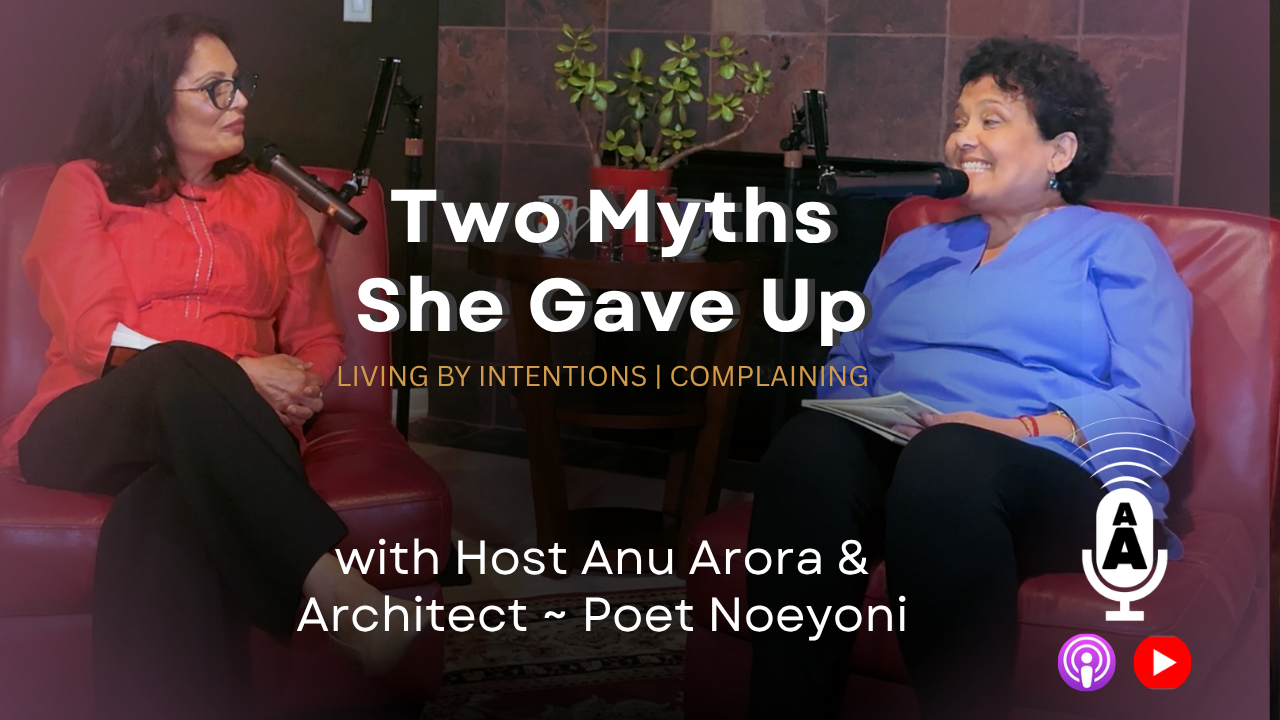
Key Takeaways
Inner work can deepen a profession rather than replace it. Noeyoni still practices architecture and community planning, but now brings more openness, fearlessness, and a spirit of service to her clients and communities.
Ego isn't the same as arrogance. Noeyoni came to understand ego as the belief that our identity is separate from other people's.
Intentional living is different from living with intentions. Living with intentions means tracking goals like a checklist, while intentional living means setting an intention and then letting go of how and when it arrives.
Observing life instead of trying to control it, becoming a witness to it, helped Noeyoni move through a long period of anger and disappointment.
In Noeyoni's view, leadership is shifting from a single leader directing the group to collective leadership, where people organize together and listen for answers that may come from anyone.
Noeyoni gave up complaining and now treats a complaint as a signal of something within herself that needs attention.
Quotes from this Conversation
"When they say ego, what they're meaning is believing that our identity is separate from others." — Noeyoni
"We are beings of joy. Our true nature, human nature, is to be joyous." — Anu Arora
"Leadership doesn't always mean having all the answers and directing people." — Noeyoni
Questions this Episode Answers
What's the difference between intentional living and living with intentions?
How is leadership shifting from individual to collective?
What does letting go of control look like in daily life?
How can a spiritual practice change the way you approach your professional work?
Some of what Noeyoni and I talked about — the anger she carried toward the divine, her becoming an unwitting therapist to a therapist, and the years it took her to stop mistaking control for care — these things really resonated with me.
I encourage you to listen to the full interview. When you’re ready for more, Noeyoni’s collection As You Be is a great place to explore. It’s currently available in digital form — the limited edition print run sold out — it’s the kind of book you don’t read in one sitting, so much as return to over and over again.
CORRECTION: Around minute 23:30, Noeyoni references Vinyasa Yoga when she was referring to Vipassana Yoga.
Resources
-
Anu Arora (0:03)
On Mindful Leadership Podcast today we have with us Noeyoni. Welcome, Noeyoni. It's just so wonderful to have you here with us today.
Noeyoni (0:15)
Thank you for having me, Anu.
Anu Arora (0:16)
Yeah, and it was a lovely chance that we recently met and realized so much we had in common, so I wanted to bring you to our podcast.
Noeyoni (0:27)
Thank you. I was just thrilled when I learned about your story and how it paralleled mine. It's just a miracle. It's uncanny.
Anu Arora (0:38)
How did your name come about? I was just so surprised. This is the name you used, Noeyoni, for your writing, for your creative pursuits. How did it come about, and why this name?
Noeyoni (0:51)
Noeyoni is actually my nickname, and it was given to me by my mother. And it's a name that many people know me by and may not know me by my official legal name, so it's really a part of me. But I have reserved this name for my creative pursuits, like you mentioned. Yeah, and why? Because you want it to be close to you when you're doing creative work. Well, I think Noeyoni, as you know, means eyes. Yeah, and I feel like a lot of the work that I'm doing is very internal. It's like, you know, the ank in Egyptian philosophy. It's about the eyes. You know, it's about seeing. Yeah, you know what they say is the eyes are the seat of the soul, yeah. So I feel like that represents the work that I'm doing.
Anu Arora (1:46)
Wow, wow. And it seems like it's been quite a shift you have made from your journey from starting as an architect and then building communities now, and also you know a poet and an author, so tell me how this journey transitioned to where you have reached, where you are now.
Noeyoni (2:09)
Well, I think I've always been armchair philosopher ever since I can remember, and in fact, growing up, a lot of my friends would tell me why do you think so much? And right now, it hasn't quite replaced architecture or community planning. It just parallels it, and it brings a depth of understanding and sensitivity to the work that I do. Not only in designing spaces and allowing myself to be completely open to what I'm hearing from the clients, but also connecting powerfully with the communities that I work with and fearlessly.
Anu Arora (2:53)
I love that. So you're still doing the work of an architect, but you're doing it with a lot more, you know, fearlessness, yes, and courage, and and and and space and eternal space.
Noeyoni (3:11)
Right. In fact, I once asked a person who's on her own spiritual journey, saying, "Why am I doing architecture? You know, this is my journey, the spiritual journey internally. Why am I doing architecture?" She said the reason will become evident eventually, but it's basically a way for leaving my energy in that space. And there will be a time, apparently, where I'll harness that energy to do what I need to be doing.
Anu Arora (3:45)
Wow!
Noeyoni
So it was a very cryptic message. I'm just sharing that with you.
Anu Arora
But it also seems like it's aligned because you can still bring your whole self to it. You know, it's architecture, but it's it's whole of you which is coming in your energy, your fearlessness, you know your curiosity, and perhaps your poetry also.
Noeyoni
I think I agree with you absolutely because when I'm working with clients, it's really important that I set my ego aside.
Noeyoni (4:20)
And when I started the spiritual journey, I get messages from the universe. The message I got that time was, "Your ego will be destroyed," and I was very surprised. I was like, "I'm not egotistical. I'm not arrogant. What do they mean that they're going to destroy my ego?" And it took me eight years, but I finally realized the word ego doesn't mean arrogance, or maybe there is a different word for it. But when they say ego, what they're meaning is believing that our identity is separate from others. That is what got destroyed in the eight years of my intense start of this journey, and now how I see the work and see and enter my clients' lives, I see it as a reflection of me, and and I see it as a part of my journey. It's not me designing something, but it's me being of service to them to help them along their journey.
Anu Arora (5:31)
And we're going to talk about these eight years because we got a gift from that, right? This this is what led to this book you wrote, As You Be. It's a beautiful book of poetry. I've read a few of these and just been mesmerized by them. But also, I know that there is a journey behind how this book came about. It's a part of that eight-year journey. So curious to know the details. We talked about it a little bit, but I know more is going to come out when we are talking now.
Noeyoni (6:07)
It was because during these eight years, it was during the big recession. So you know, first thing that the governments cut out is architecture and planning. So work was lean, and I was introduced to all these thinkers and speakers and books and so on and so forth, and it was just amazing how my life view completely transformed. And along the way, I was thinking, oh, I should probably capture this somehow, you know, so I don't forget all this because this was so much new knowledge, and I was just thinking, oh my gosh, writing a book sounds so boring. I can't do it. It's just too much work. And I started taking a few notes, and I was warned that I'll be in in an accident, and I was a little worried. I'm like, oh my gosh, I hope it's okay. What they didn't tell me was that I was going to be in seven accidents over a six-year period, which was amazing, which was a blessing. Oh my God, I keep talking about accidents as amazing because I met so many healers in our area, so many different modalities of healing, it was just amazing.
My insurance company was not happy with me because they were convinced I was somehow creating these accidents, and I was like, no. In each of these rear-ended accidents, I was still, I wasn't moving, and I was laughing about this with my last healer. And I told her, "Why is this happening?" And for some reason, every accident affected my third vertebra.
It's like, why do you think it keeps happening? Obviously, I'm not getting some message.
And she said, you know, your third vertebra is your communications chakra. And even though we're Indians, you and I know we are not talked about chakras growing up in school. I didn't know anything about our chakras. I was like, oh, we have a communications chakra, and it needs to be open. So then I started my whole journey into the science of chakras, and that is by itself an amazing experience. How each of them unfolded the way they did, and I came face to face with the fact that I'm being asked to actually communicate and capture what I have read, and therein this book was born, and it was a magical process because when I committed to it, this healer that I worked with said, because I was complaining how I was waking up at you know four in the morning, and you know, couldn't go back to sleep. And she's like, "What if that's a good thing?" I was like, "What do you mean?" She's like, "It's quiet. You don't have anyone disturbing you. You're fresh. Maybe that's the best time to write." And I accepted that. So the book was written from four to six every morning, I would wake up, look at the poem, and if I felt it needed some work, I would edit it. But I didn't make versions of the book. It was only one book that I I wrote for those six months.
Anu Arora (9:37)
Wow! So the book was coming to you.
Noeyoni (9:40)
Yes, pretty much. It's such a parallel journey here too, right? Right, and you were going through a similar experience, almost the same year. Same, same time. That's crazy.
Anu Arora (9:50)
I was writing around the same time, and my book came around, I think, two years after yours. Right. Yeah, yeah. I'd love for us to read something out of your book, okay, right?
Noeyoni (10:04)
Yeah, I'm gonna read about joy because you and I felt like that's something that really binds us together. All right, we can read about joy. You want to read from my book too?
Anu Arora
Yes, I want to read from your book. This is her book, which is amazing, and it's just brilliant that her messages resonate completely with what I have written, isn't it? Some of our chapters are like we opened the book and we opened a chapter on courage, and then happiness and joy, and you know there was an abundance, a chapter on abundance, or or a or a writing or poem on abundance, but very similar. Yeah, I think the ethos of both books are absolutely yeah in sync.
Anu Arora (10:51)
It's too uncanny. So let me read from your book, As You Be. Yes, "Joy."
"We are simply irrepressible expressions of joy. The rest is our journey away from and back to this reality. If we are drawn away from our constant state of joy, we can meditate to understand what of that instance has us depressed? Was it the actions or the words spoken, another memory or a fear that holds us prisoner to that moment? Acknowledge the creativity expanded in making so much of a moment, even when we had the choice to let it go. Joyless is an unnatural state. To release ourselves from misery, we can tune in and question the weak foundation of our fears till we are present to the insignificance and impermanence of all, and can freely choose to return to our natural state of bliss, joy."
So beautiful.
Noeyoni (12:09)
That's wonderful. And the coincidence was when I opened up your book, the poem that stood out for me was "Come Out and Dance." And with your permission, I'd like to read from this.
Anu Arora (12:23)
Yeah, please do.
Noeyoni (12:26)
"On a bright winter morning, I look out of my window. I see the bare branches of the maples carrying the sun with pride, beaming with light through the new space in between, my eyes reach the trail. The sun is visiting the river too, sitting majestically on its surface. And nearby, the squirrel is dancing on the branches, sending me an invite. Why are you sitting in the quilt? Come out and dance. You don't want to carry the guilt of missing my celebration in your hours of deliberation. Come out and dance."
Anu Arora (13:20)
We are beings of joy, isn't it? Our true nature, human nature, is to be joyous. Right. So many times, we forget that. Yeah. A lot of my book, I think, the central theme through my book is energy. Yeah. What we let out is what we get back, yeah. And creativity. It basically fundamentally says each one of us is extremely creative, and what we experience in our life is a result of our creativity, and what I feel runs through your books, which gives me shivers, is that you already see the creativity around us in nature, because your poems are replete with reflections of nature, and how that nature is calling out to us, speaking to us and giving us the lessons we need to learn.
Yeah, and reminding us that we are beings of nature. We and nature are not two separate things. We are we are one with it. Right. And so many times we forget that we we feel like we because we stay in these brick houses or wooden houses that we are some something separate from the nature.
Noeyoni (14:46)
Yeah. In my prologue, I actually mention that. Yeah. And that's how I experience life too. Is if I'm feeling happy, the sun is bright, you know, everything looks green, and the sky looks blue, and if I'm pensive for any reason, the weather almost always reflects how I'm feeling. So I look at the weather and I'm like, yes, this is a time to take a little break and go inside if it's cloudy. And I've seen some amazing sunny day, so really I feel like I'm dancing with nature all the time.
Anu Arora (15:26)
You are so much in tune. I can feel that, and I can I can see that. But I think you are also doing this deliberately too. You call something like intentional living. I want to understand that a little bit more. What do you mean when you say that this is intentional living?
Noeyoni (15:47)
I searched very hard for a phrase to capture what I wanted to summarize in that book, and I could not find any other phrase than intentional living. A lot of people, I feel, kind of conflate it with living with intentions. And what I've heard reflected back at me is the belief that living with intentions, setting goals, and making sure your everyday reflects what your intentions are is one of the things I gave up. And intentional living is where you set your intentions, and you then let life come back at you. So living with intentions is a very, I might say, regimental. You know, you're always on your toes, and you're keeping track, and you're like, "Am I doing what I'm supposed to be doing? Because this is where I want to go."
It's a checklist. It's a checklist life, and intentional living is, you know, I really want to be doing this, or I want to be seeing this, or experiencing this, and then you just let go, and then you find things just miraculously line up. The only problem with intentional living is you don't control the life, the timeline. You don't know when your intentions will be filled. Sometimes it might be decades, and when it happens, I'm like, "That's right. I had wanted this about 15 years ago, and now it's showing up." Here we are. But I would say that, where do we have control? We think we have control. Even living with intentions, you can have a checklist life, and you've seen people so unhappy with the checklist lives?
Anu Arora (17:41)
Yes, yes, they are struggling.
Noeyoni (17:44)
Yeah, that is very true, because they believe this is the old paradigm, is you know where you get up, you work hard, you do your thing, and the rewards will come. And then we know so many people that at the end of their lives, they're like you know, I did the best I can. I probably didn't get what I wanted, but you know that was the best I can. But I feel that life can be disheartening because you really want something and you don't get it. But if you let go, and if you don't always believe that you know the path to getting what you want. That release releases your energy, so the universe can start feeding you and directing you and bringing people into your life. Like it brought you into my life, and we knew each other from before, but we only now reconnected on this commonality that you and I experienced about 10 years ago.
Anu Arora (18:47)
That's synchronicity, isn't it? Yeah, that is this vibrations connecting.
Noeyoni (18:53)
Yes, yeah.
Anu Arora (18:54)
And you know the other other thing, which is that we then experience the magic of the universe. Yes. When we drop the control. Yes. What we are experiencing is is is something which we can't you know touch, but we can feel it. Yes. Yes. Absolutely. That there is that something is in the air. You can feel it. I can feel it. I can feel it when I'm in in synchronicity with myself. I can feel that I'm so aligned, and you probably feel that.
Noeyoni (19:30)
I'm aligned with everything else around me. It's very tough to get angry or upset when you're not controlling the wheel, and there's a new word that I'm seeing everywhere around me, and it's called allowance. So instead of control, directing, you know, it's just allowing things to unfold as it is. And I think the next book I'll write will be about letting go, because even my journey towards letting go is so interesting. How it unfolded. I want... Can I share that?
Anu Arora (20:15)
I want to hear that one too.
Noeyoni (20:17)
Okay. So through my journey, I fell in love with the divine, the universe. You know, we hear the story of Meera falling in love with Krishna. It's very similar. You just feel absolute abandon, and you're just filled with joy, with the universe. But then I started thinking about all the misery in our lives, all the wars and disease, you know, people being born with disabilities and all that, and I realized five or six months later that I had developed extreme anger towards the divine, and I was like, surely there's another way to teach us what we need to learn. You know, is this really the best you have? You know, so much misery you have in the world, and I found myself closing off, closing off, closing off, and then I realized one morning, and I started laughing. I said, "Okay, I think someone even told that back to me, like one Reiki person. I said, "I went to at that time. She said, "You're angry with God," and I said, "Yep, I'm quite angry, quite disappointed actually, to be honest." And I I started laughing, and I said, you know, I have really searched for coaches to help me through this period of anger and understand why I'm feeling this way. But every coach I was hiring, very expensive coaches, I ended up coaching them, and I was like, okay, this is not very fruitful. So I said, you need to send me someone who is stronger than me, who I cannot manipulate, if you might call that. I know you're focusing on them rather than focusing on myself.
Anu Arora (22:13)
Sometimes you go to a therapist and they are getting therapy.
Noeyoni (22:20)
Yes, that was my experience. I was paying people so much money to get healing from me, and then an old friend of mine, someone I worked with, happened to be at this art fair. I met him after two years. I knew he had gone back to an international location, so I was shocked to see him, and I sat laughing. I said, "Good choice," because I knew...
Anu Arora (22:43)
It was a sign.
Noeyoni (22:45)
I knew that I cannot get out of arguing with him.
Anu Arora (22:49)
Yeah, because...
Noeyoni (22:50)
He's the one who kind of did the big nudge that I needed to start this journey.
Anu Arora (22:54)
Yeah.
Noeyoni (22:55)
And I went up to him and I said, "Would you have a few minutes? I need to really talk to you." Said, "Yeah, sure." And I told him, "This is where I'm at. And I'm just so mad that this was the best God could come up with to teach us what we need to learn. You know, it's heartbreaking what people are going through. You know, surely there's another way. I'm not saying I know the way because I'm not as creative as God, but surely there's a better way for learning." And at that time, what he taught me to do is to just let go and not get involved in our life, but just to watch it. You know, kind of like what you learn in vipassana, is where you just don't let go. You don't touch. You just watch it.
Anu Arora (23:45)
You become an observer.
Noeyoni (23:46)
You become an observer.
Anu Arora (23:48)
A witness.
Noeyoni (23:49)
Witness to it. And there was some more depths to that conversation. In fact, I've been thinking. I I want to write a book on him called The Mystic on the Corner, but I laughed. I laughed my head off at the end of the conversation, and I said, "Okay, good job, good person, right message. I got it. Thank you."
Anu Arora (24:10)
And you were able to move on.
Noeyoni
I moved on.
Anu Arora
Very nice. That's such a beautiful story as well. I want to read another poem. This time, you read from your own book. I'd love for you to just pick up another, and you read it in your way from your book. I think I'd love to exchange books.
Noeyoni (24:27)
Yeah, I, I, I think we'll give this one a rest. What I do want to read, because I would like your thoughts about it. Yeah, a lot of people struggle with this, especially since your listeners are leaders and are, you know, engaged in this conversation called leadership. I'd like to actually read from my poem called "Power," and I would love to talk about it, to see what it means to you.
Anu Arora (25:08)
I'd love to hear. Also, I want you to show them the mudras because there's something very unique in this book. And can you also talk about why you chose this this action of the hands for this poem? How how do you decide what, and how did these mudras came about with each one of them?
Noeyoni (25:27)
So I did about six years of Indian classical dance training. So and then if you go into our shastras, you know our historic books, you'll understand that each of the movements in the dance, they have tremendous energetic reflections in the body. I can't remember all of them, but people have read those books and have talked about how this is such an important gesture for relaxing, for letting go, and each of the gestures, so each of the gestures in dance means something. So the cover is actually the essence of the book, which is basically that how you are is the universe reflecting it back at you, yeah. It's a connection area. It's basically, yeah, this hand reflecting that hand.
Anu Arora
Yeah. So makes sense. Yeah.
Noeyoni
And then you want to show power. This is this is a dance, a typical dance mudra in Bharatanatyam, in Odissi, which I learned, and in many dance forms, this is a symbol of power. So, here it goes.
"Power is ephemeral, yet tangible. You can sense when it is present and when it is absent, as a manifestation of our confidence in a higher being, the universe or the divine by any name, power is knowing that we are being directed to do exactly what we need to do, and being comfortable in our actions, even without knowing the outcomes. Power is limitless. We can sense power in ourselves when we have the opportunity to give it away. The void is filled with a greater sense of our potential. We can choose to let another's power overwhelm us with fear and diminish our self-worth. Instead, if we reconnect to our unconditional self-love and feel our spirit magnify in the process, we can then relate fearlessly and powerfully with others."
Anu Arora
Wonderful, wonderful. And I think this is where I see you bring the other concept. It's not control. It's in letting go. It's in giving. It's in giving. It's in you know when you give you you get more. Know that, and it's being in in comfortable in not knowing where it leads you to. But just connecting with your deeper self, yeah. And our deeper self lies in our heart and in our second chakra, the gut, Manipura, yeah, Manipura chakra, yeah. And if you are well connected to that, then you can take actions fearlessly without knowing or even expecting the outcomes. It's wonderful. I love it. So, let's transition to leadership. This is exactly the time we can transition to leadership. And you are a leader. You know, you you work in community. You know, sustainable communities you build. What is it this inner work has taught you about leadership?
Noeyoni
It's interesting, you know. When I started this journey in 2000, my answer would have been different, and I think I resonate with the belief that we are in a period of deep transformation. I think maybe for the past two, 3,000 years, we were to believe that leadership was an external source, a king who would lead the men into battle, you know, or an activist who would lead a movement, and so on and so forth, and those are all absolutely correct, and they happened as it needed to happen, but what we I feel are moving into, and one spiritual person said, we are moving from a culture of lions, and the lion leading the pride but not doing much of the work. Right, the lion usually is resting while the female lions do all the work. Into a culture of ants. So, and I'm seeing that in the younger generation, is they work so beautifully together as a community wherever they go. They are not looking for that one person who's going to lead them. They have this innate ability to just organize and do what's necessary. [crosstalk] Because a lot of the heroes, if you read their story, it was born from fear. It was a need to prove themselves to themselves or their parents or their grandparents or the desire to leave a legacy and imprint, you know, the statues somewhere. You know, that's that that's what previous leaders were born of, right? And I think the future is where all of us tap into our leadership, and leadership doesn't always mean having all the answers and directing people.
Noeyoni (31:46)
You know, I think a lot of lead leaders have learned that sometimes you have to listen because you may not have the answers, and the answers may come from somebody else. So I think that is the transition we're going through, is where we're going to transform into a collective identity, into a community, rather than having a king lead us and determine our destiny. You know, so I'm very excited. I think we're in some very exciting times.
Anu Arora
So we're coming towards the end of our interview, not really interview. It's been a lovely conversation actually, and the question that's coming up is:
Anu Arora (32:30)
You've been through quite a spiritual journey, and has it changed your life?
Noeyoni (32:39)
It has completely.
Anu Arora
How?
Noeyoni
Well, I have to say, I remember my childhood. I was very precocious. I was fearless, curious, very happy child, and the in-between years were very turbulent, and I didn't know a way out of it, and I was carrying a lot of anger and self-loathing for whatever reason. And through the spiritual journey, I was able to wrap my arms around all of that and welcome it, and thank it, and let it go, and accept that it wasn't a part of my future, but it everything that happened led me to this moment. So it was a lot of acceptance in the past, and it's basically made me very self-conscious of who I am. And one of the big things that I've given up through this journey, and it's replete in a lot of the poems and in the book, is I gave up complaining. What I've learned is when people complain, it's usually what we call the higher self, or you know, the higher part of you, the energetic part of you, reflecting back at yourself what you need to repair. So I've just given up complaining. I'm like, okay, I don't, I don't want another accident. I've learned so many lessons.
Anu Arora (34:17)
Not another one, not another one.
Noeyoni (34:21)
And I just don't complain. It's just total acceptance, you know. And sometimes when I revert back, because I'm still human, sometimes when I do revert back, and I devolve into the previous way of thinking, my husband does help me work through some of that, as do my sisters and my mother. But I sometimes just open my book, and I was like, "Oh, doing that again."
Anu Arora (34:47)
You are an inspiration for your own self through your own book.
Noeyoni (34:51)
Through my own book, and that's what I write in the prologue. Is basically I'm writing this book for myself, and if it gives anybody else the comfort, the realization, the ability to let go, then nothing will make me happier. And a lot of people who have bought the book have bought like several copies, given it to friends. I know one lady who was going through a divorce, and I happened to visit her, and the book was right on her desk, and there were like so many post-it notes throughout the whole book, and it took her several years from being a very bitter divorced woman to actually complimenting her ex-husband when we last met. So it was it was a miracle that she was able to work through her own mind and what it was doing to her to accept all the trauma she has been through and to not blame her ex-husband for it.
Anu Arora
In in some ways, the journey you went through became a part of her journey.
Noeyoni
Pretty much. Yeah.
Anu Arora (36:05)
Isn't it? Life is so interconnected. We feel that that we are these separate, silo human beings, and here we are, you know, interconnected. So, what inspires you every morning, anyway?
Noeyoni (36:22)
Before, when I was starting off on this whole intentional living, you know, they say, you know, start with an intention. So I would, you know, have my certain intentions and so on and so forth, and that was great. That was wonderful. But now I just, I'm being taught how to let go. That is my current journey. So when I wake up in the morning, I have a whole routine of waking up. It's about an hour, and as a part of that journey, my I set the intention that let me be operating at the highest potential I'm meant to be to complete today. Every day, that's my prayer every day.
Anu Arora
Yes.
Noeyoni (37:12)
And I don't know what's going to transpire, but I knew that some, I do know that some intention I've set in the past will come to be.
Anu Arora
So let's just end on that note. And it has been beautiful having you today with us. And I have really enjoyed this conversation. As cannot remember another conversation that deep and that spiritual and that connected. So thanks for being here today, and I'm sure we'll be back again talking about more books and more more discoveries and more wonder in nature and around us because there's joy everywhere.
Noeyoni (38:00)
Wonderful, and let it be so. Thank you.
Anu Arora
Thank you. And As You Be, is it there for people to buy at Amazon?
Noeyoni
Yeah, it's currently available in digital format. All the hard copies I sent out were sold. It was a limited edition. So, if there's interest, I can do more of them.
Anu Arora
Yeah, that'll be lovely. All right. Thank you. Thanks so much.
Noeyoni
Bye bye.
Episode Details
Guest: Noeyoni, architect, community planner, and poet, author of As You Be
Host: Anu Arora, executive and team coach
Series: Mindful Momentum: Leader Podcast
Published: September 16, 2026 · 38 minutes
Watch on YouTube