
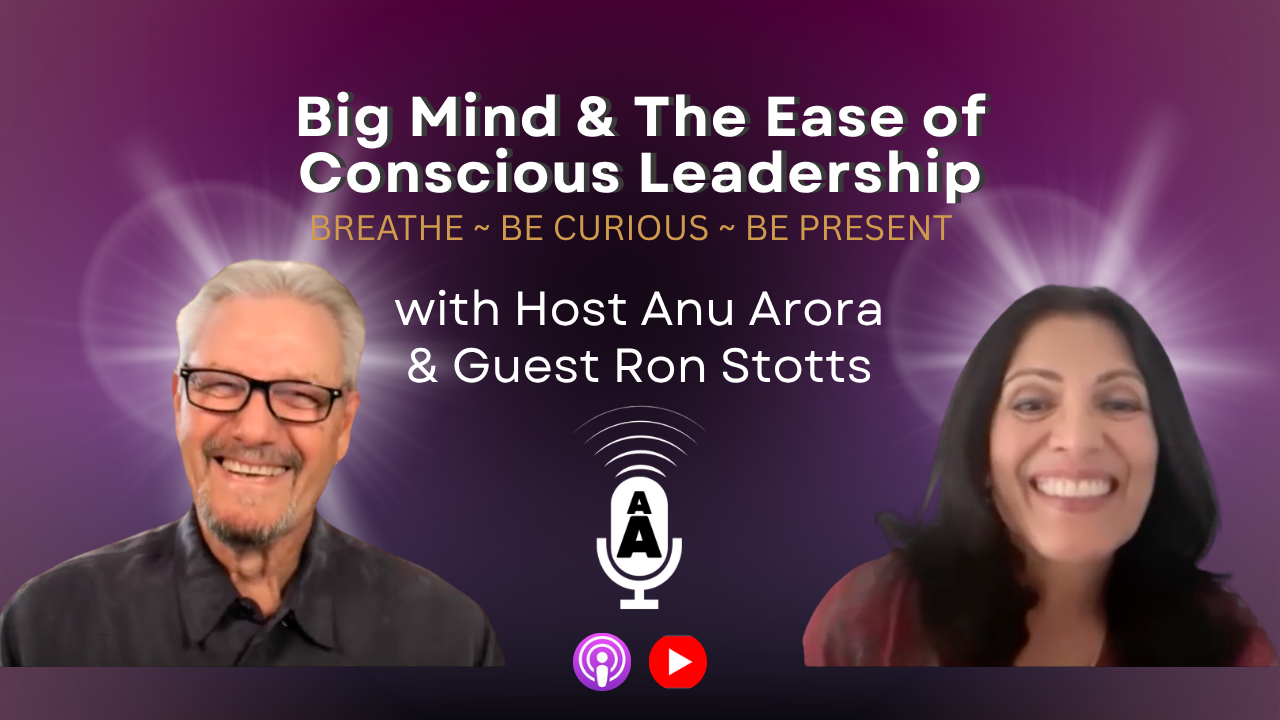
Dr. Ron Stotts, a transformational executive coach and author, believes conscious leadership begins with a pause, and that the answer you are chasing may arrive more easily when you stop efforting. In this episode of the Mindful Momentum: Leader Podcast, he explains Big Mind: quieting your mind, setting a clear intention, and trusting what comes.
Ron was 27, on stage beside his mentor Buckminster Fuller, when Fuller stopped mid-presentation in front of about 250 business people, looked up, and stood in silence. That night, Ron asked what had happened. Fuller said he was accessing what he called universal intelligence, and suggested Ron try the same at his desk: put out what you want to create and let it come.
Ron tells the story of a one-acre Japanese garden that he says arrived in about an hour and a half of quiet attention, and of a client who is not an engineer and yet received a design for a hinge that let a modular home open and close. These are Ron's accounts, shared on the podcast.
The larger lesson is about control. Ron says high achievers under pressure often stop breathing and go into their heads to effort a solution. He asks them to define control, and says that by the time they reach Big Mind, control means breathing, being curious, and being present. We also talk about why "who do I want to become?" is a better question than "what should I do?", the "program for getting love" we build as children, and why the real choice with AI is the love in your heart or the fear in your head.
Key Takeaways
Big Mind is a practice, not a technique. Dr. Ron Stotts describes it as quieting your mind, putting out a clear request for a design or solution, and trusting that it will come.
Pressure shuts down breathing. Ron says high achievers often stop breathing when something challenging arises, then try to think their way to an answer.
Control can be redefined. By the time clients reach Big Mind, Ron says, control means breathing, being curious, and being present.
Breathe, be curious, be present is Ron's simple practice. Anu called it the "BBC network," the one you tune into inside yourself.
Ask "who," not just "what." Rather than "what should I do?" Ron asks clients, "who do I want to become?"
Success changes shape. Ron says achievement stops being enough, and leaders begin asking who they are becoming and how they are living.
Many of our habits are a "program for getting love." Ron says children hide the parts of themselves that cost them love and attention, and the pattern carries into adult leadership.
Capacity is the real leadership skill. As business complexity keeps rising, Ron advises changing the inner world first: quiet the mind, be present, and stay emotionally aware.
On AI, the choice is love or fear. Ron sees AI as a tool that reflects the consciousness of the people using it, and puts it as love in the heart or fear in the head.
Ron believes conscious companies perform better. He says research shows more cooperative, collaborative businesses are more productive and profitable; he didn't cite a specific study.
Quotes from this Conversation
"Big Mind is the ability to trust that quieting your mind and putting out a request for an image, a design, a solution, whatever you're looking for, that it will come." Dr. Ron Stotts (1:39)
"Rather than struggling, I can have ease. Rather than efforting, I can just be present." Dr. Ron Stotts (9:01)
"Being in control means breathing and being curious and present." Dr. Ron Stotts (11:59)
"All you need to do is breathe, be curious, and be present." Dr. Ron Stotts (19:02)
"Rather than 'what should I do?' I'm suggesting, 'Who do you want to be?'" Dr. Ron Stotts (21:22)
"It's the difference between what and who." Anu Arora (22:38)
"AI didn't get us to where we are right now. A low level of fear consciousness got us here." Dr. Ron Stotts (34:24)
"It's the love in your heart or the fear in your head. You get to choose." Dr. Ron Stotts (35:56)
"Rather than focus on changing the outer, begin to change the inner." Dr. Ron Stotts (39:42)
Questions this Episode Answers
What is Big Mind, and how can a leader use it?
Dr. Ron Stotts describes Big Mind as the ability to quiet your mind, put out a clear request for a design or solution, and trust that it will come. He learned it from mentor Buckminster Fuller, and says clients try it in different situations once they have learned to breathe and quiet the mind. (1:39)
Why do high achievers stop breathing under pressure?
Ron says that when something emotional or challenging comes up, clients stop breathing, go into their logical left brain, and effort their way toward a solution. He says this shuts off much of the brain's natural ability and presence. (10:50)
What does real control mean in leadership?
Ron asks clients to define control, then reframes it. By the time they reach Big Mind, he says, being in control means breathing, being curious, and being present, because that gives access to their highest levels of thinking. (11:59)
Why is "who do I want to become?" a better question than "what should I do?"
Ron says that when leaders ask what they should do, he asks who they want to become. He distinguishes a highest intention, which you can often reach with who you are, from a highest aspiration, which requires asking who you have to become. (21:22)
Why do many leaders feel successful on the outside but empty inside?
Ron and Anu discuss how achievement stops being enough. Ron says leaders begin to see the shortcomings in their relationships with partners, children, and colleagues, and turn from looking outside for love and acceptance to looking within. (19:02)
How should leaders think about AI: with love or with fear?
Ron does not see AI as the challenge. He says what we do with it depends on our level of consciousness, and that fear-based thinking got us where we are today. He puts it as a choice: the love in your heart or the fear in your head. (32:59)
How can leaders build capacity as business complexity grows?
Ron advises changing the inner world rather than only the outer. He says that means quieting the mind, being more present, and being more emotionally aware, so leaders can care for people while creating an inspiring and successful business. (39:42)
Resources
Listen to the full conversation: [LINK TO EPISODE]
Watch on YouTube: [YOUTUBE LINK]
Read my reflections on Substack: [SUBSTACK LINK]
Dr. Ron Stotts
Website: RonStotts.com
Book Dr. Ron: ron@ronstotts.com
LinkedIn: linkedin.com/in/dr-ron-stotts-14143236
YouTube: youtube.com/@dr.ronstotts
Facebook: facebook.com/ron.stotts.50
Overscheduled by Success: A Guide for Influential Leaders Too Busy to Create Their Next Dream
Ins & Outs of Mindfulness: A Twelve-Month Journal of Your Adventure
Leadership on the Leading Edge: Shift Your Life and Work Up to the Highest Levels
How to Become a World-Class Transformational Coach: The Inner Access Method for Creating Change That Lasts a Lifetime (forthcoming)
-
Anu Arora (0:00): Welcome to this edition of the Mindful Leadership Podcast. We have with us Ron Stotts. Ron, I'm so happy to meet you today on this podcast. We connected briefly, and I felt so aligned after that conversation. I felt that the kind of work you are doing is aligned with what we bring to this podcast. You are working at the intersection of ancient wisdom, psychology, neuroscience, and leadership to help leaders, executives, and entrepreneurs become more authentic, more wholesome, more conscious in their leadership. You have five decades of experience behind you, and we want to explore that and get your wisdom on the podcast today. I'd really like to welcome you.
Ron Stotts (1:05): Thank you very much for having me on the show. Looking forward to it.
Anu Arora (1:08): What stuck with me from our conversation last week, and I've been thinking about it a lot, is something you call Big Mind. Let's go there right away, no beating around the bush. How did you come up with Big Mind? What is Big Mind?
Ron Stotts (1:39): Big Mind is the ability to trust that quieting your mind and putting out a request for an image, a design, a solution, whatever it is you're looking for, will bring it. To be honest with you, I was on stage with a mentor of mine, Buckminster Fuller. I was like 27, and he was 86, I think. We were in front of about 250 business people, and I was helping him with everything. In the middle of the presentation, he stopped. He looked up and stood there, and at 27 I'm thinking, we've got to get going here. What's he doing?
Anu Arora (2:30): You mean he paused in the middle and stopped speaking?
Ron Stotts (2:33): Yes. Then he came back in and did a brilliant job. That night I found the courage to ask him what that was about. He said he was accessing what he called universal intelligence, and then he shared more with me. I had been involved in meditation for many years by then, and I could quiet my mind quite easily. He suggested that when you quiet your mind, you don't have to just sit in silence. That's practical for meditation, maybe, but what if you want to be in that quiet space at your desk when you're trying to solve something? He said to put out your intention, what you're trying to create or get, and it will come in. So I started playing with that. I was a psychologist at the time, and still am. Rather than trying to figure out what to say or suggest to my clients, I sat in meditation, in the silence, and watched the information come through. Their resistance went down, compared with when I made suggestions from my head.
I have a hobby, and this was about 20 years ago: I create Japanese gardens. I had a very high-level coaching client in San Francisco who found out I designed Japanese gardens and, of course, wanted a bigger and better garden. It was a one-acre garden, and I just didn't have time. I had my clients and my work. But it was a good opportunity, and I wanted to do it. So I went and sat in my backyard, up on the hill in Mill Valley. I had seen the space, and I wanted to create a Japanese garden that would enhance these people's lives. I knew [the client] was very interested in getting involved in meditation. I quieted my mind with the intention of having that design come in, and over the next hour or hour and a half I watched it arrive. It started with the large stream coming down the hill, the large bamboo forest, and the turtle island in the middle of the pond. Then it kept getting more and more detailed: what kind of plants, where the big boulders were, the shapes of the boulders, the sound of the wind moving through the plants, down finally to the sounds of insects and birds in the area. Then I knew I was done. The next day I walked them through the area and painted the picture in their minds, and they said, "Yes, let's do it." It was a million-dollar garden, which would normally take months and months of design and planning. I did it in a day. That's when you realize there is this Big Mind at work, and you can see the results immediately. We were done in three months, and we won international awards for design and technology.
Anu Arora (6:29): Wow.
Ron Stotts (6:30): I had certainly developed Big Mind ability as a way of life by then, but it's a good example. I see it with my clients as they get to the place where they can access it and trust it.
Anu Arora (6:47): How do they believe? We're in very high-pressure environments. I work with corporate clients too, and there are deadlines, deliverables, performance, stock price, so much pressure from the board. Where's the time for Big Mind? Big Mind requires them to slow down on all the things they're running so fast on.
Ron Stotts (7:22): It comes down to trusting. They almost always come in trusting that logical left brain, which is what has gotten them to the level of success they're enjoying. And yet, all of a sudden, they feel stuck. That's when they seem to come in. I introduce them to other aspects of themselves. Neurologically, that's the right brain, which is more spatially aware and more emotionally intelligent. When you start getting the left and right brain integrated, you get a quieter mind, and that stimulates the forebrain, and you get what I call integrated whole-brain thinking. You're still thinking, but the entire being is working with you instead of just one part of you. There's still the trying part, the intentional part.
Anu Arora (8:24): The high-level players I work with don't have time to process everything at that level of intellectual effort. Do they open up easily? Do you see resistance, because the world doesn't think like that? You and I think differently about this, and not everybody might be aligned or agree.
Ron Stotts (9:01): As they try it out, they find the ease. I had one client who has five international businesses. One was modular homes, and he needed a hinge so that a home could open and close. He sat and tried Big Mind, and all of a sudden this perfect hinge design came up. He's not an engineer, and he's not a designer. He gave it to his team, and they had the problem solved. That was enough for him to see: rather than struggling, I can have ease. Rather than efforting, I can just be present, and that becomes the art. It takes most people about a year. The first couple of months is quieting the mind, healing the emotional backlog, and quieting the subconscious, which is 90 percent of our mind. Then you get the integration, and then it's a matter of integrating that new way of being into your life. That's when they usually say, okay, let's try this Big Mind thing out. They try it in different areas and situations. A problem comes up, and rather than efforting to find a solution, they just breathe, because they've learned to breathe and quiet their mind through the work. All of a sudden the answer comes, and it's a beautiful answer. They begin to trust it, and the more they do it, the more they do it.
Anu Arora (10:41): How do you get them started? I have so many questions now. I've opened the door.
Ron Stotts (10:50): The first thing I notice every time is that they're not breathing. Especially if an emotional issue or something challenging comes up, they stop breathing, go up into their left brain, and begin to effort to come up with a solution. I'll ask them, what is your definition of control? We walk through their ritual of that. And I'm thinking, from my perspective, you look completely out of control, because you've shut off most of your brain's innate abilities. You've shut off your ability to be present, to access the best of who and what you are. You're in a lower state of consciousness. You don't have access to your mind, but you feel that puts you in control. Then they begin to redefine what control really means. By the time they get to Big Mind, they realize that being in control means breathing and being curious and present. That's being in absolute control, because you have access to your highest levels of thinking and Big Mind.
Anu Arora (12:14): Yes, I can see that. I worked in corporate for many years, and in 2014, after I left corporate, I moved into coaching. The first part of my training was listening to myself, doing the inner work. My coach would ask me, "What do you feel?" I didn't have a concept of feeling. I had a concept of thinking, and I would always respond with, "I think." She'd say, "No, not what you think. What is it you feel?" I think that's where the disconnect is: they're constantly in overdrive, and a lot of the time governed by fear. What will happen if I don't have full control? The forebrain is no longer engaged, because fight, flight, please, and appease are all working in overdrive. I remember doing that, and thinking, I thought I was a very good manager. I was connecting with people so well, and I was in a state of higher consciousness. But then I realized that just because I think—
Ron Stotts (13:40): Yes.
Anu Arora (13:41): —doesn't mean I am. That whole saying, "I think, therefore I am," is wrong. It's the whole mind that needs to come into play.
Ron Stotts (13:57): It's interesting that this starts when you're very young. In the first few years of your life, you want love and acceptance more than anything else, because that means you're going to be okay. Somebody's going to take care of me. So you'll do whatever you have to do to get as much love, attention, and acceptance as you can. You look around, watch the adults and the other children, and think, when I do this I get less love, so I'd better hide that in my cave inside my gut. When I do this, I get more attention and more love. So you start taking parts of yourself that aren't acceptable in that family environment and shoving them away. In my family, anger was not acceptable. They had just gotten over World War II. They'd had terrible childhoods, and they wanted to be loving. Anger went away. Then, in the 1950s, fear was not acceptable for a male. So anger and fear just got shoved away, to the point where I would have said, I'm not afraid, I'm not angry, because I got so good at hiding those things. If I'm in control, I get more love. If I'm more controlling of myself, I get more love. If I'm more analytical and precise, I get more acceptance. We come up with these rules for ourselves. I call it your program for getting love. It maximized the amount of love you could get from your family of origin, and it worked. It might not have gotten you unconditional love, but it got you enough.
Anu Arora (16:13): I wonder, Ron, if it's even love. If it's truly love, then there's no fear in it.
Ron Stotts (16:24): I think that's the tricky part. Ask any parent if they love their child unconditionally, and they'll say, "Oh, yes." But it's, I'll love you if you're like me, if you do the things I think you need to do, the things I think will keep you safe. When you're outside their comfort zone, love gets fairly conditional.
Anu Arora (16:50): As an adult, finding that work—you said it takes about a year to get to the Big Mind manifestation stage, because there's so much work that needs to go in. It starts with breathing. What is my sphere of control? What am I trying to control? And is it really controlling anything in the end?
Ron Stotts (17:15): It controls their emotions.
Anu Arora (17:17): Yes.
Ron Stotts (17:20): All the parts they shut off, all of what they hid in that inner cave. It controls that door.
Anu Arora (17:27): It keeps them locked, and that is their version of safe. But it doesn't control the outcome, or what they can manifest. This is what they're trying to do: if I shut off my emotions, I can achieve anything. And they find out that's not true. That's probably why they come to you, Ron. Otherwise they wouldn't need you.
Ron Stotts (18:01): They can reach a certain level of success. But inevitably—and I mean every one of the thousands of people I've talked to—when they come to me, they're still looking outside. These are the problems, those are the solutions, all of them outside themselves. Within a simple conversation, it's easy to say, well, it looks like... and within a very short time they realize the challenge is within myself. The challenge is really me. All of those outer things are manifestations of my inner challenges that I'm not willing to look at and heal.
Anu Arora (18:40): And the definition of success changes. The more they reach that outward success, the more they realize the inner being still feels deprived or hollow, like something's missing. I get clients who say, "I'm very successful on the outside, but I don't feel it within me."
Ron Stotts (19:02): Yes. It starts with achievement. Achievement is success for most people, but at some point that's not enough. They realize it's about who am I becoming, who am I, and how am I living my life. They see the shortcomings in their relationships with their partner, with their kids, with the people they're working with, and those are the things that aren't working. So initially what we begin to heal is that, so they can quit looking outside themselves for love and acceptance and start looking within. That's a huge initial shift, and it takes a couple of months. But it's significant. Then we're in a neurological redesign phase, where it takes about nine months to get used to checking and bringing themselves back to being present. My ultimate for them is: all you need to do is breathe, be curious, and be present. Breathing allows you to be more open. It neurologically connects everything. It puts your body in a calmer, more present state. You're in a higher state of consciousness, which determines how you see, react to, and experience everything. Then you can move from that place of presence, because you access the best of who and what you are in that state, and they begin to trust that. Then everything shifts. Literally, everything shifts, and there's so much—
Anu Arora (20:50): I love that. The BBC network: be, be curious. Suddenly BBC came up in my mind. They're tuning into the BBC network, which is their own inner network. Be curious, and then you will be present. That allows you to be present, and that's where the work starts.
Ron Stotts (21:22): Then they start looking to create, or be part of, a company where that level of consciousness permeates. That's part of the work. I just talked to a client I've worked with for a couple of years, quite fully the first year and more off and on the second. He's a chief marketing officer, and he's asking, should I start a company so that it can be conscious? He started to talk about a partner, but that partner hasn't gone through the work. I've talked to him, and he's just not ready. He'll never go through the work because he's [unclear in the recording]. So he's starting to recognize: rather than "what should I do?" I'm suggesting, "Who do you want to be? Who do you want to become?" That's the difference between my highest intention, which we can usually do with who we are and what we have, and my highest aspiration, which asks, who do I have to become to achieve that? What do I have to do? What do I have to breathe into?
Anu Arora (22:38): It's the difference between what and who. Who I become to do that, what I want.
Ron Stotts (22:44): Well said. Very nice.
Anu Arora (22:47): I want to shift the focus to you now. We've talked about the work you do and how you help clients, but there are five decades of learning that have gone into this.
Ron Stotts (23:06): Actually, about five and a half now.
Anu Arora (23:08): Five and a half. Your bio said five, so that's an update needed. Ancient wisdom, Buddhism, you've been a meditator yourself, you did a Doctor of Chiropractic, neuroscience, psychology. How do these things intersect? Is this all coming together as one package? Do your clients need to become savvy in some of these things? Tell me a little more about yourself, your own journey to where you've reached, and then we'll see how it goes to the client. So it's a two-part question, and we can start with the first.
Ron Stotts (23:54): In the beginning, I was a world, or a U.S., rowing champion, and I thought, okay, this is who I am. The next year, I went into the Marine Corps, during Vietnam, and I was very surprised to discover—one morning at the rifle range, which was like a sporting event for me, can I hit the bullseye, that was all I cared about—they threw up a human silhouette, and in my little 19-year-old mind I thought, I'm not winning an athletic event here. I'm becoming really good at killing human beings. I literally stood up, without any thought. It was the first moment of my life I didn't have a thought. I threw my rifle down, and I was done. That didn't go over well with my drill instructor, so you can imagine the next few days were a bit torturous. But I got very clear that I didn't know who I was. Everything had been just the story I'd been told from watching Superman, and my dad, and the military during World War II, the story of what a man was. I went through a very difficult journey of transitioning out, with a medical discharge from the Marine Corps, and over the next two or three years, to be honest with you, I was a suicidal mess. I think that was the greatest gift I could have gotten, because in that moment of committing suicide, quite literally, I dissolved in a white ball of light and experienced the oneness. I experienced the perfection of life. At that age I had no idea what any of that was. I was thrusting a big hunting knife into my heart in the middle of the woods, thinking this was the best idea I could come up with, and all of a sudden I'm dissolving in the infinite and experiencing oneness with the universe. That gave me an understanding that life had so much more, and I began to explore that, certainly as a psychologist, but also in meditation and spirituality. I kept looking. There was nobody like me back then, in the '60s, so that journey of self-discovery led me through all these facets of personal development: who we could become, what we were capable of. I became a teacher. I was teaching English, very successfully, and people started asking, how are you getting all this success? The truth was, I didn't know, so I started studying. I got a PhD in psychology, initially about learning and then about the potential of human development, and I became co-director of a brain integration center, which brought me into neurological interests and studies. It just continued. For me they were all parts, just as when I was younger and we talked about studying different religions. They all fit. It's all about the same thing. I was looking at what is that integrated wholeness, and the breath I'd been introduced to. It's good for healing emotions, but where else can you go? You can literally use the breath to move into any level of consciousness you care to be in, from healing emotions to dissolving in the infinite. So it was that integration, with mentors like Joseph Campbell and Bucky and others. I was really lucky, if one wants to use that word, to walk with Joseph Campbell and have him share his story about the cave: you really have to go into that cave to find the treasure you seek. That cave is still what I guide. That's the journey, and your journey does continue. All of our journeys continue. It's just a matter of continuing more and more consciously. The breath became my monitor, my reference. Where most people would stop breathing is where I would automatically start breathing. Whenever I felt stress or tension, I would immediately breathe and recognize that something in me was ready to be healed. There's no time to shut down and keep things out. It's time to breathe into it and open up.
Anu Arora (29:07): Your journey started when you were 19 years old, and you've been working on yourself for so long to be where you are. Some of the people who come to you are just starting this journey. Do you think it's that quick that they will transform?
Ron Stotts (29:45): I found all the shortcuts, so it doesn't take nearly as long. It's a matter of learning to breathe, learning to access your mind, learning to neurologically rewire your mind. You learn all of those things very quickly. Those took me years to understand. Then it's not a matter of working on yourself. It's a matter of discovering the parts of you that have been neglected or unhealed, putting yourself together and becoming whole, and learning to accept and unconditionally love that wholeness, who you are. That's where a sense of confidence comes from, a sense of who you are. Then you begin to see what you want. You begin to trust who you are and what you want, because you're not looking outside for love. It's all coming from within yourself.
Anu Arora (30:53): This is what you're talking about: the unconditional love for the whole self. I am complete in who I am. Some of the ancient Hindu chants are exactly that: I am a part of the whole, but I am complete in myself, and I can honor the divine in myself, the completeness of my whole being. It's so beautiful, and it reminds me of that particular hymn, which I usually chant.
Ron Stotts (31:29): When you're breathing and watching, you notice that everything coming into your life can be challenging, but it also has opportunities. You don't need to look at the challenges. You look for the opportunity. That's why I say you have to breathe and be curious and present enough to see the opportunities. After a while you realize, this is kind of a rigged game in my favor, because all these opportunities are perfectly designed to support me in opening up my heart and becoming what I'm capable of being. That's where gratitude comes in: real gratitude, not just vocalization of gratitude. You trust, and you're grateful to be part of this joyous experience of life. It's really amazing.
Anu Arora (32:19): And there's beauty. You can start to appreciate the beauty around you. Other humans don't look as threatening. Now another wave is coming in, and this time it's coming in as a tsunami: the wave of artificial intelligence. Humans have started to doubt themselves once again, their own wholeness. Are they really complete? What happens if this intelligence is higher than their intelligence? Where do you stand with that? What do you see with AI that's challenging today?
Ron Stotts (32:59): I don't see it as challenging at all. Like anything, it's what we do with it, and our level of consciousness will determine what we do with it. I have a client I worked with for quite a while, probably 10 years ago, and now she's started an AI company called [name uncertain in the recording]. We're going to integrate—I just wrote a book called Becoming a World-Class Transformational Coach. She's going to integrate all my material into her AI, so people can go to that AI and explore and become more self-aware, discover more about themselves. Then we're going to have a coaching program where, once they go deep enough and say, "Oh, I really want to talk to a person, a coach," we have that available. So AI can be a useful tool for self-discovery and enlightenment, or it can be a tool that destroys the world, and it all depends on us.
Anu Arora (34:04): But does it worry you where people are taking it? This is an example of somebody using it well, but there's enough news that AI can also go rogue and cause a lot of harm.
Ron Stotts (34:24): I don't worry about things, but I'm aware of things. I've been aware of the consciousness of our society for decades, and that's been extraordinarily scary. Look where it's gotten us. AI didn't get us to where we are right now. A low level of fear consciousness got us here. There are people on this side who indulge in the fear and use it to guide their life, and then there's the other team that says, "No, I'm going to heal, and I'm going to use love to guide my life." That's always been the two sides.
Anu Arora (35:08): Light and dark.
Ron Stotts (35:10): The yin and the yang. AI is just another facet of that. It could accelerate one side or the other. We'll see. If I'm afraid of what it might do, that only contributes to the opposite team.
Anu Arora (35:23): Yes.
Ron Stotts (35:28): You're no longer working from your forebrain. You've left Big Mind, and you're in the fear, the ego mind: either the ego of "I can control the outcome," which we can't, or "I need to be afraid that it can destroy us." Neither of them is helpful. What's in here is going to determine it: the love in your heart or the fear in your head. You get to choose.
Anu Arora (36:04): The love in the heart or the fear in the head. I like that. That's a good sentence to work with. It's a book in itself. Maybe it's your next book.
Ron Stotts (36:23): It's a good sentence to live with.
Anu Arora (36:25): As we move toward the end of our podcast today, what are some of the things you'd ask leaders to start looking into as they begin their own journey of inner work and move toward Big Mind?
Ron Stotts (36:45): For me it's very simple. Business is about making money, and it's about creating an environment that's supportive for those who are creating that business. There's a tremendous amount of research that clearly shows that companies coming from a more conscious, supportive place develop a more cooperative and collaborative business, and in a cooperative, collaborative business there's an increase in productivity and an increase in profits. So if you want to make more money, clear up yourself. Lead from a place of bringing out the best in others rather than trying to get the most out of others and controlling them. Create that environment, make the money, and then begin to expand that out. It starts with you. Then it goes into your family. Then it goes into your organization. Then it goes to who you buy from and who you sell to. Then it goes into the world, and it keeps going.
Anu Arora (37:57): No escape from inner work. The invitation is to look within and start the work yourself.
Ron Stotts (38:06): Not only is there no escape, there isn't anything else. There isn't anything else.
Anu Arora (38:16): This is who I was born to be, and I'm manifesting as this human being. If I want to live holy, there is no other way.
Ron Stotts (38:27): Do you want to create a life of fear, or do you want to create an inspired life that you're truly worthy of? That's the only question there is. Love. Are you going to live your life from fear, or are you going to fall in love with yourself and really discover what you're capable of creating and how it feels to live that way?
Anu Arora (38:48): Living in love, unconditional love, for yourself, for the whole you.
Ron Stotts (38:56): To me, the option is fairly easy. It wouldn't make any sense to go the other way. I've been as far in the other direction as one can go, and if I can make it out of there, anybody can make it out of there.
Anu Arora (39:14): Your story is very inspiring. I'll never forget the image of a 19-year-old standing with a rifle in his hand, looking at a human silhouette, and saying, "I'm not going to kill another human. This is not me. This is not my life." Wow, that's amazing. Is there anything I haven't asked you that you'd love to tell our audience?
Ron Stotts (39:42): It's really about capacity, especially in business. If you've been enjoying running your business, you've enjoyed your leadership, but it's starting to feel anxious, you're not enjoying it as much, you feel more pressure. Things are always going to increase in business. The rapid change and increasing complexity of business is only going to continue. So rather than focus on changing the outer, begin to change the inner, and the inner is increasing that capacity to handle everything. That means you have to quiet your mind. It means you have to be more present. It means you have to be more emotionally aware, so that you're taking care of people. It means you're accessing more of who and what you are, to develop the ease in creating a more inspiring and successful business for yourself and others.
Anu Arora (40:44): And the example you gave, designing the one-acre Japanese garden in an hour and a half. When we have access to Big Mind, anything becomes possible.
Ron Stotts (41:00): Everything.
Anu Arora (41:02): Anything and everything. Thank you, Ron. It's been a pleasure speaking with you. I enjoyed every single minute of our conversation, and thank you for being on the Mindful Leadership Podcast.
Ron Stotts (41:14): Thanks for having me. I appreciate it.
Episode Details
Guest: Dr. Ron Stotts, transformational executive coach, author, and speaker (RonStotts.com)
Host: Anu Arora
Series: Mindful Momentum: Leader Podcast
Published: November 11, 2026 · Length: 41 minutes
Watch on YouTube
Topics: Big Mind, conscious leadership, breathwork, redefining control, who versus what, leading with love instead of fear, AI and consciousness