
I > AI & The Competition that Never Was
Growing up, there was always a boy.
Maybe it wasn't a boy in your house. Maybe it was a girl, a cousin, a neighbor three doors down. But if you grew up in an Indian household, you know exactly who I mean. He got the best marks. He got into the good college. And every auntie, every uncle, every well-meaning relative at every family gathering would eventually turn to you and ask some version of: why can't you be more like them?
I hadn't thought about that kid in years. But, in a conversation with my dear friend Sandeep Krishnamurthy, Dean of the College of Business Administration at Cal Poly Pomona, a person who has spent his whole career thinking about intelligence, technology, and what makes us human — he said "Today, AI is that boy."
I was really struck when he said it because he's right, isn't he? AI writes faster. Better. AI never gets tired, never forgets a fact, never has a bad day. Somewhere underneath all our talk about productivity and career disruption, a niggling voice has started asking the same question our aunties used to ask: why can't you be more like AI?
Unfair Comparison
Here's the thing about the neighbor's boy: he was only one kind of smart. He could ace an exam. He probably could not have told you why you were crying, or noticed when you needed someone to simply sit with you and say nothing at all. He was, in Sandeep's words, singularly intelligent — narrow and specific. And so is AI.
Artificial intelligence is, by its nature, built to produce whatever answer is most likely to satisfy you in the moment. But human intelligence was never singular. It's plural. It's the friend who can perform two hours of Shakespeare from memory. It’s the leader who walks into a room and somehow makes everyone in it feel more at ease. It’s the person who notices, before you've even said a word, that something in you feels off.
You cannot hold the same ruler up to that kind of variety and call the measurement meaningful. It wasn't fair to compare you to the neighbor’s boy, and it isn't a fair comparison now.
Intelligence, Not Consciousness
Because here’s the thing. Intelligence and consciousness are not the same thing. Sandeep put it simply — AI acts as though it's intelligent. It performs understanding. It does not hold what he called, in Sanskrit, the jivatma — the living presence, the animating spark that enlivens us all.
No AI has ever made you feel instantly at ease the moment it walked into a room. No AI has ever made you feel truly seen and loved in an unconditional way. That is not insignificant. In fact, it might be the whole shebang.
This is Not a Competition
You don't have to compete with the neighbor's boy. You never did. That burden wasn’t yours to bear then, and it’s not yours to carry now.
Notice the areas where your humanness — not necessarily your productive output — is the thing that actually matters.
Lean into your humanity. Be the one who sits with their struggling friend instead of trying to fix their problems. Savor the moments when you were simply, fully present with another person in a way no algorithm could ever possibly be.
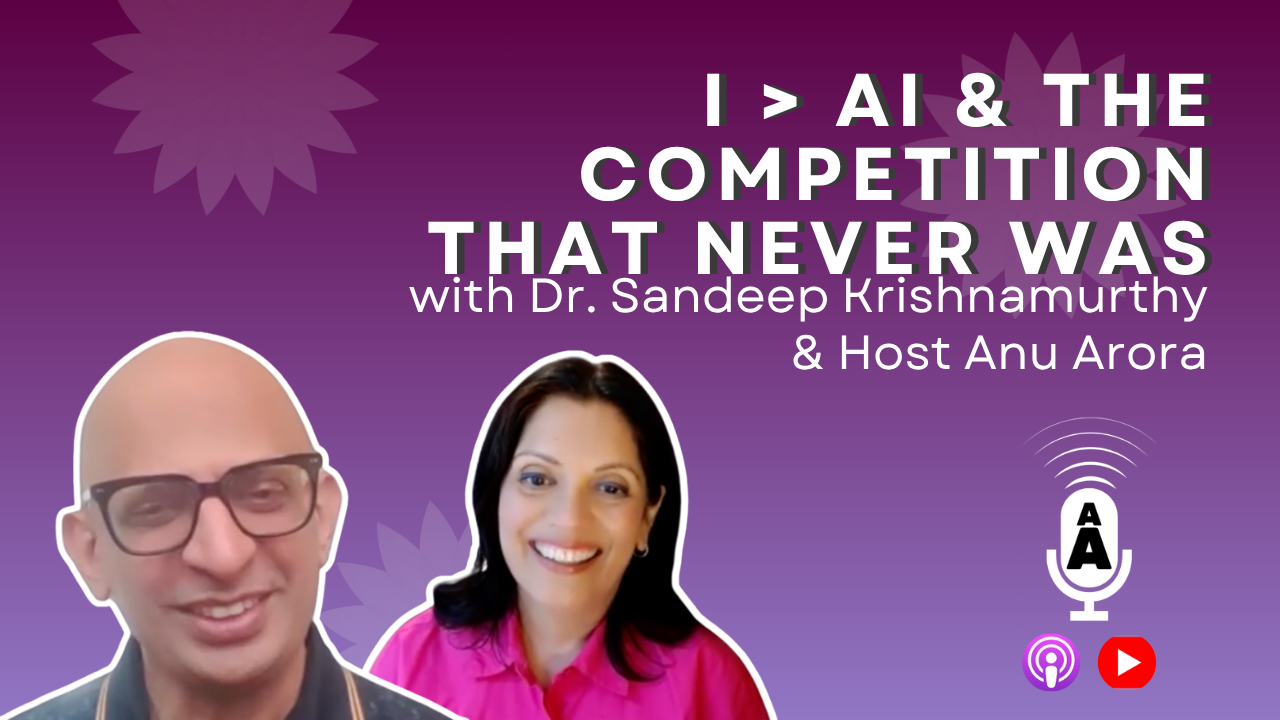
If the idea of I > AI resonates with you, Sandeep and I go much deeper in our full discussion, including AI-related career disruption and the growing impact of artificial intimacy. Check it out!
Key Takeaways
AI acts as though it is intelligent. Sandeep explains that it produces the words most likely to please the person asking, which is why it rarely challenges us.
Intelligence is not the same as consciousness. AI is instrumental: it helps people reach goals like writing code or doing research, but it doesn't hold consciousness or what Sandeep calls the jivatma, the living presence in each of us.
AI intelligence is singular, while human intelligence is plural. People differ in spatial, verbal, emotional, and social intelligence, and different AI tools tend to give similar answers to the same prompt, while no two people would.
Calling it "artificial intelligence" creates a false equivalence with human intelligence. Comparing the two on AI's terms is like the Indian relatives who asked why you couldn't be more like the neighbor's boy.
AI may take your job, but it will never take your place in your family, friendships, and community. Sandeep suggests keeping AI on the economic and instrumental level rather than treating it as a rival to human beings.
Entry-level jobs built on routine processes will feel the biggest impact. Sandeep also warns that companies laying off people to fund AI may be surprised by the cost, since agentic AI can burn through far more money than simple prompting.
His advice to students is to move toward AI rather than away from it: experiment, build what he calls "recombinant AI fluency" by using several AI tools and having them check each other's work, and try small paid projects, like building a website for a local business, before graduating.
A person's own knowledge and values shape what they get out of AI. As Sandeep puts it, an astrophysicist and a layperson would ask Albert Einstein very different questions.
Sandeep sees "artificial intimacy," forming close emotional or romantic attachments to AI, as more dangerous than artificial intelligence itself, especially as people are already becoming more isolated from one another.
Quotes from this Conversation
"Today, AI is that boy." — Sandeep Krishnamurthy
"AI may take your job, but AI will never take your place." — Sandeep Krishnamurthy
"Human intelligence cannot be singular, it has to be plural." — Sandeep Krishnamurthy
"Artificial intimacy is much more dangerous than artificial intelligence." — Sandeep Krishnamurthy
"Maybe it should be called artificial information intelligence." — Anu Arora
Questions this Episode Answers
Is AI actually intelligent, or does it only act intelligent?
What's the difference between intelligence and consciousness?
Will AI take my job, and how should students prepare for an AI-driven job market?
Why do different AI tools give such similar answers?
What is recombinant AI fluency?
Why might agentic AI cost companies more than they expect?
What is artificial intimacy, and why is it a concern?
-
Anu Arora (0:03)
Hi Sandeep, I'm so glad to see you.
Sandeep Krishnamurthy (0:07)
How are you doing? Good, you know. Are we catching up after a long time?
Anu Arora
Yeah, but with you it's like where we stopped. Six months, even more than that, about eight months ago. It just almost feels like it's a continuation of the conversation which we were having.
Sandeep Krishnamurthy (0:28)
Absolutely, absolutely, I feel that way too. Always, it's joyous to talk to you, and let's, let's keep it that way.
Anu Arora (0:36)
Good, good. Thank you. So, I was preparing a little bit, to be honest about that, before you came in, and I said, "Oh, how do I introduce Sandeep?"
Sandeep Krishnamurthy
Why don't you introduce me as a human being today?
Anu Arora (0:55)
As a dear friend, even more than that, my dearest friend, my soul friend. The thing which I found was, on LinkedIn, you had created a visual, yes, of your work life.
Sandeep Krishnamurthy (1:13)
Yes.
Anu Arora (1:14)
Like it was just a sign. I just went in, I didn't even look for your name yet, and in my feed appeared this visual.
Sandeep Krishnamurthy (1:22)
Yeah.
Anu Arora (1:23)
And I'm going to show that visual. This is going to be a video we are recording, so it'll be really good to have people see this visual that you created.
Sandeep Krishnamurthy (1:33)
Sure.
Anu Arora
Here it is. Are you seeing it as well?
Sandeep Krishnamurthy (1:36)
Yes, I'm seeing it now.
Anu Arora (1:38)
Okay. Okay, so I went through this and I was looking at it, and it's just, you know, amazing, and the couple of things which were really very interesting were your career journey, just the one at the left-hand side: raised in India, IIT Bombay, and then now today you are the Dean of Cal Poly. And you are, you know, that boy in India who grew up, and you, you know, in India, right, did your master's in India, and now here you are in US teaching business.
Sandeep Krishnamurthy
Yes.
Anu Arora
To the American kids.
Sandeep Krishnamurthy
Yes.
Anu Arora
What do you, when you look at this, what do you think about, you know, yourself as a little boy growing up in India, and that journey to this point?
Sandeep Krishnamurthy (2:36)
Yeah, it is, you know, quite unbelievable, actually. You know that I never expected, as a boy, you know, to have this kind of a life. I just feel that, you know, sometimes there is some potential in us that is invisible to us at various stages in our life, you know, and sometimes, you know, whatever is unthinkable is actually your potential, right? You meet someone and they say, you know, "I can totally see you in this role," and you'll say, "Oh my god, really? That's unthinkable for me," right? And that's the thing: somebody else saw that in you. So which means that whatever was unthinkable for you at that stage is actually your potential. But I, you know, as a young kid, you know, growing up in India, I could not see past those horizons, for sure. You know, I had some relatives in the US, you know, so I could maybe imagine a life in the US, but I did not know how that would look, you know. I didn't know that I would have a chance to lead others. I didn't know that I would have a chance to, you know, take on this kind of, you know, a platform where I can build collaborations, I can partner with others. So these are the sorts of things that were always innate in me, just based on how my family raised me, the kind of, you know, sanskar and sampraday, as we say, that I come from. I come from a family where my grandfather was an educator, and so on. So it was in me, I think, but somehow, I think, you know, not all seeds get water and sunlight and fertilizer. Somehow, you know, in my case, at least, I got some sunshine, some water, some fertilizer from mentors and teachers and people who saw something in me, and I think those sorts of inputs have led me to where I am today. And also, I think there are a lot of people who don't see us fully all the time, right? They mistake us, misunderstand us, distort who we are, you know, etc. But then there are some who believe in us, and who really, you know, encourage us the right way, and who sometimes, you know, see something in us that we ourselves don't see, right? So I had the benefit of maybe a few such people who encouraged me, who told me how I should approach my life, and so on. So I feel grateful that I have this journey today.
Anu Arora (5:42)
Yeah, and here you are inspiring hundreds of thousands of students, and, you know, people around you, and every conversation with you has been enriching in my life. The biggest thing, Sandeep, about you, as perhaps thousands might have already told you, is your humility.
Sandeep Krishnamurthy (6:06)
Oh, thanks.
Anu Arora (6:07)
Yeah. Wherever you are, whatever you're doing, you will find time for your friends. You made time for this right away. And I reached out, and for dal chawal...
Sandeep Krishnamurthy (6:21)
Yeah, yeah, absolutely, absolutely.
Anu Arora (6:27)
Yeah.
Sandeep Krishnamurthy
It's my pleasure. It's my pleasure, because I think, you know, we have to make time, you know, for those that we care about. Yeah, absolutely. Happy, very happy to be here.
Anu Arora (6:39)
Yeah. So, as you know, I have a mindful leadership Substack.
Sandeep Krishnamurthy
Yeah.
Anu Arora (6:47)
And one of the series that I have been planning for some time, but then it was just, you know, in my head, I was trying to create what it looked like, has been around artificial intelligence and human intelligence together. Yeah, we've seen extremes. We've seen that one view of, you know, "Oh, AI is everything, and we should just run, and we should just, you know, get on that bandwagon, and if we don't do it, we'd be left behind." And others are like, "Okay, we're just going to stay here and see how it shapes us, and then we'll make the call." And I feel like there's just such a beautiful intersection which we are ignoring and not spending enough time on. There are few, few people who are talking about it, including you. In fact, you are one of the people who is talking about it on your blog, right? Sandeep Krishnamurthy is your blog, and you've been talking about it. And I said, okay, I have a series, and you're going to kick-start this.
Sandeep Krishnamurthy (7:59)
No, it's great. Anu, can you stop sharing now? I think, you know, people have had a chance to see it.
Anu Arora
Yeah, that's a good point. Yeah.
Sandeep Krishnamurthy (8:08)
Yeah. No, I think this is a profound issue that will be with us, you know, now, maybe for a decade, two decades, and so on. I think the main thing is, you know, we have to start with this idea that AI is artificially intelligent, and I keep telling people this, that, you know, most of the business people that I talk to, they're more interested in the intelligent part than the artificial part. They're interested in, for example, saying that, "Hey, this is a new technology. Here are the problems I can solve better, faster, cheaper with it. I just have to plug this to this, and then good things happen." They're thinking like that, and, you know, I mean, I guess that's what they're going to do. I mean, we can't really, you know, judge them or come in the way of them doing that, and so on. But I think the important thing to remember is that AI acts as though it is intelligent, right? So, basically, whatever AI that you like, you know, Claude versus Gemini or ChatGPT, or whatever, whenever you ask it something, it basically produces a list of words that has the highest probability of pleasing Anu. When Anu says this, it tries to produce something that it thinks has the highest chance of pleasing you.
Anu Arora (9:36)
That's why we love it so much, isn't it? Anu looks very good with the AI.
Sandeep Krishnamurthy (9:42)
Yeah. Never challenges you, never makes you look bad. It is acting, you know, in a way that pleases you, you know, and it's doing that in order to kind of get your continued interest, and for you to stay with it, right? Um, but the important thing is, so that's the first thing, you know, that we have to kind of, you know, come to grips with. The second thing is, you know, intelligence is not the same as consciousness.
Anu Arora (10:11)
Yeah, yeah.
Sandeep Krishnamurthy (10:12)
Right. So, this is not a conscious or mindful, you know, presence.
Anu Arora (10:19)
Yeah, yeah, it is not.
Sandeep Krishnamurthy (10:20)
It is not that at all. It only exists in order to basically help you, you know, achieve some goals. It is what we call instrumental, meaning that you have some, you know, problems to solve, goals to achieve, you know, whatever it is: do research, you know, write code, you know, etc. And then you go to this thing, and it does its best to come up with some output, whether it's text or code, or, you know, audio or video, that essentially, you know, comes close to you meeting your goals, right? So, um, but the AI is not the holder of consciousness, right? Which also means that we have to come to the third, you know, kind of level of thinking about this, which is: how important is intelligence in our lives?
Anu Arora (11:20)
That's a good question, isn't it? We are talking about all this, but how important is intelligence?
Sandeep Krishnamurthy (11:28)
Yeah. So I think you and I know people who are extremely intelligent, but who are not nice people. They're selfish, they're uncaring, they're indifferent to other people's suffering. They will never give you a hug, you know. They're not, you know, happy when you talk to them, etc., etc., etc. They have their own issues. But then you meet somebody, you don't even care about their intelligence, but they are so happy to see you. They are warm to you, they're affectionate to you, you know. They connect with you, you know, they remember things, you know, for many years, and you feel so happy just being with that person, right?
Anu Arora (12:08)
The energy they exude, and they, yeah...
Sandeep Krishnamurthy (12:11)
And so, again, we have to ask ourselves this question: how important is intelligence in our lives, you know, in our professional lives, in our personal lives, but also our community lives? You know, does it matter, you know, in the communities that we are a part of? You know, intelligence does matter to some point, but is it the only characteristic? Is it a defining characteristic? So I think this is something that we all will have to grapple with, you know, over time. And then I think, you know, finally, you know, one last idea, and then I will stop. I know I'm saying...
Anu Arora (12:51)
No, I love it. I love where you're going, and all the points you're bringing.
Sandeep Krishnamurthy (12:56)
Yeah. Also, when we think, we have to ask ourselves: is intelligence singular or plural? Intelligence or intelligences? So, for example, some people have a lot of spatial intelligence. They're able to identify patterns, they're able to, you know, make sense of, you know, networks, things of that nature, you know. But also some people are more intelligent on the people front. They can, what they say, they read the room. They walk into a room, they have an impact on the room, you know, and people connect to them, and they look into your eyes, and they talk to you, and you say, "Oh my god, this is the person I want to, you know, connect with." But wait a minute, have we made intelligence too narrow? So we have reduced intelligence to, you know, the word I used earlier, which is an instrumental intelligence, which is that it is informational, and it is driven by the goals of the user. Okay, but is that the only kind of intelligence that exists? In which case, as it is, this is artificial intelligence. But then, are we neglecting all the other kinds of intelligences that we have all experienced? It is not that, you know, we have somehow made this up, you know.
Anu Arora (14:24)
Yeah.
Sandeep Krishnamurthy (14:25)
We have experienced those other kinds of intelligences, right? We have met people who, you say, "Oh my god, there's something with this person," and that person was able to recognize some small thing in you, and you said, "Oh my goodness, how did this person even know it? There's something deep in this person that, you know, I don't have." We all get that feeling, right? But is that just, you know, coming up with, like, what we would see in AI today? Maybe not, right? So, you know, and that last point gets us closer to understanding what you had started talking about as human intelligence, which is, you know, human intelligence cannot be singular, it has to be plural. But artificial intelligence is singular. AI, singular.
Anu Arora (15:13)
Yeah.
Sandeep Krishnamurthy (15:14)
Human intelligences, plural, I would say.
Anu Arora (15:17)
And then we are actually not even comparing the right things. We are comparing singular to plural. I, you know, the thing that was coming up for me is that we got maybe the term wrong. Maybe calling it artificial intelligence is kind of... it seems like, oh, now it's artificial intelligence and human intelligence, let's look at it side by side. And that itself is wrong, because...
Sandeep Krishnamurthy (15:46)
Exactly right.
Anu Arora (15:47)
Isn't it? So, maybe it should be called artificial information intelligence.
Sandeep Krishnamurthy (15:56)
Oh, very good. Yeah, absolutely. So, the use of the term artificial intelligence creates a false equivalence between human intelligence and artificial intelligence, right? So basically, remember the first thing I said, that AI acts as though it is intelligent. It is not, in fact, intelligent, right? So what that means is that it is exactly the term you used, you know, or in other ways, you know, we can think of other terms. Maybe it is artificial intelligent computation.
Anu Arora (16:31)
Computation, or like you said, instrumental, artificial instrumental intelligence.
Sandeep Krishnamurthy (16:39)
Right? Right.
Anu Arora (16:40)
So, because when we say, and we start comparing... the series I'm doing, I am now rethinking the name itself. I want to call it artificial intelligence versus human intelligences, and that itself, see, changes the way...
Sandeep Krishnamurthy (16:59)
Changes the tone completely.
Anu Arora (17:01)
Right? Yeah.
Sandeep Krishnamurthy (17:04)
For example, you meet people, and they can do a two-hour Shakespeare play...
Anu Arora (17:10)
Yeah.
Sandeep Krishnamurthy
...memorizing all the dialogues. Then you say something, I say something, they have to come from this side, and wow, right? We meet such people, and we say, "How did you do that? I don't think I can do that. I don't think I can memorize dialogues for two hours," right? You know, it's just that that person has that knack, that kind of orientation where they're able to, you know, absorb verbal information, you know, at such a deep level, right? But, you know, ultimately we have to recognize that human beings, you know, unlike AI... So this other thing that people will say: if you take multiple AI systems now, nowadays a favorite conversation, everyone will ask us, they may have asked you also, Anu, they may say, "Anu, do you like Claude nowadays, or do you like ChatGPT?"
Anu Arora (18:00)
Which one are you using? Which is better?
Sandeep Krishnamurthy (18:04)
What's the secret? What's the secret, right? So they're acting as though, you know, that is the most important question. Is that the most important question? Because if you now actually take the same prompt... you know that infographic that you showed? I put it in two different, you know, AI systems. The answers were very similar, by the way.
Anu Arora (18:24)
Okay, okay.
Sandeep Krishnamurthy (18:26)
So, the point that I'm trying to make is, among the AIs, let us say there are 5, 10, whatever big LLMs, you add in Grok and other things people want to talk about, the level of difference among these intelligence systems or intelligence technologies is not that great. They're actually, you know, somewhat similar. But if you compare human beings, like if I ask you to compare even 1,000 human beings, you'd say, "Oh my god, so different."
Anu Arora (19:04)
Yeah.
Sandeep Krishnamurthy (19:04)
Right? The way we think, the way we speak, the way we solve problems, the way we communicate with each other, the way we connect. We are multidimensionally different as human beings, and we can easily demonstrate that. You bring in 1,000 people into a room, and you try to sort them out on one variable...
Anu Arora (19:23)
Yeah.
Sandeep Krishnamurthy (19:24)
It will come across as very, you know, unsatisfying. It is unsatisfying to do that. Why? You know, so-and-so can tell a great story. Next person is a chess grandmaster. The third person, you know, can do a Shakespeare play for two hours. The fourth person can sing. I mean, we are all very different. We have different ways of showing who we are, right? But human beings are much more complex, and hence we are also different from each other in dramatically different ways. In dramatically different ways. So again, going back to what you said, AI versus HI: are we setting them up at the same level?
Anu Arora (20:09)
And yeah, I mean, probably if we are, then we are limiting humans. We suddenly decided that, humans, you are now in this box, and this is the box you are in, because we want to compare you with artificial intelligence. And to compare you, we're going to see if you can compute this thing to the decimal place. You see, it can do it, or we can do this, and see, you can't do it. AI can do this. So, you see...
Sandeep Krishnamurthy (20:41)
You know, you know what it reminds me of?
Anu Arora (20:42)
Yeah.
Sandeep Krishnamurthy (20:43)
Like in India, you know, both you and I grew up in India, all the uncles and aunties would tell us, like, the neighbor's boy who used to get good, you know, great... "See how he studies, he's so smart. Can't you be like him?" You know? Today, AI is that boy.
Anu Arora (20:59)
Yeah, he's like... it's like that.
Sandeep Krishnamurthy (21:00)
So it is as though we are being told AI is greater than I, meaning AI is greater than me as a human being. That's why, you know, I started this small thing. I want to make it even bigger. It is to say that we have to keep repeating this idea that I is greater than AI, meaning that the human is greater than artificial intelligence, that we are asserting this idea. You know, let us not forget the nuance and the complexity of the human experience, and let us find a way to kind of truly, you know, assert the humanity. And we haven't even talked about... I mean, we're still talking about how humans are different in terms of achievement. We haven't even brought out emotions...
Anu Arora (21:46)
The consciousness, the human consciousness.
Sandeep Krishnamurthy (21:50)
And human consciousness, and, you know, which brings us to a completely different plane, which is...
Anu Arora (21:58)
Another realm, which is...
Sandeep Krishnamurthy (22:01)
You know, people keep asking this question. You know, at one point there was a big debate within Google, and so on, a few years ago, before ChatGPT, where one guy said, you know, Google's AI has become sentient. And, you know, every now and then people will say, "Oh, is it sentient now?" Meaning that, can an AI system, on its own, you know, come very close to the consciousness of a human being? This is a question that, you know, people have said, "Should we be worried? If we go on escalating this process, it is going to come close to human consciousness." So this is something, again: I is greater than AI. Human is greater than AI. So I think we should reject this idea at all levels, meaning that we should not even worry, or we should not even concede that it is even possible for AI to have the same, you know, consciousness as a human being. And we have to kind of basically come out and say that only a human being can have consciousness, and AI can only act as though it is conscious, artificially. Okay, so...
Anu Arora (23:23)
Never get there.
Sandeep Krishnamurthy (23:23)
It'll never get there. Yeah, you know, the life that is in you, the jivatma, the light, you know, that is in you and me, that connects each other, that allows us to see the radiance inside of each other. That is because you and I are human, right? So basically, only human beings have, you know, consciousness, and AI, you know, can only act as though it is conscious. You know, it can artificially act as though it is conscious.
Anu Arora (23:55)
Is not real.
Sandeep Krishnamurthy (23:56)
Acting is not real. Acting is not real. So basically, if we, you know, come to that conclusion, we can say that, look, okay, then we don't have to worry as human beings. Because people are also going too far and saying, "Oh yeah, AI may take my job." Some people are saying that, and yes, in some cases, yes, it will take your job, or it will reduce the number of jobs, however you want to put it. But what we have to understand is AI will not take your place, meaning that your place in your life, your place in society, your place in terms of connectivity with other friends and family members, and, you know, loved ones, AI will never be that, right? So AI may take your job, but AI will never take your place. Another idea, right? This business concept is that, you know, we have to basically come to this conclusion, that, you know, this is only a very limited sort of a replacement, or a limited sort of a complementarity that is getting created. That AI is complementary to humans in some contexts, and it is able to do certain things in very effective ways, and, you know, that's fine. And in some cases, those ways, you know, have economic meaning, in terms of somebody gets paid to do that, somebody gets a salary to do that, you know, and so on. Okay, I mean, to that point, we're okay. But we cannot, you know, start saying that AI will displace humans, or AI will start controlling humans. I think that is where I would tell people, let us stay on the kind of instrumental or economic plane. Let us not, you know, elevate AI to a level where it doesn't belong. The AI doesn't belong there.
Anu Arora (26:03)
But the fear, the fear, Sandeep, is real. I talk to a lot of new graduates. I, you know, have been also talking to people who've been laid off by their companies. Companies are afraid. Number one is the corporation itself is afraid, and in that fear they are laying off a lot of people, or they are justifying the money which they are spending, because AI is costly, extremely costly. So they are spending a lot of money, and then they will get rid of a few thousand people to show, "See, we can justify it, we don't need these people anymore." So that's one of the realities of the corporation. New graduates are worried as they're coming out. "Did I make the right decision? Four years ago, I didn't know that this craziness would come that soon."
Sandeep Krishnamurthy (26:55)
Right.
Anu Arora (26:55)
And you are in this education space, where you are talking to students day in and day out, and you are probably sensing and feeling that fear from them. How are you talking with them? What are you telling them? And how do they prepare themselves for what's coming for them?
Sandeep Krishnamurthy (27:17)
Yeah. No, I think, you know... So, the first thing is, we have to be honest, you know. I think that, in the sense that, you know, AI is going to especially have a disproportionate impact on lower-level or entry-level jobs, right? Why? Because those entry-level jobs, you know, required a certain level of, you know, processes or something like that that were usually very routinized, and those routinized processes can be done very well with AI. Okay, that's number one.
I think number two is, as a society, we have to also ask a bigger question, which is: what is the true cost of AI? So now there are two things going on in corporations, right? One is that there is an automation of some jobs, with AI taking over those jobs. The second effect that is going on is that everyone wants to keep up with their neighbor. So Meta wants to spend because Microsoft wants to spend, you know, Amazon wants to spend because Microsoft wants to spend, and so on. They're escalating their spending on AI, especially data centers, because they feel that if they don't do that, they will be left behind, and they're realizing that that is costly and costly and costly. So they're actually getting rid of human beings to save the salary and move the money from salary to data centers.
Anu Arora (28:36)
The two don't even equate. When I look at the numbers, there is no comparison on how much more money they have to spend for data centers than any... even if they have to fire the whole workforce.
Sandeep Krishnamurthy (28:50)
Sometimes. That's very interesting. In addition to that, you know, one of the things that we are learning is the cost structures of generative AI and agentic AI are very different.
Anu Arora (29:03)
Okay.
Sandeep Krishnamurthy (29:06)
So if you are still doing, you know, ChatGPT prompts, and we all do that, you know, I do that, you do that, everyone and their uncle does that, that's one level. But if you have eight agents, you know, one is orchestrating, one is going out and, you know, collecting data from here, the third is automating something... There are already stories where CIOs and CFOs are waking up saying, "Wait, how much is this costing?" You know, because of the token bursts that are happening in companies, because managers are going and telling their subordinates, "Hey, I need you to, you know, basically work on this agentic AI application and change this process we have for accounts receivable to agentic AI. Can you do that? I need to see that," you know. And so, well, you go and do it, and then suddenly the CFO calls you, saying, "Anu, I am Joe, the CFO. Why have you spent $100,000 worth of tokens in three days?"
Anu Arora (30:09)
That's a salary of one person.
Sandeep Krishnamurthy (30:13)
"Three days, what happened?" Oh, and you say, "I don't know, like, Bob came and told me to do this stuff."
Anu Arora (30:22)
Yeah.
Sandeep Krishnamurthy (30:24)
"I'm feeding agents, and the agents are running all night on the data."
Anu Arora (30:27)
Yeah, yeah.
Sandeep Krishnamurthy (30:29)
So this guy is pulling out all his hair, saying, "How much is this stuff going to cost us?" Nobody knows. So what they're realizing is, if we only stayed in the generative AI world...
Anu Arora (30:40)
Yeah.
Sandeep Krishnamurthy (30:41)
That was one reality. But since we added agentic AI, the cost of agentic AI is dramatically higher in most cases than the cost of generative AI, right? So, because of that, you know, we now have an issue. There is the data center issue, in terms of building infrastructure for AI, but also with agentic AI, there's an issue of how many tokens will this burn, and what cost will then result to me as an individual from this, right? So because of that, I think, you know, at some point there's going to be a reckoning where people are going to say, "Really? We just laid off 1,000 people, you know, and now we're realizing that the cost of agentic AI to solve those problems is more than the salary of those 1,000 people. What have you done?"
Anu Arora (31:35)
Yeah. Now what?
Sandeep Krishnamurthy (31:39)
And of course, the industry is going to, you know, find a way to reduce the cost of agentic AI. I mean, that will happen. But the fact remains that the costs are unpredictable, right? But now let me answer the question that you really asked me, which is, what do you tell the kids? What I tell the kids is the following things. First of all, go towards AI. Don't run away from it, you know. Experiment, try new things, push the envelope. That's why I do things like the infographic today. I want to show my students that, hey, try something. This is a new trend. I try it, see how it looks, right?
Anu Arora (32:18)
So the skill also, when you come out, you have it on your resume: "I have this skill."
Sandeep Krishnamurthy (32:26)
Exactly, because without that, you know, you're going to come across like a cave dweller, you know, and nobody will want to hire you, right? So, you know, please, you know, act as though, you know, you're going to have to use this. So just go use it, try different things with it. I think that's number one. You know, number two, I've been using this term, recombinant AI fluency. It's a mouthful, but basically what I tell people is, don't fall in love with one LLM.
Anu Arora (32:55)
Yeah.
Sandeep Krishnamurthy (32:57)
You know, don't go on asking people, like, you know, "What's the best LLM today? Has it changed since yesterday?"
Anu Arora (33:04)
"Should I change to that?"
Sandeep Krishnamurthy (33:07)
"Should I go to Gemini for a month and then come back to Claude?"
Anu Arora (33:09)
Yeah.
Sandeep Krishnamurthy (33:10)
Don't do that. Get used to the mindset where you will eventually have to use multiple LLMs, maybe. And maybe some LLMs are better at one thing than another. Maybe you can do something over here, take the result, put it in another LLM, and ask it to check the work of this one. Yeah, to think of creative ways by which you can combine the information, you know, cross-validate the information from one LLM to the other, and, you know, then find a way to kind of, you know, be a fluent thinker. So we just need you to be fluent with this, try different things, and, you know, then think of a way to connect all this intelligence to the processes and systems of the company, you know, and then good things will happen.
But then I also tell them that, you know, it used to be that... I grew up at a time, and the advice I got was, you know, go to a company, work there for 30 years, and then retire. Maybe change one or two companies. That is the advice I got. Now AI may enable economic opportunities for you. You can probably do small projects and earn money as you're going along, right? So try those things. Try to create an ad for someone, try to create a website for someone, you know. You can do these things using AI systems and make some money, you know, as you go along. Why do you have to wait till you graduate to start earning money? Get into the mindset of, hey, I can try AI, you know, quickly. And guess what? When you go for a job interview with an enterprise, they would love to hear those stories. "Oh, you made some money? How did you do that?" "Oh, I went to the pizza guy down the road and said, 'Your website's terrible. I can use Lovable, and I can create a new website for you. Shall I do that for you? I'm going to charge you $500.'" Yeah, yeah. Well, your Lovable paid subscription may be much lower than that for a whole month. If you do that for 10 businesses, you're earning money. And now your parents are proud of you, your community is proud of you. So start using this to make money. Nothing's stopping you from making money, you know, doing this.
So, what I see is that, you know, many of the, you know, kids you and I talk to, I know, I mean, they are part of computer science degrees...
Anu Arora (35:28)
Yeah, yeah, yeah.
Sandeep Krishnamurthy (35:30)
In computer science, you know, dear friends, many, many close friends who are computer science professors, they're all going through soul-searching of their discipline, right? And some good will come out of that. But really, see, when I went to IIT in 1984, the top 250 ranks, they all went to computer science. So computer science has been popular through my entire life, my professional life.
Anu Arora (35:55)
Yeah, yeah.
Sandeep Krishnamurthy (35:56)
Now they're realizing that the entire computer science education has been focused on development.
Anu Arora (36:02)
Yeah, there are no other skills.
Sandeep Krishnamurthy (36:04)
No other skills.
Anu Arora (36:06)
Yeah.
Sandeep Krishnamurthy (36:06)
So now we're realizing, hey, maybe computer science has to give way to cybersecurity more.
Anu Arora (36:12)
Yeah, yeah, yeah.
Sandeep Krishnamurthy (36:14)
Right. And maybe, you know, DevOps is going to be needed, because you can build something, but somebody has to clean it up, you know, make sure it connects with everything else. Make sure that the data is actually transferring the right way to the right, you know, databases. You know, those kinds of skills are going to be very important, right? So a pure computer science degree, you know, that is training you to be a great human developer, that may not be the smartest way to position yourself in the future. But if you're in cybersecurity, you know, guess what, I mean, you're already...
Anu Arora (36:51)
Even if you look at the LLMs, at the end of it, they are a tool. They're a tool, right? And where does it go back to human intelligence? It is also learning how to build out of them. That is a major skill in itself. Not the same... like, if four of us are in a room and we are using those, all four of us will have our own prompts, and how we are thinking through this, and the combinations we are doing, and how we are using different LLMs in tandem would be very different.
Sandeep Krishnamurthy (37:30)
Yes.
Anu Arora (37:31)
That's the human intelligence.
Sandeep Krishnamurthy (37:33)
Yeah. So it's like, you know, let us do a thought experiment, right? So today, in your living room, Albert Einstein came and sat down.
Anu Arora (37:43)
Yeah, yeah.
Sandeep Krishnamurthy (37:44)
Okay. One of the smartest people in human history. Everyone...
Anu Arora (37:47)
Glad. Welcome, Mr. Einstein. Thanks. We are... now, Sandeep, here you are. Here now. Yeah.
Sandeep Krishnamurthy (37:57)
I am not an expert in quantum physics, right? Yeah. So the questions I ask of him are going to be very different. But if there was a PhD in quantum physics sitting there, or, you know, somebody who's an expert in astrophysics there, they would be able to extract more information from Albert Einstein, right? Brainy person sitting right there, and you can say, "Well, how about this, this, this," and you can have a much higher-level discussion. But I'm going to ask him some simpler, you know, questions, like, you know, that are more humanistic in nature, maybe, or that ask about the place of nuclear, you know, warfare in our society, something more ethical in nature, is what I would ask him. But a pure astrophysicist, they might have something different. So, based on a high level of human intelligence, we can also get more out of artificial intelligence, right? So if you compare a person who's very high in human intelligence in a very conventional way, yeah, again, recognizing that there are multiple intelligences, but, you know, a highly intelligent human will get more out of the same AI than a person who's not as much of an expert, right? So even there, we have to recognize that there are differences in how much, you know, valuable things we can get out of the AI, based on who we are, and how we ask questions, and how intelligent we are, and how knowledgeable and educated we are.
Anu Arora (39:30)
And also, Sandeep, it is also what angle. Because for you, ethics might be the most important thing in this, you know, with nuclear warfare, whereas for the guy who is making the warfare, you know, for them, that aspect is more important. It is also that consciousness, our own, you know, what drives us, our values, and what is important to us, also comes in, and that is also so very unique, isn't it?
Sandeep Krishnamurthy (40:01)
Yeah, and, you know, again, we have to resist this idea that AI has values. Does AI have values?
Anu Arora (40:11)
I don't think so. By the way, can I let Mr. Einstein go? Because you and I have similar questions to ask. When you said your questions, I said mine are the same, so we don't have a PhD here to ask him. He's... there's a PhD here, but not in his topic. So we'll let him go. He's gone.
Sandeep Krishnamurthy (40:37)
Bye, Albert.
Anu Arora (40:38)
Yeah, bye.
Sandeep Krishnamurthy (40:40)
No, but as a mom and as a dad, you know, we both care about the values we pass on to our kids.
Anu Arora (40:44)
Yeah.
Sandeep Krishnamurthy (40:45)
Yeah. You know, but AI, it talks about values in a funny way, a little funny, a little slippery, you know. Remember, it is what it is, trying to please you as a user, right?
Anu Arora (41:01)
It'll bring values. It actually has, you know, collected that data, and it's trying... spitting out the same thing. And I sometimes remind it. I said, "No, we updated this." So there you go.
Sandeep Krishnamurthy (41:20)
Artificial. It is so artificial.
Anu Arora (41:21)
Yeah. I'm like, "Don't you remember, Claude? We had this conversation three weeks ago, and we updated this. Why do you keep bringing me the old data?" And it said, "I'm sorry, I'm looking at... oh, your procedure happened." I'm like, "Yeah, the procedure is done. I've recovered. Now don't give me advice based on that. You can move on." So see, it's not even... again, it's just catering to you, but it still can't remember, or still can't do it in a way where you will feel like, oh, now it has values. No.
Sandeep Krishnamurthy (41:55)
Yeah, no, exactly. So I think... but all this is just to say that, you know, ultimately it's going to be okay.
Anu Arora (42:06)
You think so? There is so much fear, so much fear, I see, I hear. So how do we calm the system down? We are here on mindful leadership, which is where, you know, my focus is: how do you bring that sense of ease where there's so much angst?
Sandeep Krishnamurthy (42:27)
Yes, I think that's... I don't know if I have all the answers on that. You know, we will need, you know, other intelligences...
Anu Arora (42:37)
Will bring... We know that human intelligence is complex, and you bring your complex intelligence, and then other people have their unique blueprint, which is different than yours, right?
Sandeep Krishnamurthy (42:48)
So, what I think... you know, economically there will be angst. You know, the angst is all economic. I think, you know, a few people have this broader angst that, you know, AI is going to take over my place as a human being and displace me in life and all that kind of stuff. For that in particular, I would say we are going to be fine. I mean, AI is not going to... So for example, you know, some people have told me that, you know, "Oh, you know, there are all these new stories now that people share all their intimate issues with AI, asking for advice. I feel like my boyfriend may actually be closer to, you know, ChatGPT than me."
Anu Arora (43:37)
It's happening, Sandeep. I have people romancing with AI now.
Sandeep Krishnamurthy (43:46)
No, but it's like, this is where I feel like we're getting into dangerous territory. Yeah, where, you know, this is again an artificial creature, you know, that is able to help you, you know, solve some problems that you might provide it... You know, you can only have a romantic relationship with someone that you can hug. Do we have to say this out loud? Maybe this is really how it is. So, you know, I think basically, at the end of the day, you know, this is where I worry. And I know, I'm not trying to, like, you know, make fun of it or diminish it, because some people may watch this and say, "Oh, they're kind of making fun of what I do," and, you know, I'm not, I really am not. But I'm trying to point out ways in which some of these applications may have taken us too far. In which case, and by the way, there has already been a case of at least one high school kid who committed suicide because he could not bear the idea of being, you know, separated from the AI. He had become so close to the AI system, etc., etc. You know, so this concept of, you know, artificial intimacy, the other AI, very dangerous, according to me. You know, it is one thing to say it is artificial intelligence. Now we are saying artificial intimacy. Oh my god, you know, now Anu needs a new series: artificial intimacy versus human intimacy.
Anu Arora (45:31)
Good. I will never run out of topics.
Sandeep Krishnamurthy (45:37)
I'm just saying. I mean, you know, as a people, we have to say that this idea that you can be, you know, emotionally very close to a person, you know, that is just a computer program or computer technology, you know, however you want to define it, as opposed to somebody who's flesh and blood, and right sitting right in front of you... I think that, you know, if we start going in that direction, I think that would be very problematic. So, to me, artificial intimacy is much more dangerous than artificial intelligence.
Anu Arora (46:22)
The other thing is, we know that there is already separation, human-to-human separation, which is happening over the years, with our attachment to devices and our connection with being absorbed in another world. Which is like, you know, there's a time where the kids would just talk to their parents through chat, right? There comes this few years in kids' lives, and then they realize, oh, not everything can be done through chat, and they come back talking to you. And we went through that, you know, few years in our kids' lives, and most of those kids do it. And we know that that separation creates so much grief for the parents who are dealing with it, realizing that this is not the one for their child. The child, in turn, the society itself becomes more and more isolated, leading to mental illness. So now we are creating a society which cannot depend on each other, cannot go to the next-door house and get an onion from them if you run out of it, right? And you don't know who your next-door neighbor is.
Sandeep Krishnamurthy (47:38)
Yes.
Anu Arora (47:38)
That basic intimacy, human intimacy, we were already losing, and now we lose it even more.
Sandeep Krishnamurthy (47:46)
Yeah. I mean, I have, you know, given talks where, you know, I say many things, but at the end, I say that, you know, do you ever experience that your kid has those, you know, earbuds in, and you're trying to say something, and she just goes, "Uh huh, uh huh"? And people say, "That just drives me crazy. I feel like I have lost my child. I feel like I can't connect with this kid, because she's lost in some world, listening to a podcast, listening to something," you know, etc., etc. "But, you know, I'm present here." So I keep telling them, you're in a physical world. She's gone into a digital world, you know. So, you know, this is an issue, again, that, you know, as human beings, we have to constantly navigate: what are the limits between a physical and digital world? You know, how are we going to interact digitally versus physically? And how do we, you know, manage all of this over time? I mean, this is something that is, you know, not easy to answer.
Anu Arora (48:51)
This is the time we are in, right? And that brings us to the time we had allocated for today. Time has flown. We'll do part two, part three, part four. You know, there's just so much. As you know, the other topic also came up in this conversation. We'll talk about artificial intimacy versus human intimacy. So we created a...
Sandeep Krishnamurthy (49:20)
Topic.
Anu Arora (49:20)
Created another topic here. But as we come towards the end of today's podcast, in 90 seconds, what is it you would want to tell the audience on this particular topic?
Sandeep Krishnamurthy (49:37)
Very simple. I is greater than AI. Human is greater than AI. Not human intelligence greater than artificial intelligence...
Anu Arora (49:45)
Human is greater.
Sandeep Krishnamurthy (49:46)
Human itself is greater than artificial intelligence, and what the human being represents...
Anu Arora (49:52)
Yeah.
Sandeep Krishnamurthy (49:52)
The core of what a human being is, is greater than any AI.
Anu Arora (49:57)
Yeah, yeah, that's all. How do they remember that when they get overwhelmed?
Sandeep Krishnamurthy (50:03)
So, Anu, you and I, we're going to start a T-shirt business, okay?
Anu Arora (50:06)
Yeah.
Sandeep Krishnamurthy (50:07)
We're going to challenge each other to sell 1,000 T-shirts each...
Anu Arora (50:10)
Of "I greater than AI."
Sandeep Krishnamurthy (50:12)
I greater than AI. And then an "I greater than AI" day. We're going to create that human spirit again.
Anu Arora (50:19)
Let's, let's, let's...
Sandeep Krishnamurthy (50:21)
Do it, totally. Why not?
Anu Arora (50:23)
All right. This is great. We'll end with that: I greater than AI. And with that, let's remember. And thank you so much, Sandeep. So good talking with you.
Sandeep Krishnamurthy (50:37)
Remember the dal chawal. I'm knocking on your door.
Anu Arora (50:39)
Definitely, the chawal is ready. It was ready today, too. You were just not in town.
Sandeep Krishnamurthy
You're killing me. You're killing me. Thank you.
Resources
The full essay on my Substack at mindfulleaders.info
Sandeep Krishnamurthy on LinkedIn
Episode Details
Guest: Sandeep Krishnamurthy, Dean of the College of Business Administration, Cal Poly Pomona
Host: Anu Arora, executive and team coach
Series: Mindful Momentum: Leader Podcast
Published: July 8, 2026 · 51 minutes