Finding Your North Star
A letter to the women who are just beginning, and a call to action for the organizations that should be supporting them.
Last week, on a bright, unusually sunny spring morning in Seattle, I had the pleasure of presenting a session called, Finding Your North Star: What Coaching Really Is (And Isn’t).
As the room began to fill, I let my eyes drift across the faces looking back at us. These were early-career women in tech. Curious. Capable. Educated. Enthusiastic. And working in the often unforgiving workforce of modern technology. I could see them trying to take it in: the norms no one had bothered to tell them about, the codes of conduct they were still deciphering, the invisible ladders that others seemed to climb with ease. They were looking for sure footing. They were looking for a roadmap.
In That Moment, I Was Transported Back In Time
My first day at Microsoft was not the first day of my career. But, it was the first day of my career in a new country.
I arrived with what I can only describe as stars in my eyes. I was full of ambition, optimism, and an unshakeable certainty that if I worked hard enough, success would follow. Wasn’t that a part of the American Dream?
I was a go-getter, and I knew it.
But, very quickly, I discovered something that no one tells you at orientation. Working hard is not enough. It is necessary. It is foundational. But it is not enough.
There is a whole subtext to professional life. The security of networks, the importance of advocacy, the courage to ask for what you want, the wisdom to know what you’re worth… and I didn’t speak that language yet.
Then, Microsoft sponsored me to attend a conference in the Bay area.
My World Opened Up
I sat in the audience, exactly where the women in front of me were sitting now.
I remember the feeling of my world expanding, session by session. People were talking about speaking up. About understanding your own strengths. About having clarity on your career path rather than just following wherever the current takes you. It was about finding mentors, building networks, and lifting other women around you as you rose.
My optimism, which had grown dim and diffuse in the grinding reality of figuring things out alone, began to come back. Not in the same way. I didn’t just feel hopeful again. I felt empowered.
What Followed Was Nothing Short Of Magic
I met Eddie Pate, the Diversity PM at Microsoft at the time, and asked him what I thought was a simple, innocent question: Why doesn’t Microsoft have its own women’s conference?
That question became a proposal. The proposal found its way to Charles Stevens, former VP of our division. He agreed to sponsor it. He gave us a small budget and a great deal of faith, and we built something that outlasted all of us – the first Microsoft Women’s Conference, putting women’s development at the forefront.
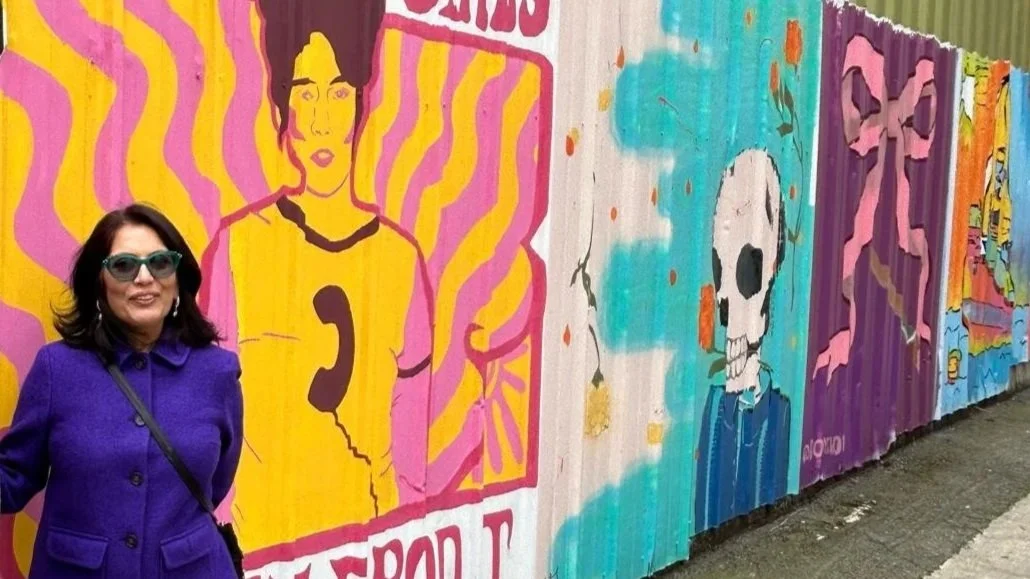
Anu Arora in front of a mural, which reads “All Girls To The Front”
Make the Invisible, Visible
I also found my mentors during this time period. Patrick Copeland and Shoshaana Budzionowski are people whose paths I could see ahead of mine and who were generous enough to share the inside view. They gave me not just inspiration but also information. They helped make the invisible, visible.
That is what this kind of investment does. That is what happens when someone with more experience says: here is what I can see that you cannot yet. Let me show you.
So, as I looked at the faces of the women in front of me last week, I felt that familiar swell of recognition and hope.
And, then I was struck.
The Room Was Half Empty
I have presented at this conference for years. I have seen rooms packed with standing-room-only audiences, humming with the energy of women hungry to grow. This time, the seats were pretty empty.
The organizers told me why: organizations are no longer sponsoring these kinds of workshops. They don’t see it as essential. Companies are in survival mode. They are placing their bets, and increasingly, they are betting on artificial intelligence over human development.
Failure to Invest is Fiscally Irresponsible
The thing is, there is no artificial intelligence in the world that can replace the learning, growth, and wisdom that come from the lived human experience. From trying and failing. From being in a room full of other people who have stumbled, then found their footing and turned to extend their hand to help someone else.
When we fail to invest in the full development of half our population, we are not making a fiscally conservative choice, we are making an extraordinarily costly one. We are leaving future potential on the table. Wisdom untapped and disavowed.
The women in that room were ready. I saw it in how they leaned forward. In their engagement. In the questions they asked. In the hunger that I saw in their eyes, because I’ve been hungry too.
They are not asking anyone to do the work for them. They are asking for what I once asked for, for what every person at the beginning of their journey hopes for — for someone further along to turn around, recognize the need to assist, and let them know that they’ve been exactly where you are. To say, “I understand how you feel. Now, let me show you what I’ve learned along the way.”
We owe them that room. That conference. That space and time for connection. We owe them that investment. In their future, and in ours.
First published on my Substack at MindfulLeaders.info